
The 2026 NFL FLAG Championships in Westfield, Indiana, show that flag football’s Olympic future is no longer a distant idea. It is becoming an infrastructure test happening in real time.
From July 23–26, more than 350 girls’ and boys’ teams are scheduled to compete at Droplight Grand Park Sports Campus, a massive sports complex in the Indianapolis metro area. The event brings together teams from NFL FLAG Regional Tournaments connected to all 32 NFL clubs, along with international teams representing countries from around the world. It includes boys, girls, coed, high school, and international divisions. It also carries national television and streaming coverage across ESPN, ABC, NFL Network, NFL+, Disney platforms, YouTube, and select international markets.
That scale matters because flag football will make its Olympic debut at the Los Angeles 2028 Games. The sport is moving from youth fields and weekend tournaments into a global competition pathway with Olympic stakes. Westfield now gives the sport a visible example of what that transition requires: fields, officials, schedules, travel systems, digital scoring, broadcast production, family access, security, player check-in, international teams, and a venue capable of handling hundreds of teams over four days.
For aplevante.org’s Infrastructure category, this is the real story. The 2026 NFL FLAG Championships are not only a youth tournament. They are a live demonstration of how fast emerging sports infrastructure has to scale when Olympic recognition accelerates demand. That connects directly to the broader question of flag football infrastructure growth, where communities, schools, leagues, and sports complexes are being pushed to adapt quickly for sports that are moving from niche participation to national planning conversations.
Why Westfield Became A Flag Football Infrastructure Test
Westfield was not chosen by accident.
Droplight Grand Park Sports Campus gives the NFL FLAG Championships something the sport now needs: space, flexibility, and tournament capacity. The NFL described the venue as a 400-plus-acre sports complex with more than 30 multipurpose fields in the Indianapolis metro area. That matters because flag football’s infrastructure needs are different from traditional tackle football. It does not require one large stadium. It requires many playable surfaces, coordinated schedules, safe sidelines, efficient check-in, officials, family amenities, hydration planning, digital communication, and traffic flow across multiple fields.
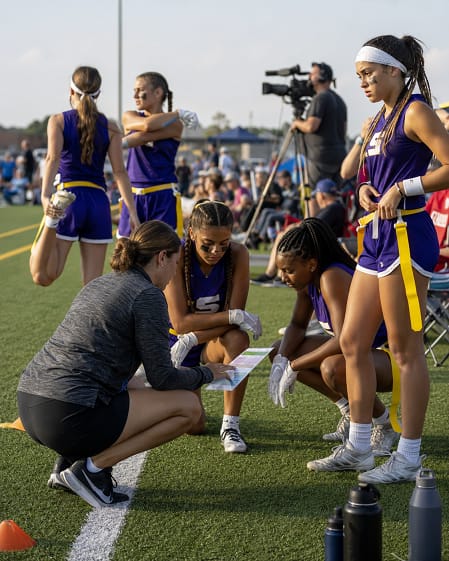
That kind of multi-field environment is exactly what a sport needs when participation is growing quickly.
The event’s schedule shows the operational demand. Gameplay runs from Thursday morning through Sunday afternoon, with different divisions moving through pool play, bracket rounds, semifinals, and championships. Some divisions require Wednesday check-in. Others arrive Thursday. The public-facing NFL Experience runs alongside the competition, adding another layer of fan movement and event operations.
This is why Westfield is more than a host site. It is a stress test for flag football’s next era. If the sport is going to grow through schools, clubs, girls’ programs, international competition, and Olympic qualification, it needs venues that can support scale without losing organization.
Grand Park gives that test a national stage.
How The Championships Show The Sport’s Global Shift
The 2026 event is also important because it is not purely domestic.
NFL FLAG says international divisions will include 15U Coed and 15U Girls teams, with countries represented including Mexico, Brazil, Spain, Canada, Great Britain, Ireland, Germany, China, Australia, New Zealand, Panama, and Puerto Rico. That list matters because flag football’s Olympic debut changes the sport’s identity. It is no longer only an American youth version of football. It is becoming a global game with national-team implications.
That shift creates new infrastructure pressure. International teams need travel planning, housing systems, clear rules, consistent officiating, translation support, broadcast context, medical services, and competition standards that feel credible across borders. A tournament that once might have been judged mainly as a domestic youth event is now part of a global development ecosystem.
The Olympic connection makes that even more urgent. LA28 describes flag football as a fast, non-contact format that will debut at the Games in 2028. Once a sport enters the Olympic program, its youth tournaments are viewed differently. Families see pathways. National federations see development opportunities. Sponsors see growth. Broadcasters see inventory. Cities see hosting potential.
Westfield sits at that intersection. It is a youth tournament, but it is also a signal that flag football’s global architecture is forming quickly.
Why Girls’ Divisions Are Central To The Olympic Story
The girls’ side of the 2026 NFL FLAG Championships may be the most important part of the event.
The tournament includes girls’ divisions from 10U through high school, plus an international 15U girls division. ESPN is returning on-site to broadcast and stream selected games, including the High School Girls Division. That visibility matters because flag football’s Olympic debut includes both men’s and women’s events, and the sport’s fastest growth in the United States is tied closely to girls’ participation.
This is where infrastructure and equity meet.
Girls’ flag football cannot scale only through publicity. It needs fields, trained coaches, school support, officials, uniforms, safe competition formats, state association recognition, college pathways, and media coverage that treats girls’ competition as central rather than secondary. A national championship weekend that puts high school girls on major platforms helps normalize that pathway.
It also creates expectations. If girls see flag football as a real competitive future, local systems must be ready. Schools need to decide whether to sanction the sport. Parks departments need to make fields available. Coaches need training. Colleges need recruitment structures. Families need affordable entry points.
The Westfield championships show why the Olympic timeline matters. LA28 is close enough that today’s high school and youth players can imagine themselves inside that future. That makes every major girls’ flag football event a development checkpoint.
How Broadcast Coverage Turns Youth Flag Into A Media Product
One of the clearest signs of flag football’s rapid scaling is the broadcast footprint.
The 2026 NFL FLAG Championships are scheduled for coverage across ESPN, ESPN2, ABC, ESPN Deportes, NFL Network, the ESPN App, NFL+, Disney+, Disney Channel, Disney XD, YouTube, and select international markets. That is not a small streaming add-on. It is a broad media distribution plan for a youth sports event.

That matters because broadcast infrastructure changes how a sport grows. A game that is visible nationally becomes easier to explain, promote, recruit around, and sponsor. Young athletes can be seen by family members, coaches, fans, and future programs beyond the complex. The sport becomes more than a participation activity. It becomes content.
That creates opportunity, but also responsibility.
Youth flag football has to protect its development mission while adapting to media exposure. Broadcasts should celebrate athletes without turning young players into commercial props. Coverage should help explain the sport, highlight girls’ participation, show international growth, and make the rules accessible to new viewers. It should also avoid presenting the sport only as a mini version of the NFL.
The Westfield event shows that flag football is already becoming a media product. The leadership test is whether that product helps build the sport’s base rather than simply extracting attention from young athletes.
Why Tournament Logistics Reveal The Sport’s Real Growth
The operational details of the 2026 championships are just as revealing as the headline numbers.
NFL FLAG’s event guide includes mandatory NFL OnePass registration for free entry, clear bag security, team check-in windows, stay-to-play hotel requirements, live scoring in the NFL OnePass app, refill stations throughout the complex, and specific gameplay hours for each day. Those details may sound administrative, but they are exactly what emerging sports need when they scale.
A national tournament cannot run on enthusiasm alone. It needs repeatable systems. Teams must know where to go. Families need clear entry procedures. Officials need schedules. Media partners need reliable timing. Security teams need consistent policies. Medical and hydration planning must be visible. Digital scoring must update quickly enough to support families, fans, and broadcasters.
That is sports infrastructure.
For flag football, the challenge is that growth is moving faster than many local systems. A city or complex that wants to host major flag events needs more than open fields. It needs tournament technology, communication systems, parking planning, hotel coordination, shade, rest areas, emergency access, and enough trained staff to manage a youth-heavy environment.
Westfield shows what that scale looks like when national attention arrives.
How Grand Park Reflects The Future Of Multipurpose Sports Campuses
Grand Park also points to a larger trend in American sports infrastructure: the rise of multipurpose youth sports campuses.
These campuses are designed to host tournaments that bring hundreds or thousands of athletes and families into a region over multiple days. Soccer, lacrosse, baseball, softball, rugby, ultimate, and flag football can all benefit from the same basic model: multiple fields, flexible layouts, parking, concessions, nearby hotels, digital schedules, and a regional tourism economy.
Flag football fits that model well because the game is compact, fast, and field-flexible. Multiple games can happen at once. Divisions can be separated across fields. Smaller-sided formats allow organizers to use space efficiently. The sport’s non-contact nature also makes it accessible to a wider range of youth athletes.
That does not mean every community needs a giant complex. But it does mean that flag football’s growth will increasingly depend on field availability and scheduling intelligence. Public parks, school fields, suburban sports campuses, indoor facilities, and college venues will all have roles to play.
The Westfield championships show the high-end version of the model. The broader infrastructure challenge is translating that capacity into local systems so that the sport can grow beyond showcase events.
Why Olympic Recognition Changes Local Planning
Once flag football became an Olympic sport, local planning changed.
A school district deciding whether to offer girls’ flag football is no longer only adding a recreational activity. It may be creating the first step in a pathway that runs toward college programs, national-team identification, international competition, and LA28. A parks department deciding whether to line fields for flag football is not only accommodating a new league. It is supporting an Olympic sport’s growth.
That shift can be powerful, but it can also create unevenness. Wealthier communities may add programs, travel teams, and tournaments faster. Communities with fewer fields, fewer coaches, and less flexible school infrastructure may fall behind. If flag football’s Olympic growth is going to be equitable, leaders need to plan for access early.
The Westfield championships make that planning need visible. The event shows what top-end tournament scale looks like. The next question is whether the sport’s base can expand in a way that includes urban, rural, suburban, lower-income, and girls’ programs with equal seriousness.
Olympic recognition can accelerate a sport. It can also widen gaps if infrastructure does not keep up.
What The NFL’s Role Means For The Sport
The NFL’s involvement gives flag football enormous advantages.
The league brings brand power, club networks, media relationships, event expertise, corporate partners, youth programming, and access to high-profile platforms. NFL FLAG Regional Tournaments hosted by all 32 clubs create a national structure that few emerging sports can match. That structure helps standardize competition and gives families recognizable entry points.
But the NFL’s role also raises a leadership question. Can a professional league-driven youth system support broad development without making the sport feel too commercial, too expensive, or too dependent on one brand?
That balance will matter as flag football moves toward the Olympics. The sport needs the NFL’s visibility, but it also needs public-school adoption, nonprofit access, local coaches, parks departments, USA Football, international federation structures, and community-led programming. A healthy Olympic pathway cannot rely only on a professional league’s marketing machine.
The Westfield championships show the power of NFL-backed scale. The long-term test is whether that scale helps build an open ecosystem.
Why Access Still Has To Be Protected
The 2026 championships offer free public access through NFL OnePass, which is important. Families and local fans can attend without buying a ticket, and the NFL Experience adds a festival element around the competition.
But access in youth sports has more layers than admission price.
Teams still face travel, hotel, food, transportation, equipment, and time costs. The stay-to-play requirement means teams must meet hotel booking minimums, which is common in major youth tournaments but can add pressure for families and programs. If national championship pathways become more visible and more expensive at the same time, leaders need to think carefully about scholarships, local qualifying access, regional balance, and support for lower-resource teams.
That is not a criticism of one event. It is a reality of youth sports infrastructure.
Flag football’s non-contact format can make it more accessible than tackle football in some ways. But travel-based competition can still create barriers. As the sport grows, leaders should protect low-cost entry points while building elite pathways. A child should not need a national travel budget to belong in the sport.
The best Olympic infrastructure is not only built for future medalists. It is built for broad participation.
What Cities Should Learn From Westfield
Westfield’s NFL FLAG Championships offer a clear lesson for other cities: flag football is becoming a serious facilities and event-planning category.
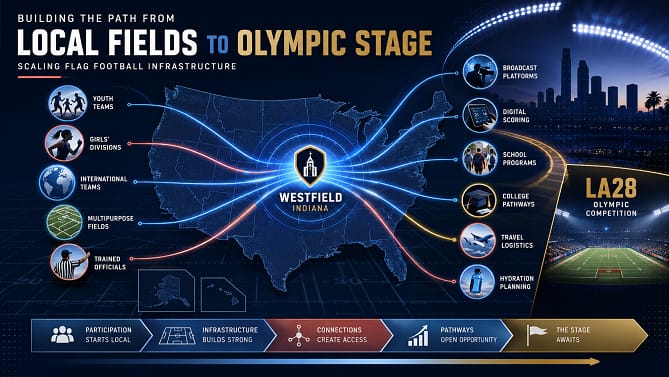
Cities that want to attract tournaments should evaluate field capacity, lights, restrooms, parking, hotels, security, weather plans, medical coverage, hydration access, digital scoring systems, and broadcast readiness. School districts should evaluate how flag football fits into fall, winter, and spring calendars. Parks departments should consider whether existing multipurpose fields can be lined and scheduled for flag programs. Local sports commissions should understand that flag football can bring family travel, media attention, and youth participation benefits.
The sport’s infrastructure needs are still manageable compared with many large sports. It does not require expensive fixed stadiums in every community. But it does require coordinated planning. Poor field quality, weak scheduling, limited officials, and inconsistent rules can slow growth quickly.
Westfield shows what happens when the pieces line up: a major youth sports campus, NFL backing, international teams, national media, girls’ divisions, family access, and an Olympic narrative all in one place.
That is why the event matters beyond Indiana.
Why This Is Flag Football’s Olympic Infrastructure Moment
The 2026 NFL FLAG Championships show that flag football’s Olympic infrastructure is scaling fast because the sport is being pulled in multiple directions at once.
Youth participation is growing. Girls’ programs are expanding. International teams are arriving. Media platforms are investing. The NFL is building national event structures. LA28 is approaching. Schools and colleges are reassessing pathways. Cities are looking at event hosting. Families are beginning to see flag football as more than a casual alternative to tackle football.
That combination creates momentum, but momentum alone is not infrastructure.
Infrastructure means fields that can handle demand, coaches who can teach safely, officials who can manage the game, tournaments that can scale fairly, media coverage that respects youth athletes, girls’ pathways that are treated as central, and local access that does not disappear behind travel costs.
Westfield is a snapshot of that future. It shows the sport at a high point of visibility, but also reveals the systems required to support the next phase.
Flag football’s Olympic debut at LA28 will last days. The infrastructure being built around it will shape the sport for years. The 2026 NFL FLAG Championships make that clear: the race to scale the game has already started.