

Community sports fields were once designed with a single purpose: hosting games. A baseball diamond served baseball. A soccer pitch served soccer. When games ended, the facilities often sat empty until the next scheduled practice or tournament.
Today, that model is rapidly changing. Across the United States and in many parts of the world, cities and school districts are embracing a multi-use field philosophy, transforming traditional sports facilities into flexible community assets. These spaces now serve youth athletics, public recreation, school activities, and civic events—all within the same footprint.
As public budgets tighten and community expectations evolve, multi-purpose sports infrastructure has become both a financial necessity and a planning opportunity. The most successful facilities are no longer just fields; they are carefully designed environments that maximize accessibility, usability, and long-term value.
Why Single-Purpose Fields Are Becoming Obsolete
Historically, sports facilities were built around specific league requirements. Field dimensions, seating areas, and lighting systems were optimized for one sport. While this approach worked in an era of stable schedules and localized leagues, modern community sports ecosystems are far more dynamic.
Youth sports participation continues to diversify. Soccer, lacrosse, flag football, rugby, and adaptive athletics all compete for limited field space. At the same time, community demand for recreational open space has increased dramatically.
A field used only for a handful of scheduled games each week represents a significant underutilization of public infrastructure.
Modern facility planning now emphasizes:
- Shared athletic use across multiple sports
- Flexible layouts that accommodate different field sizes
- Public access during non-league hours
- Community programming and recreation
In many municipalities, multi-use field design has doubled or even tripled annual facility utilization without expanding land footprints.
Flexible Design: The Foundation Of Multi-Sport Fields
At the center of the multi-use revolution is flexible field geometry. Instead of dedicating a space to a single sport, designers now plan fields with adaptable markings and layouts that can support multiple activities.

A typical multi-use complex might support:
- Youth soccer and lacrosse
- Flag football or rugby
- Community fitness programs
- Physical education classes
- Recreational leagues
- Cultural or civic events
Synthetic turf surfaces often play a key role in these designs because they can withstand higher usage volumes with minimal recovery time.
The design considerations extend beyond the playing surface. Infrastructure elements such as lighting, storage, and spectator areas must support multiple user groups.
| Facility Element | Traditional Sport Model | Multi-Use Field |
|---|---|---|
| Field Layout | Fixed dimensions | Adjustable markings and layouts |
| Surface Durability | Moderate usage | High-use synthetic or reinforced turf |
| Scheduling | Single league priority | Multi-program scheduling |
| Infrastructure | Sport-specific | Flexible and shared |
| Community Access | Limited | Open during non-league hours |
When designed correctly, one field can serve the equivalent of three traditional facilities in terms of weekly activity.
Community Integration Beyond Athletics
Multi-use facilities succeed when planners look beyond sports.
Fields located within community parks or near schools often become neighborhood gathering spaces, serving residents throughout the day. Walking paths, shaded seating areas, and open lawns can transform a sports complex into a broader recreational hub.
Some municipalities now design sports complexes that include:
- Community walking and running tracks
- Outdoor fitness zones
- Public playgrounds
- Picnic areas
- Event spaces for festivals or local markets
These additions ensure that sports infrastructure supports year-round community engagement, not just scheduled athletic events.
This broader design philosophy aligns with research from organizations such as the Urban Land Institute, which highlights how well-designed public recreational spaces can strengthen local economies and improve community health.
By integrating sports facilities into broader urban planning strategies, cities maximize both social and economic returns on infrastructure investments.
Scheduling As A Strategic Resource
Even the most flexible facility can become inefficient without careful scheduling.
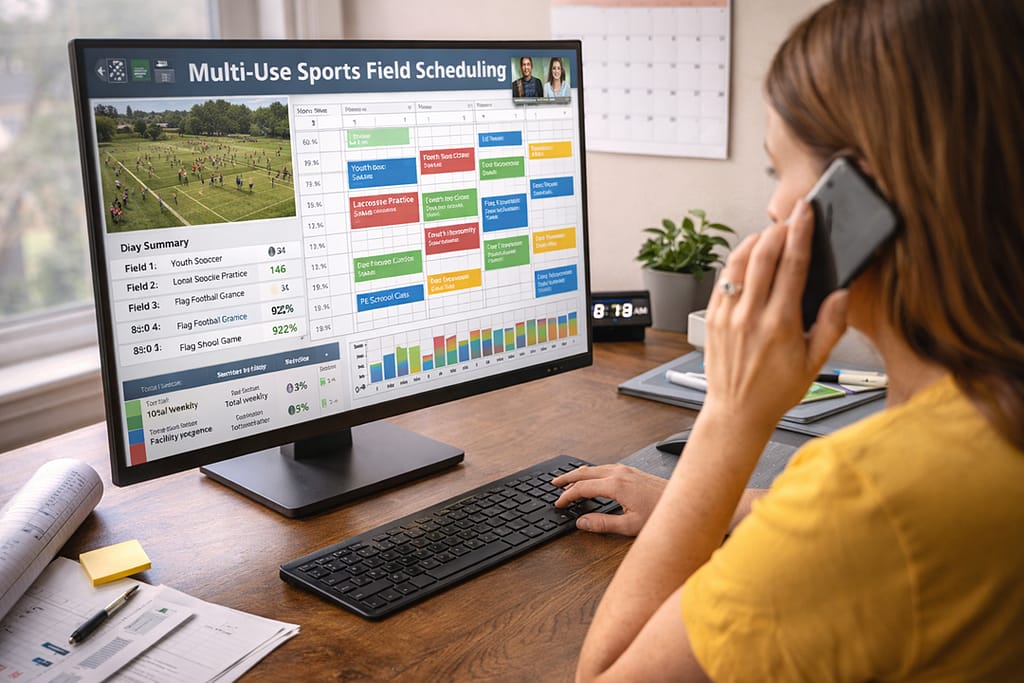
Multi-use sports complexes often rely on centralized scheduling systems that coordinate school teams, recreational leagues, and public access periods. This approach prevents conflicts and ensures equitable access for multiple user groups.
A well-managed multi-use field schedule might include:
- Morning school physical education classes
- Afternoon youth practices
- Evening recreational leagues
- Weekend tournaments or community events
The result is a facility that remains active from morning to night.
Modern scheduling systems increasingly incorporate data-driven facility management, allowing administrators to track usage patterns and adjust access policies over time.
In some cases, these systems are also integrated with broader environmental monitoring strategies, such as the air quality safety thresholds used by many leagues during wildfire smoke events.
Accessibility And Inclusive Design
Multi-use fields also create an opportunity to build more inclusive sports environments.
Traditional sports complexes often lacked accessible pathways, adaptive equipment areas, or spectator accommodations for individuals with disabilities. Modern planning standards increasingly prioritize universal design principles that allow broader participation.
Design elements now frequently include:
- Smooth, wheelchair-accessible pathways
- Accessible seating areas for spectators
- Adaptive sports zones
- Inclusive playground features
Communities that invest in inclusive facilities often see higher overall participation rates across youth programs.
These improvements reflect the broader principles discussed in our guide to adaptive sports infrastructure planning, where accessibility and thoughtful design expand opportunities for athletes of all abilities.
The Long-Term Economic Case For Multi-Use Fields
While multi-use sports facilities often require higher upfront planning investment, their long-term economic benefits are substantial.
Municipalities benefit from:
- Reduced land acquisition costs
- Lower infrastructure redundancy
- Higher facility utilization rates
- Increased community engagement
Multi-use complexes can also support regional tournaments and events, generating tourism revenue and strengthening local economies.
The result is a sports facility that functions not only as an athletic venue but also as a long-term civic investment.
Rethinking What A Field Can Be
The evolution of multi-use sports facilities reflects a broader shift in how communities think about public space.
A field is no longer just a place where games happen. It is a platform for recreation, wellness, education, and social connection.
When thoughtfully designed, multi-use sports infrastructure ensures that every square foot of public investment serves the widest possible community.
As cities confront growing population pressures, environmental challenges, and evolving recreational needs, the multi-use field model offers a blueprint for sports facilities that truly belong to everyone.