
In mid-2026, as North American host cities prepare for the arrival of the FIFA World Cup, the traditional framework of sports infrastructure management has undergone a permanent digital expansion. Urban planners, municipal authorities, and telecommunications executives are no longer evaluating stadium capacity purely through physical assets like transit links, seat counts, or concourse widths. Instead, a sports venue’s modern viability is increasingly dictated by its wireless throughput and spectral density. With stadium data usage projected to exceed 50 terabytes (TB) per match—the equivalent of streaming high-definition video continuously for multiple years—the tournament’s 16 competition venues are executing massive network upgrades. This capital-intensive infrastructure overhaul is driven by a fundamental shift in spectator behavior: the transition from passive observation to high-bandwidth, real-time digital engagement.
This digital transformation introduces a new layer of complexity to municipal finance and facility planning. The contemporary sports fan operates as a high-frequency consumer of data, utilizing localized networks to stream multicam replays, access real-time player statistics, manage digital tickets, and execute friction-free mobile transactions. For host cities, building the underlying network architecture to support this behavioral evolution is a major public-private planning challenge. Capturing the economic benefits of a global tournament requires a robust digital backbone that can process unprecedented peak data loads without experiencing systemic failure.
The Telecom Architecture of High-Density Venues
The scale of the physical deployment required for the 2026 tournament highlights the industrial nature of modern stadium telecommunications. As the official telecommunications services sponsor for the event, Verizon has engaged in a multi-year capacity planning initiative across the 11 U.S. host venues, including iconic facilities like MetLife Stadium, AT&T Stadium, and SoFi Stadium. To prevent network collapse under matchday conditions, engineers are delivering a three-to-five-fold increase in operational bandwidth. This is achieved by compounding traditional 5G technology with high-capacity C-band and millimeter-wave (mmWave) spectrum bands, allowing for dense data distribution across thousands of concurrent users.

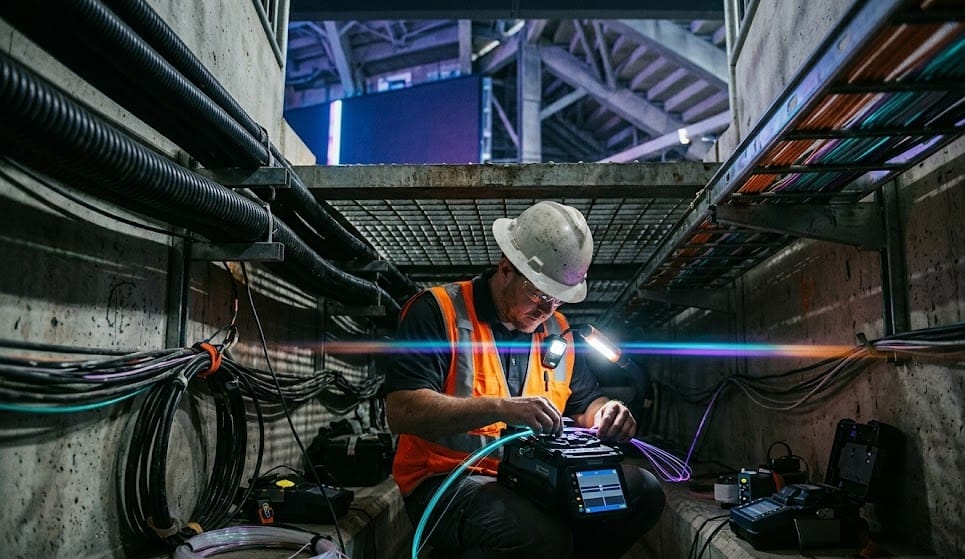
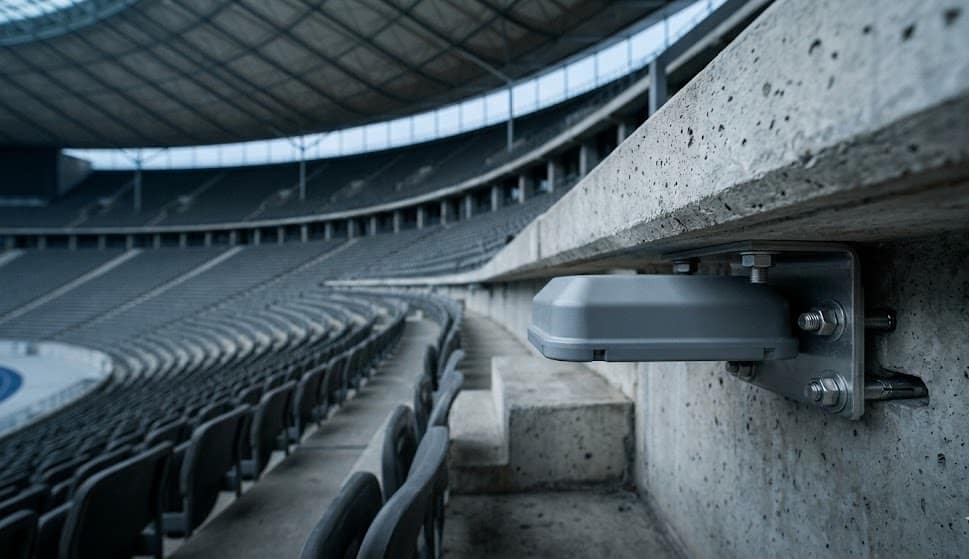
The installation footprint inside these venues requires substantial structural modification. Teams have routed over 6 million feet of new fiber-optic cabling through stadium massing to link decentralized antennas directly to high-speed transit networks. To maintain a clear aesthetic while optimizing line-of-sight signal propagation, technicians have deployed thousands of low-profile antennas directly beneath spectator seats. Furthermore, massive, specialized ball-shaped antennas have been structurally mounted in upper deck sections to deliver targeted 4G and 5G coverage to historically underserved higher tiers.
| Infrastructure Component | Legacy Stadium Standard | World Cup 2026 Deployment Framework |
| Core Bandwidth Capacity | 10–15 TB per major event | 50+ TB projected per tournament match |
| Fiber-Optic Backbone | Standard localized loops | 6 million+ feet of high-capacity cabling |
| Antennas & Small Cells | Peripheral concourse arrays | Under-seat systems & 140 exterior small cells |
| Broadcast Connectivity | Shared public/media networks | 64x100G wave circuits via dedicated BCN |
Beyond the stadium gates, the network architecture extends deep into the surrounding municipal fabric. Telecom providers have deployed approximately 140 small cells and temporary cellular sites across key transit corridors, official team training facilities, and FIFA Fan Festival locations. This localized densification ensures that the influx of international visitors does not compromise the core communications networks relied upon by local residents and municipal transit systems.
Network Slicing and the Segmentation of Fan-Driven Capital Flows
The primary technical challenge of managing 50 terabytes of matchday data is not merely expanding capacity, but governing performance under extreme contention. To maintain operational integrity, network administrators are relying heavily on advanced network slicing technology. By logically partitioning a single physical 5G network into multiple virtual slices, operators can dedicate isolated, high-performance bandwidth to specific, mission-critical workflows. For instance, private 5G slices are securely sequestered to power the Lenovo Referee View body cameras and team analytical tablets, ensuring that on-field officiation and coaching communications remain entirely unaffected by general fan traffic.
Simultaneously, public network slices must be optimized to accommodate the rapid financialization of the fan experience. The modern sports spectator interacts with borderless digital economies that require immediate, low-latency execution. A notable driver of this trend is the integration of decentralized financial services and global sports wagering platforms. For example, modern bitcoin sportsbooks are changing how fans approach World Cup betting by shifting transaction processing away from traditional localized banking infrastructure toward instantaneous, encrypted peer-to-peer data transfers. To support these continuous micro-transactions alongside traditional point-of-sale concession networks, stadium infrastructure must deliver continuous, secure connectivity that protects user data while processing immense transaction volumes simultaneously.
Municipal ROI and the Long-Term Digital Legacy
The justification for the multi-million-dollar tech investments required by global sporting events is frequently framed around the concept of a long-term legacy. Historically, this legacy was measured in physical assets like concrete arenas or expanded highways. In the context of 2026, however, the most significant municipal return on investment may be digital. The permanent fiber-optic lines, small cell arrays, and spectrum allocations deployed for the World Cup will remain embedded in host communities long after the final whistle.
When evaluating these major capital allocations, civic leaders are increasingly aligning their stadium upgrades with broader urban planning initiatives. Advanced sports infrastructure planning models demonstrate that high-density digital installations function most efficiently when designed to serve a dual purpose. By coordinating with municipal planners, telecommunications providers are ensuring that the network densification deployed for tournament venues directly transitions into permanent civic utility.
- Public Safety Enhancements: Host cities are leveraging the tournament’s technology stack to permanently upgrade emergency response infrastructure, utilizing dedicated virtual network slices to provide first responders with reliable, high-bandwidth communications during future civic crises.
- Small Business Digital Readiness: Municipal programs linked to the tournament’s deployment are funding Wi-Fi upgrades and digital point-of-sale training for local commercial districts, preparing small businesses to handle higher customer volumes in a post-cash economy.
- Bridging the Urban Connectivity Gap: The extension of high-capacity fiber networks into transit corridors and outer-ring facility zones provides a baseline infrastructure that cities can leverage to expand municipal broadband access into historically underserved neighborhoods.
Sustaining Capital Infrastructure Beyond the Tournament Lifecycle
The hyper-connected environment engineered for the 2026 World Cup represents a structural turning point for large-scale sports architecture. The tournament has demonstrated that a modern stadium can no longer function as an isolated physical bowl; it must operate as a highly integrated, data-driven node within a city’s broader economic and technological ecosystem. The financial and operational success of these venues is now fundamentally tied to their ability to govern performance under immense digital pressure.
For civic decision-makers and venue developers, the strategic takeaway is clear: future stadium capital plans must treat digital connectivity with the same priority as structural engineering. By moving past short-term commercial solutions and focusing on permanent, multi-layered network design, host cities can transform high-profile sporting events into catalysts for long-term municipal development. The true value of the 2026 infrastructure spend will not be determined by the data consumed during the matches, but by how effectively the remaining digital backbone supports the economic, social, and civic connectivity of the host communities for decades to come.