
When the FIFA World Cup 2026 arrives across the United States, Canada, and Mexico, the most visible pressure will fall on stadiums, airports, transit systems, fan zones, and public safety operations. But the deeper test will come after the final whistle. The tournament’s expanded 48-team, 104-match format is expected to intensify soccer interest across North America, and cities that treat the event only as a short-term spectacle risk missing the larger infrastructure question: whether local youth soccer systems are ready for the demand that follows.
For U.S. communities, World Cup 2026 is not just a professional soccer event. It is a stress test for fields, coaching access, scheduling capacity, neighborhood recreation systems, and the public-private partnerships that shape youth participation.
The World Cup Demand Surge Is Already A Planning Issue
World Cup demand is not limited to ticket sales or international tourism. It also changes how families, schools, clubs, and municipalities think about soccer participation. When global soccer becomes part of daily conversation, youth leagues often experience increased registration interest, more pressure on existing fields, and higher expectations from parents seeking structured development pathways.
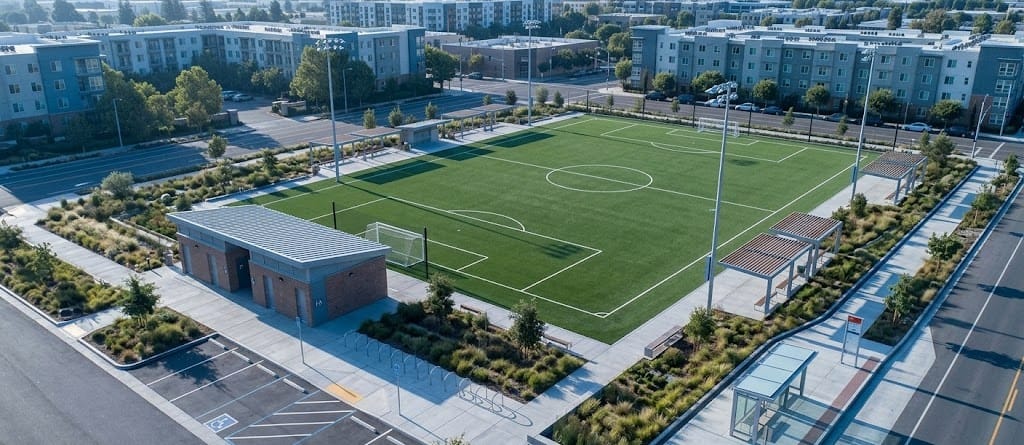
That creates a challenge for cities where youth soccer infrastructure is already strained. Many communities rely on aging grass fields, limited lighting, overloaded weekend schedules, and facilities shared across multiple sports. A major soccer moment can expose those weaknesses quickly.
The issue is especially relevant because World Cup 2026 is not concentrated in one city or one region. U.S. host markets such as Los Angeles, Dallas, Houston, Kansas City, Miami, Atlanta, Philadelphia, Boston, Seattle, San Francisco Bay Area, and New York/New Jersey are preparing for match-day logistics, but the participation ripple will extend well beyond host cities.
Youth Soccer Infrastructure Is More Than Fields
The most common mistake in youth soccer planning is reducing infrastructure to field count. More fields matter, but demand is shaped by the full operating system around those fields: transportation access, lighting, restrooms, drainage, parking, maintenance budgets, coaching availability, and affordability.
A city can build new fields and still fail if those fields are difficult to reach, unavailable during peak hours, unaffordable for local clubs, or unusable after heavy rain. World Cup-driven interest will reward communities that think in systems rather than isolated facilities.
| Infrastructure Need | Why It Matters After World Cup 2026 | Long-Term Community Value |
|---|---|---|
| Lighted fields | Expands evening practice capacity | More flexible access for working families |
| All-weather surfaces | Reduces cancellations and field damage | Stronger seasonal reliability |
| Public transit access | Connects underserved neighborhoods | More equitable participation |
| Shared-use agreements | Opens school and municipal facilities | Better asset utilization |
| Coaching development | Improves program quality | Stronger youth development pathways |
This broader definition matters because youth soccer demand is not evenly distributed. Families with private-club access may find new opportunities quickly, while lower-income communities often depend on public parks, school facilities, and nonprofit programming.
Legacy Programs Must Move Beyond Symbolic Access
Host committees and local organizations have already begun positioning World Cup 2026 as a community legacy opportunity. In Los Angeles, for example, the local host committee announced a program to provide hundreds of youth from underserved communities with access to World Cup experiences. Houston Dynamo also announced a five-week Soccer Celebration Community Tour with free youth clinics and pickup games across city parks during the tournament window.
These initiatives matter because they make the event visible to young people who may otherwise be priced out of the World Cup experience. But symbolic access cannot substitute for durable infrastructure. A clinic can inspire a child; a well-maintained neighborhood field gives that child somewhere to keep playing.
That is where cities need to connect event programming with long-term investment. Programs should be linked to facility audits, field upgrades, youth coaching pipelines, and permanent access policies. The question is not whether World Cup 2026 creates excitement. The question is whether cities can convert that excitement into sustained participation.
The Equity Challenge Behind The Soccer Boom
The coming surge in soccer interest could widen existing participation gaps if cities fail to plan deliberately. Competitive youth soccer in the United States has often been shaped by pay-to-play economics, travel costs, private coaching, and tournament fees. If World Cup demand increases interest without expanding affordable access, the benefits will flow disproportionately to families already positioned inside the system.
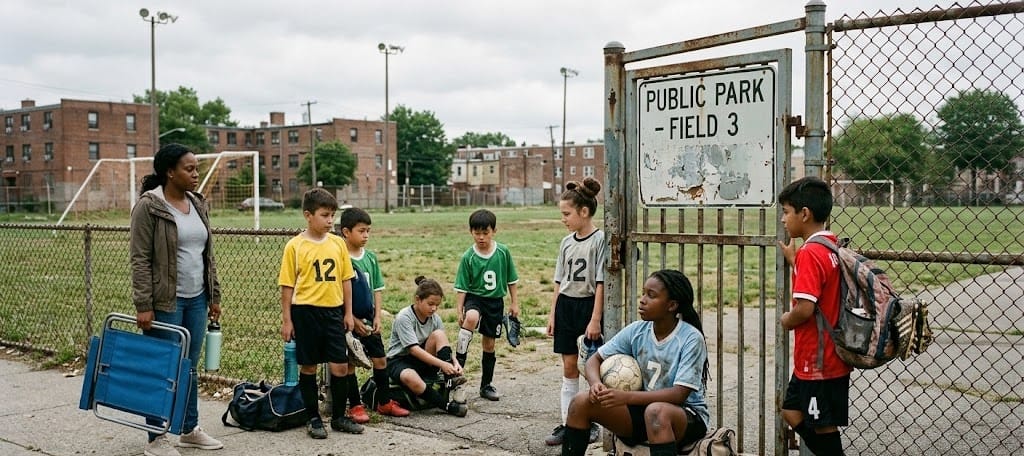
That makes municipal infrastructure central to equity. Public fields, school partnerships, low-cost clinics, and community-based clubs can reduce barriers. But they require planning discipline.
Cities should evaluate where soccer facilities are located, which neighborhoods face the longest travel times, and whether public fields are scheduled in ways that favor established clubs over new or underserved programs. These questions are not administrative details. They determine who actually benefits from a global soccer moment.
Lessons from community sports infrastructure planning show that participation growth depends less on one-time enthusiasm than on reliable access, transparent scheduling, and facilities designed for repeated community use.
Host Cities Are Building Fan Infrastructure, But Youth Systems Need Equal Attention
Much of the current World Cup planning conversation focuses on fan zones, transit, security, and crowd movement. That is understandable. Host cities must manage large numbers of visitors, public gatherings, and transportation challenges across a compressed tournament schedule.
But fan infrastructure and youth infrastructure should not be treated as separate worlds. Public viewing areas, temporary soccer activations, park-based events, and community festivals can be designed to leave behind usable assets. Modular futsal courts, lighting improvements, upgraded park surfaces, and equipment donations can create longer-term value if planned correctly.
The broader sports economy is already preparing for World Cup-driven attention, from media platforms to travel operators to betting-adjacent industries. Coverage of World Cup sportsbook readiness reflects how far the tournament’s operational ripple effects extend beyond the stadium. Cities should apply the same level of preparation to youth participation, where the long-term social value may be far greater.
Facilities Must Be Designed For Flexibility
World Cup 2026 demand will not affect every community in the same way. Some cities may see immediate registration increases. Others may experience more demand for public watch events, short-format soccer, summer camps, or school-based programming. This variation makes flexible infrastructure essential.
Instead of building only full-size fields, cities should consider a layered model:
- Full-size fields for older youth and competitive play
- Small-sided fields for younger children and entry-level programs
- Futsal or hard-court spaces for dense urban neighborhoods
- Shared public spaces that can support clinics, festivals, and informal play
This model is especially valuable in land-constrained cities where traditional field expansion is difficult. Small-sided soccer spaces can serve more users per acre, support informal participation, and reduce the barrier for new players.
Maintenance Is The Hidden Infrastructure Test
New demand can damage weak systems. More practices and games mean more field wear, more scheduling pressure, and higher maintenance costs. Without dedicated funding, World Cup-inspired participation growth can leave communities with overused fields and frustrated families.

Maintenance planning should be part of every youth soccer legacy strategy. That includes turf management, drainage, lighting upkeep, restroom cleaning, trash removal, and field rotation policies. Cities also need transparent budgets so community stakeholders understand what it costs to keep facilities playable.
In many cases, the most responsible infrastructure investment may not be a new complex. It may be upgrading drainage at existing parks, adding lights to underused fields, or improving basic amenities that make facilities safer and more welcoming.
Public-Private Partnerships Need Clear Community Requirements
Corporate sponsors, professional clubs, nonprofits, and local governments all have roles to play in expanding soccer access. But public-private partnerships must be structured around community outcomes, not just brand visibility.
Strong agreements should define:
- How many hours facilities remain available for public or low-cost use
- Which neighborhoods receive priority investment
- Who pays for long-term maintenance
- How success will be measured after the tournament
Without these requirements, World Cup legacy projects risk becoming temporary activations rather than lasting infrastructure improvements.
The Real Legacy Will Be Measured After 2026
World Cup 2026 will bring global attention, but attention is not the same as capacity. The real legacy will be measured by what happens in 2027 and beyond: whether more children can access safe fields, whether underserved neighborhoods gain meaningful soccer opportunities, whether cities maintain new facilities, and whether participation growth becomes inclusive rather than selective.
For planners, the lesson is clear. World Cup demand should not be treated as a temporary spike. It should be treated as a forecasting signal.
Cities that act early can use the tournament to modernize youth soccer infrastructure, strengthen public recreation systems, and build more equitable development pathways. Cities that wait may find themselves with more interest than capacity, more enthusiasm than access, and more pressure than planning.
Building A Youth Soccer System That Outlasts The Tournament
The strongest World Cup legacy will not be defined only by packed stadiums or fan festivals. It will be defined by whether local systems become stronger when the tournament leaves.
That requires infrastructure built for everyday use, not just event optics. It requires public parks that can handle increased demand, school partnerships that expand access, coaching pipelines that support new players, and funding models that protect long-term maintenance.
World Cup 2026 gives cities a rare opportunity to rethink youth soccer as civic infrastructure. The communities that succeed will be the ones that understand the event not as an endpoint, but as the beginning of a larger participation cycle.