
USA Football’s 2026 Summer Series in Los Angeles is more than a showcase for fast routes, quick throws, and Olympic ambition. It is a live infrastructure test for a sport that must scale from school fields and club tournaments into an international event system before flag football makes its Olympic debut at LA28.
The event runs June 17–21, 2026, in Los Angeles, with USA Football positioning the Summer Series as a global stage for flag football. The governing body lists eight countries, more than 1,000 athletes, coaches, and team personnel, and a competition environment centered at Dignity Health Sports Park. For a sport often praised because it is accessible and low-contact, the harder question now is operational: can the United States build enough fields, officials, training pathways, fan services, and event-ready venues to match the attention coming before 2028?
That question fits directly into the larger conversation around emerging sports infrastructure, where fast-growing games need more than participation numbers. They need facilities, scheduling systems, coaching education, insurance models, parking plans, and community access that can survive after the headline event leaves town.
Why Los Angeles Is The Right Stress Test For Olympic Flag Football
Los Angeles gives flag football a rare testing ground because the city is already connected to the sport’s Olympic future. LA28 lists flag football as part of the Olympic program, with men’s and women’s six-team tournaments and Exposition Park Stadium identified as the Olympic venue. That instantly changes the meaning of every major flag football event in Southern California before 2028.

The Summer Series is not taking place in isolation. It is happening in the same regional sports market that will soon need to host Olympic teams, training sessions, credentialed media, family travel, fan activations, youth clinics, and international visitors around the sport. That makes the event useful beyond the scoreboard.
At Dignity Health Sports Park, organizers can test what a flag football event looks like when it sits inside a professional sports campus rather than a small weekend tournament setup. The venue’s own event information points fans toward directions, parking, accessibility information, concessions, bag policies, and guest services. Those details may seem ordinary for established sports, but they matter for flag football because Olympic growth will bring new spectators who may not already understand event flow, field layouts, roster structures, or competition pacing.
USA Football’s Summer Series schedule also gives the event a wider purpose. It is not a single exhibition. It includes youth international competition, development-team events, hometown-based emerging-athlete showcases, and senior national team matchups. That mix is exactly why the infrastructure question matters: a sport cannot grow sustainably if elite, youth, and community layers are all fighting for the same limited fields and officials.
How The Event Connects Youth Development To The Olympic Pipeline
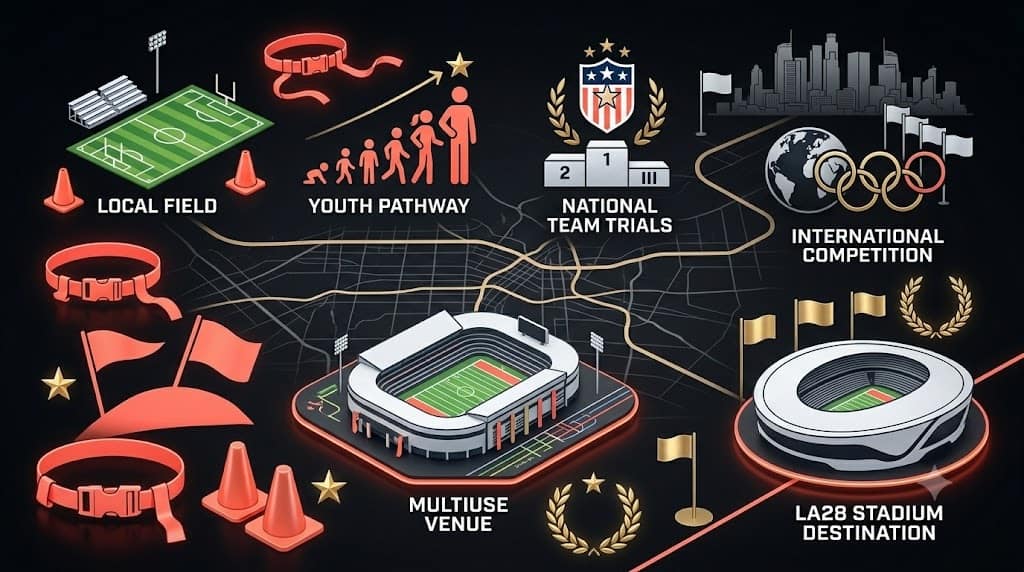
The most revealing part of the Summer Series is how many layers of the flag football pathway appear in one event window. USA Football lists the Junior International Cup from June 17–21, with 15U and 17U U.S. girls’ and boys’ national teams competing against international opponents. The Select Bowl, scheduled June 17–20, is part of the National Team Development Program and gives athletes across eight age divisions a route toward U.S. National Team Trials. Stars & States, running June 19–21, puts emerging athletes on teams connected to California, Texas, Florida, and New York.
That structure shows why flag football’s Olympic rise is not only about who makes the 2028 roster. The larger test is whether the sport can build a visible, fair, and repeatable pathway from youth participation to national-team consideration.
For families, that pathway needs clarity. They need to know where camps happen, how athletes are evaluated, what age divisions matter, how travel costs are managed, and whether local leagues connect to higher-level opportunities. For coaches, it requires training standards and event calendars that do not feel random. For communities, it requires field time that does not crowd out recreational access or turn every local facility into a pay-to-play tournament site.
USA Football’s role as the sport’s U.S. National Governing Body adds weight to that structure. The organization is responsible for selecting, training, and leading U.S. National Teams for international competition, including the sport’s Olympic debut. That makes the Summer Series a practical trial of talent identification, not just a promotional stop.
The stronger the development system becomes, the more pressure it puts on infrastructure. More athletes mean more fields. More events mean more trained officials. More international competition means more medical staffing, credential systems, equipment zones, livestream setups, and tournament operations. That is where Olympic excitement becomes a planning challenge.
Why Dignity Health Sports Park Matters As A Multiuse Venue Model
Dignity Health Sports Park is a useful case study because it is not a single-purpose flag football venue. It is a multiuse sports campus in Carson, California, associated with professional soccer, U.S. Soccer activity, track cycling, tennis, rugby-style event capacity, and major event operations. That type of site matters because emerging Olympic sports rarely get brand-new dedicated venues at the start of their growth curve.
Flag football’s near-term future will likely depend on adaptable fields and sports complexes that can host multiple age groups, multiple games, and multiple fan environments in one weekend. A field that works for a small youth league may not be ready for an international event. A stadium that can host a professional match may still need different field markings, sideline management, athlete warmup zones, and rapid turnaround plans for tournament play.
The 2026 Summer Series is a chance to study those details. Can several competitions share the same campus without confusing fans? Can athlete movement stay separated from public entry? Can families navigate parking and concessions across a long tournament day? Can the event support media, streaming, and data collection without slowing down operations?
Dignity Health Sports Park’s own venue information highlights the site’s flexibility and its broader LA28 role. That matters because flag football needs venues that can serve elite competition without losing the community-facing traits that made the sport attractive in the first place.
The best infrastructure outcome would not be a handful of expensive showcase events. It would be a stronger chain of multiuse facilities where local leagues, school programs, development camps, national-team trials, and international events can coexist.
What Communities Should Learn Before Flag Football Peaks In 2028
The lesson for cities, school districts, parks departments, and private sports operators is simple: the Olympic timeline is shorter than it looks. LA28 may feel distant to casual fans, but facility calendars, youth programming, sponsorship plans, coaching courses, and field upgrades move slowly. Communities that wait until 2028 to react will already be behind.
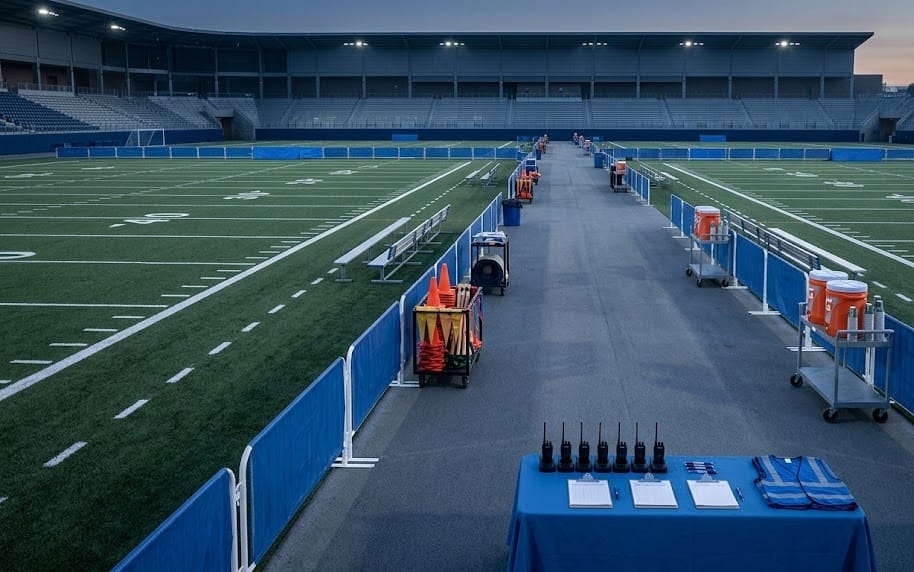
Flag football is attractive because it can use smaller rosters, flexible field layouts, and a non-contact format that broadens participation. That does not make infrastructure automatic. A growing flag football ecosystem still needs lighting, turf maintenance, restrooms, safe entry points, trained staff, storage space, hydration access, first-aid planning, and scheduling systems that protect girls’ and boys’ participation equally.
The sport’s gender balance will be especially important. LA28’s flag football plan includes both men’s and women’s events. At the local level, that should push communities to treat girls’ flag football as a core planning priority rather than an add-on. If the Olympic version gives equal stage space to men and women, the youth infrastructure underneath it should reflect the same logic.
That means better access to quality fields for girls’ leagues, more female coaching development, tournament formats that are built for families, and event environments that do not treat women’s divisions as secondary. The Summer Series helps make that visible because it places girls’ and boys’ youth national teams, emerging athletes, and senior national teams inside the same broader event identity.
For schools and municipal facilities, this is where flag football can become a planning advantage. A well-run flag football program can bring more students into organized sports, offer a lower-contact football option, and make better use of multipurpose fields. Poor planning can produce the opposite: crowded calendars, uneven access, and short-term events that leave no lasting community value.
How The Summer Series Shows The Next Facility Standard
The next standard for flag football facilities will not be defined only by field dimensions. It will be defined by how well a site handles layered participation. A future-ready venue must serve young players, adult athletes, coaches, referees, families, media, and fans without turning the event into an operational maze.
That requires a different planning mindset. A football field used for tackle games may need flag-specific striping, flexible sideline zones, and safer tournament flow. A soccer complex may need temporary football layouts and separate warmup areas. A parks department may need to think about weekend tournament traffic, lighting costs, trash collection, and shared use with other community programs.
USA Football’s Summer Series is valuable because it compresses many of those questions into one visible event window. The event includes international competition, U.S. National Team activity, youth development, fan engagement, and Olympic signaling. That makes it a preview of what cities across the country may face as flag football grows after LA28.
The risk is that communities treat Olympic exposure as a branding opportunity without building the base underneath it. The better approach is to use the Summer Series as a planning model: connect elite events to local access, link player pathways to coaching education, and measure venue success by more than attendance.
Flag football’s Olympic future will be decided on the field in 2028, but its long-term American future will be shaped earlier, in places where communities decide whether the sport gets organized space, trained adults, clear pathways, and facilities that can handle growth.
Why The Olympic Test Has Already Started
The 2026 Los Angeles Summer Series shows that flag football’s Olympic infrastructure test is no longer theoretical. It is already being run through youth divisions, national-team pathways, international opponents, multiuse venue operations, and fan-facing event planning.
That is why the event matters for more than the athletes wearing national-team gear. It matters for city planners, school athletic directors, parks departments, sports campus operators, youth coaches, and families watching where the sport is headed.
If the United States wants flag football to become more than a short Olympic spotlight, the work has to happen before LA28. Los Angeles is showing what the sport can look like at scale. The next step is making sure that same structure reaches local fields, community programs, and regional sports facilities long after the Olympic flame leaves California.