
World Cup hydration breaks are being debated as a soccer rhythm issue, but in the United States they are becoming something larger: a stadium operations story. The mandatory stoppages at the 2026 FIFA World Cup are forcing venues, host cities, broadcasters, coaches, fans, and event staff to adjust how a matchday works in real time.
The rule is simple on the surface. Matches stop midway through each half so players can drink, recover, and receive instructions. The operational effect is more complicated. A three-minute pause changes player routines, coaching windows, television timing, crowd movement, concession demand, stadium messaging, heat protocols, and the way fans experience long summer matchdays in North American venues.
That makes the issue a natural extension of broader World Cup 2026 infrastructure planning. The tournament is not only testing stadium capacity. It is testing whether U.S. venues can manage heat, hydration, fan services, medical staffing, broadcast pauses, and player welfare without making the match feel less like a World Cup game.
Why Hydration Breaks Became More Than A Player Welfare Rule
FIFA has defended hydration breaks as a player-safety measure and a way to keep conditions consistent across the tournament. That reasoning carries weight because the 2026 World Cup is being played across the United States, Mexico, and Canada during summer, with matches spread across very different climates.
Outdoor venues in places such as Kansas City, Dallas, Houston, Miami, Philadelphia, and New York/New Jersey can face different combinations of heat, humidity, storms, and direct sun. Even matches that begin in the evening may be shaped by afternoon fan movement, pregame travel, tailgating, transit lines, and security queues. Player welfare is the visible part of the policy, but the matchday environment extends beyond the pitch.
The controversy comes from uniform application. FIFA’s hydration break explanation has framed the policy around safety and equal conditions. Critics argue that a mandatory break in every match feels excessive when games are played in cooler conditions, climate-controlled venues, or after weather delays.
That tension is exactly why this is an operations story. A rule designed for fairness must still be implemented in stadiums that are not experiencing identical conditions. A closed-roof stadium in one city, a humid outdoor venue in another, and a cooler evening match in a third market may all follow the same stoppage pattern. For fans, that can feel confusing. For venues, it creates a fixed operational rhythm whether the weather demands it or not.
How Stadiums Feel The Break Before Players Do
On television, a hydration break looks like players walking to the sideline. Inside the stadium, it is a synchronized event-management moment.
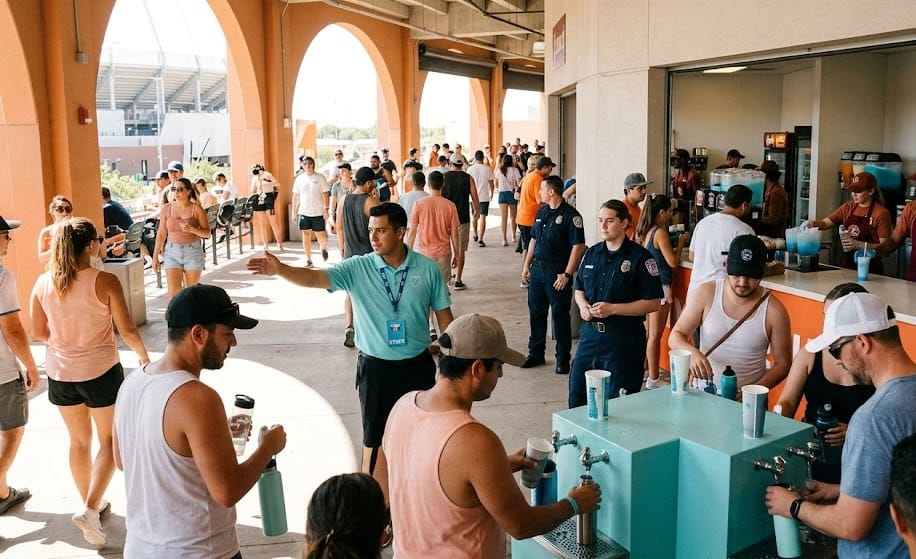
Venue staff know that thousands of fans may use the stoppage as a cue to move. Some will head to concessions. Others will look for water, restrooms, shade, or mobile ordering stations. In hot cities, a break can become a sudden demand spike for bottled water, sports drinks, ice, first-aid support, and concourse circulation.
That matters because soccer traditionally gives venues fewer predictable breaks than American football, basketball, or baseball. A World Cup match normally builds around two 45-minute halves with halftime as the main organized service window. Hydration breaks interrupt that pattern. They create smaller mid-half service pulses, which stadium operators must now plan around.
The stadium screen also becomes part of the event. During breaks, fans need clear information: why play stopped, how long the pause lasts, whether the break is part of standard tournament rules, and when play will resume. If the video board focuses only on ads or generic entertainment, fans may feel the pause is commercial rather than safety-driven.
That perception problem has followed the rule throughout the tournament. ESPN’s World Cup hydration breaks analysis noted that all 104 matches are stopping for two breaks, while critics have questioned whether the pauses are being shaped by broadcast and commercial incentives. Whether or not that criticism is fair, stadium communication has to be sharper when a safety measure also creates a visible commercial window.
Why Heat Makes Fan Operations As Important As Player Protocols
The player-safety purpose of hydration breaks is real, but heat risk does not stop at the touchline. Fans, security workers, concession staff, volunteers, media crews, and transportation workers all experience the same summer environment, often for longer periods than the players.
Kansas City offered a clear example of how the issue expands beyond match play. Fans gathering for a knockout-round match faced temperatures in the 90s and triple-digit heat indexes, turning hydration into part of the fan experience rather than a private player concern. ABC17’s Kansas City heat report showed how matchday conditions shaped fan conversations before kickoff.
For stadium operators, that means hydration planning cannot be limited to the two breaks. Water access needs to be visible before gates open. Shade needs to be part of queue management. Medical teams need to know where heat-related issues are most likely to appear. Concession stands need enough water inventory. Security lines need to move quickly enough that fans are not standing in exposed areas for too long.
The Guardian reported that multiple group-stage matches were played in extreme heat conditions, with players’ union warnings about wet bulb globe temperature thresholds and broader safety concerns around summer scheduling. That kind of climate pressure makes the World Cup heat warning a stadium planning issue, not only a tournament policy debate.
A hydration break helps players during the match. It does not automatically protect a family walking from a parking lot, a volunteer scanning tickets in direct sun, or fans waiting for trains after full time. Host cities need to treat the break as one part of a larger heat operations plan.
How Breaks Are Changing Coaching, Broadcasts, And Match Rhythm
Hydration breaks have created a second debate: competitive rhythm. Coaches now get two planned tactical windows inside regulation time. That can help teams reset shape, address pressing problems, calm a game down, or change the psychological momentum of a half.
For some coaches, that is useful. For some players and fans, it can feel intrusive. Traditional soccer flow depends on long stretches of continuous play, where fatigue, pressure, and game management unfold without scheduled interruptions. Breaks can cut into that rhythm, especially when a team is building pressure.
The effect is visible in how managers behave. The break is no longer only about drinking water. It can become a mini-timeout. Coaches gather players, point to boards, make tactical gestures, and use the stoppage to deliver instructions that would normally wait until halftime or be shouted from the technical area.
That gives stadium operations another layer. Broadcast partners need camera plans. In-stadium production teams need content timing. Referees need a clear restart process. Teams need sideline access without chaos. Medical staff need space to observe players. Ball kids, officials, stewards, and photographers all have to know what happens during the pause.
The more these breaks resemble structured American-sports timeouts, the more soccer purists resist them. But the operational reality is already here. In the U.S., where stadiums are built around scheduled pauses in football and basketball, hydration breaks may feel familiar to venue operators but unfamiliar to global soccer audiences.
What U.S. Venues Should Learn From The Tournament
The lesson for U.S. stadiums is not that hydration breaks are good or bad. The lesson is that climate, match rhythm, and fan services are now connected.
Future host venues need to prepare for soccer as a long-duration outdoor event with fewer natural stoppages than most American sports. That means heat planning must begin outside the bowl: parking areas, rideshare zones, transit platforms, security queues, fan festivals, and walking routes all matter.

Inside the venue, operators should think about hydration breaks as planned surges. Water access should be fast. Restrooms should be staffed. Concessions should prepare for short, sharp lines. Video boards should explain the rule clearly. Medical teams should treat each break as a scan point for player and fan conditions.
The same thinking applies to workers. Security staff, ushers, cleanup crews, broadcast crews, and concession employees need rotation plans during extreme heat. If the tournament frames hydration as player welfare while stadium workers remain exposed for hours, the policy will feel incomplete.
There is also a legacy opportunity. Host cities can use the World Cup to improve permanent heat resilience: shaded concourses, misting areas, better water refill stations, clearer emergency messaging, real-time weather monitoring, and transit coordination for hot matchdays. Those improvements would matter after the tournament for soccer, football, concerts, college games, youth tournaments, and civic events.
Why Hydration Breaks Will Shape Future Stadium Planning
Hydration breaks may or may not remain in the same form after 2026, but the operational lessons will last. Global sports events are moving into hotter, more complex climate conditions. Stadiums that once measured readiness by capacity and premium seating now need to prove they can protect athletes, fans, and workers in extreme weather.
The 2026 World Cup is showing that player welfare policies can reshape the entire matchday system. A break on the field becomes a concession surge. A safety rule becomes a broadcast debate. A coaching pause becomes a tactical advantage. A heat protocol becomes a test of transit, staffing, and stadium communication.
That is why the hydration break debate belongs in the infrastructure conversation. It is not only about whether soccer should pause twice per match. It is about whether U.S. venues can adapt to a global event where climate, competition, fan experience, and commercial timing all meet inside the same three-minute window.
If host cities learn from this tournament, hydration planning will not end with the final whistle. It will become part of how stadiums prepare for summer events, how operators design fan services, and how sports facilities define safety in a hotter calendar.