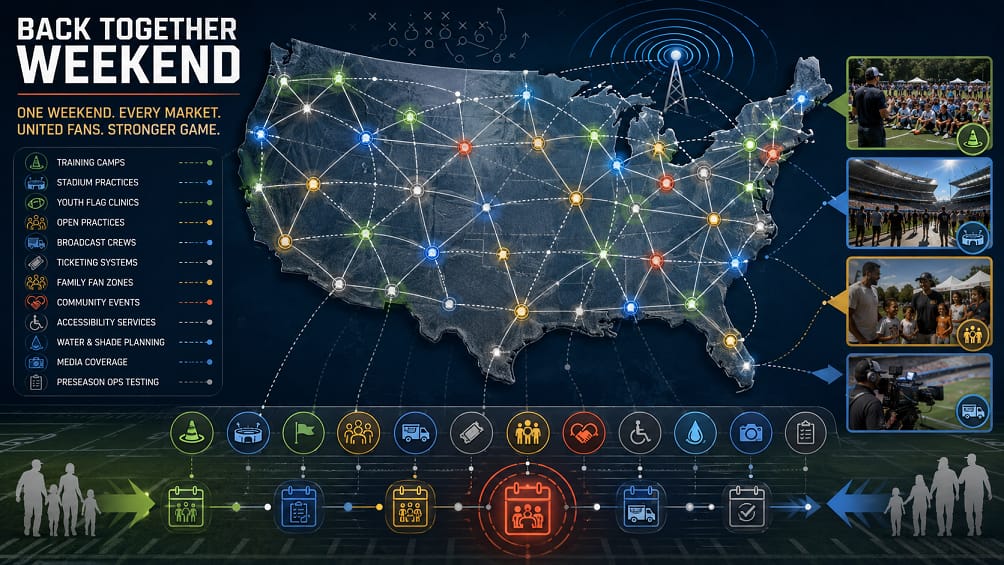
NFL Training Camp: Back Together Weekend shows that training camp is no longer just a football evaluation period. It has become a nationwide fan infrastructure system.
On August 1–2, 2026, all 32 NFL clubs participated in the sixth consecutive edition of Back Together Weekend, a league-wide celebration built around club-led fan events, open practices, player interactions, youth flag football programming, live entertainment, creator activations, community celebrations, and family-friendly activities. NFL Network and ESPN carried national coverage, while local teams turned practice fields, stadiums, training facilities, and fan zones into early-season access points.
That is the important shift.
Training camp used to be treated mainly as an internal football operation. Coaches installed systems. Players competed for roster spots. Beat writers tracked depth charts. Fans who attended open practices were often participating in a local tradition rather than a coordinated national event. Back Together Weekend changes that model by organizing the start of camp as a league-wide fan platform.
For aplevante.org’s Fan Planning category, this is the real story. The NFL is turning August practices into an infrastructure layer that connects teams, fans, youth football, broadcast platforms, ticketing, local communities, and digital engagement before the regular season begins.
It also connects naturally to the rise of flag football’s Olympic infrastructure, because the league is increasingly using fan-facing events to link professional football, youth participation, and future pathways.
Why Back Together Weekend Is Bigger Than A Practice Schedule
Back Together Weekend matters because it takes a decentralized football ritual and gives it a national structure.
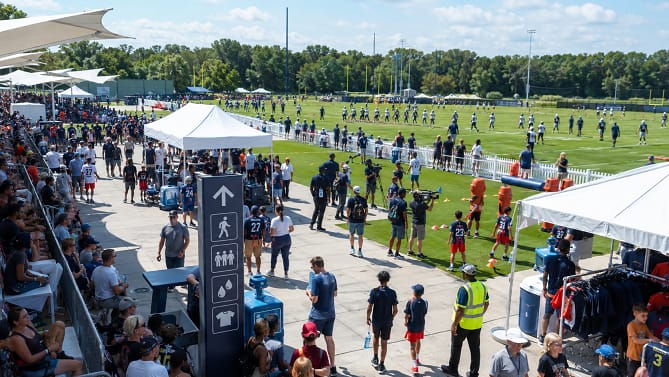
Every NFL club already has its own training camp culture. Some teams train at long-established remote sites. Others remain at modern headquarters. Some hold stadium practices. Others run more controlled open sessions at team facilities. Fan access varies by geography, venue, ticketing rules, security, seating, weather, and local demand.
Back Together Weekend does not erase those local differences. Instead, it organizes them under one shared league platform.
That structure matters because it gives fans across the country a synchronized entry point into the season. Whether a fan is in Green Bay, Jacksonville, Charlotte, Pittsburgh, Minnesota, Philadelphia, Baltimore, Buffalo, or Cleveland, the message is the same: football is back, and the club is opening a piece of its preseason build-up to the public.
That is fan infrastructure.
It creates a predictable national weekend. It gives broadcasters programming. It gives teams a community event framework. It gives sponsors a coordinated activation window. It gives families a reason to visit camp. It gives youth football programs a place inside the NFL calendar.
The practice itself is still important. But the system around the practice is now just as important.
How The NFL Turned Camp Access Into A National Event
The 2026 version of Back Together Weekend shows how much planning now sits behind fan access.
NFL Media said the weekend included open practices, player interactions, youth flag football programming, live entertainment, creator activations, community celebrations, and family-friendly activities. That list is useful because it shows how training camp has expanded beyond watching drills.
A modern fan event requires ticket registration, security screening, parking, seating, water access, shade, concessions, restrooms, retail, autograph policies, media zones, accessibility planning, youth activities, digital promotion, sponsor integration, and weather contingencies. When every club participates during the same weekend, the league is not simply hosting scattered practices. It is operating a national fan network.
This is why Back Together Weekend should be viewed through the same infrastructure lens used for stadium districts and major events.
The fan experience begins before a family reaches the gate. Fans need to know how to reserve tickets, where to park, what they can bring, what time gates open, which players may appear, whether practices are indoors or outdoors, and how children can participate safely. Teams need staff, volunteers, operations crews, security, medical support, and communications plans.
That level of organization turns training camp into a civic sports event.
Why All 32 Clubs Matter
The “all 32 clubs” detail is not just a marketing line. It is the core of the infrastructure story.
When every team participates, the NFL creates a national standard for early-season fan access. Not every club hosts the same kind of event, but every club becomes part of the same seasonal system. That helps the league make training camp feel like the beginning of the season for the entire country rather than a collection of local practices.
That league-wide participation also gives the NFL a stronger media product.
NFL Network and ESPN can move across the country, showing practices, interviews, fan fests, rookies, veterans, quarterback battles, youth events, and stadium atmospheres. The coverage turns local camp scenes into national content. It also gives teams outside the biggest markets a place in the shared preseason conversation.
This is especially important in a league built around parity and national reach. Back Together Weekend gives every fan base a version of the same emotional reset. The previous season is over. Roster competition has started. New players are visible. Families can return to team spaces. Local communities can reconnect.
That uniformity is valuable.
A league-wide fan infrastructure system works because it gives each market a shared role while preserving local identity.
How Training Facilities Became Fan Venues
The rise of Back Together Weekend also shows how training facilities have changed.
A team headquarters used to be primarily a workplace: practice fields, weight rooms, meeting rooms, locker rooms, medical spaces, offices, and media access. Many are still designed around competitive preparation first. But as training camp events grow, these facilities also have to function as temporary fan venues.
That changes planning.
A fan-facing training camp site needs safe circulation between parking areas, seating zones, practice fields, restrooms, concessions, merchandise, sponsor activations, and security checkpoints. It needs shaded areas in hot climates. It needs accessible routes. It needs camera positions and interview areas. It needs enough separation between fans and football operations to protect competitive work while still creating intimacy.
This is a delicate balance.
Fans want closeness. Coaches want control. Players need preparation. Broadcasters need access. Teams need safety. Sponsors want visibility. Families need comfort.
Back Together Weekend forces clubs to solve that balance each year.
That is why training facilities are no longer invisible infrastructure. They are part of the fan-facing sports landscape.
Why Stadium Practices Still Carry Special Value
Some clubs use stadiums as part of Back Together Weekend, and those events carry a different kind of value.
NFL Media highlighted examples such as the Baltimore Ravens hosting a sold-out practice for about 20,000 fans at SECU Stadium, the Carolina Panthers bringing Fan Fest back to Bank of America Stadium, the Green Bay Packers holding Family Night at Lambeau Field, and the Tennessee Titans adding fireworks around a stadium practice.
Those examples show that training camp can activate a stadium before the season officially begins.
A stadium practice gives fans a gameday-like setting at a lower-pressure moment. Families can introduce children to the venue. New players can experience the crowd. Teams can test operations. Stadium staff can rehearse entry, concessions, seating, security, parking, and fan-flow systems before preseason and regular-season games.
That makes stadium practices useful beyond entertainment.
They are soft openings for the season. They let teams check equipment, staffing, technology, ticketing, and crowd management under live conditions. They also give fans a reason to return to the venue before the standings matter.
In fan planning terms, a stadium practice is both community event and operational rehearsal.
How Youth Flag Football Fits The Weekend
Youth flag football programming is one of the most important parts of Back Together Weekend.
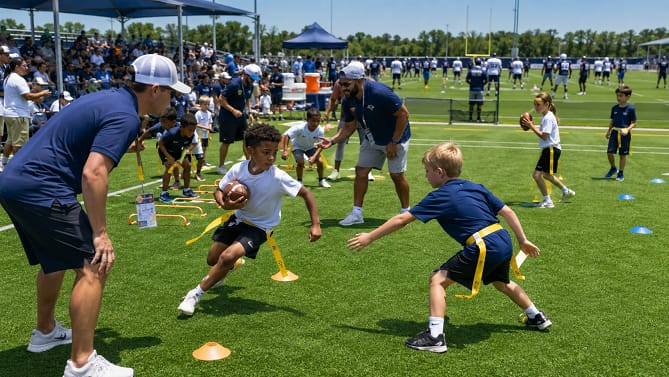
The NFL has invested heavily in NFL FLAG, and flag football’s Olympic debut at LA28 has made the sport’s pathway more visible. By placing youth flag programming inside a league-wide training camp weekend, the NFL connects the professional season to youth participation at the exact moment fans are reengaging with football.
That is smart infrastructure planning.
A child attending a fan event may watch rookies practice, meet a mascot, try a flag football activity, and see the sport as something they can play. A parent may leave with information about local leagues. A team may use the event to strengthen community programming. A sponsor may support youth access. The league may connect its national brand to a lower-contact, more inclusive entry point.
This matters because modern football growth cannot depend only on tackle participation. Families are more conscious of safety, cost, access, and age-appropriate formats. Flag football gives the NFL a way to expand youth engagement while creating a pathway that reaches girls, coed teams, school programs, and Olympic-connected development.
Back Together Weekend becomes a bridge between watching football and playing football.
Why Broadcast Coverage Is Part Of The Infrastructure
The national broadcast layer is another sign that training camp has evolved.
NFL Network provided nine hours of live coverage across the two days, while ESPN provided additional coverage on August 1. NFL Network’s Inside Training Camp then continued daily coverage from August 3 through August 12.
That coverage turns training camp into a media property.
Fans who cannot attend still participate. They see live practice look-ins, player interviews, mic’d-up segments, behind-the-scenes moments, and fan fests across the league. That helps the NFL stretch the start of the season across platforms before preseason games begin.
Broadcast coverage also affects how teams operate events. Camera positions, interview availability, practice timing, player access, audio, signage, crowd shots, and digital clips become part of the planning. The camp site is not only hosting local fans. It is producing national content.
That is a major infrastructure shift.
A modern training camp event exists in three places at once: on the practice field, inside the local fan venue, and across national media platforms. The best teams plan for all three.
How Back Together Weekend Supports Local Community Identity
Even though Back Together Weekend is a national platform, its strongest value may still be local.

Football teams are civic institutions in many cities. Training camp gives clubs a chance to appear more accessible than they do during the regular season, when ticket prices, stadium scale, and competitive pressure can create distance between the team and its community.
Open practices and fan events reduce that distance.
A child can see a player up close. A family can attend without committing to a regular-season game. Local businesses can benefit from visitors. Youth football groups can participate. Community organizations can be recognized. Fans can reconnect with the team before the season becomes stressful.
This local identity is important because the NFL’s national power can sometimes make teams feel like media brands more than neighborhood institutions. Back Together Weekend gives clubs a chance to show local roots.
The most effective events will not feel like generic league promotions. They will reflect each market’s culture: Green Bay’s Family Night, Pittsburgh’s Latrobe tradition, Minnesota’s night practice at TCO Stadium, Jacksonville’s stadium-future showcase, or Carolina’s Fan Fest in Charlotte.
The national system works best when local flavor remains visible.
Why Fan Access Needs Better Infrastructure Standards
Back Together Weekend also raises a question: what should good training camp access look like?
As more clubs turn camp into a fan-facing event, the league should think about informal standards. Fans should have clear information about tickets, parking, prohibited items, heat policies, accessibility, water, shade, family activities, autograph expectations, practice cancellation rules, and emergency communication.
That is especially important because many training camps occur in hot weather. Outdoor practices in August require hydration planning, shaded seating, medical staff, misting areas, and heat communication. Families with young children need comfort and clarity. Older fans need accessible movement and rest areas. Fans with disabilities need predictable routes and seating options.
These details may not generate headlines, but they determine whether a fan event feels welcoming.
Back Together Weekend has become large enough that infrastructure quality matters. If the NFL wants this weekend to remain a national fan celebration, every club should treat basic fan services as part of the product.
The future of fan access depends on consistency.
How Training Camp Helps Teams Test New Fan Ideas
Training camp is also a useful laboratory for fan experience.
Teams can test new mobile ticketing flows, parking systems, concession concepts, merchandise layouts, fan-zone activities, kid-friendly programming, sponsor activations, seating arrangements, and digital engagement tools. Because camp events are smaller than regular-season games, they provide space to learn.
That makes Back Together Weekend valuable for stadium and facility operators.
A club can evaluate which family activities draw attention, how fans move through a practice site, where lines form, what signage is confusing, how app check-ins work, and how weather affects attendance. Those lessons can feed into preseason and regular-season planning.
The league can also learn at scale. With all 32 clubs participating, best practices can spread quickly. If one team creates a better youth flag experience, heat plan, accessibility process, or broadcast-friendly fan zone, other clubs can adapt it.
This is how fan infrastructure improves over time.
Back Together Weekend should not be viewed only as a kickoff party. It should be viewed as a national operations test.
Why The Weekend Strengthens The NFL Calendar
The NFL calendar is one of the league’s greatest assets. Back Together Weekend gives the league another fixed moment inside that calendar.
The offseason has the draft, free agency, schedule release, rookie minicamps, organized team activities, mandatory minicamp, and training camp report dates. The regular season has kickoff, Thanksgiving, international games, division races, playoffs, and the Super Bowl. Back Together Weekend gives fans a clear signal between camp reporting and preseason games: this is the public return of football.
That timing is valuable.
It arrives when storylines are forming but results have not yet narrowed attention. Rookies can be introduced. Quarterback competitions can be framed. Injured stars can return to public view. New coaches can connect with fans. Teams can sell hope before games begin.
From a fan planning perspective, that hope is important. It creates early engagement across all 32 markets.
The NFL has turned the start of training camp into a shared event because the league understands that fandom is not only activated by games. It is activated by rituals.
What Other Sports Can Learn From Back Together Weekend
Back Together Weekend offers lessons for other sports leagues.
First, preseason access can become a structured national event. Leagues do not have to wait for official games to engage fans.
Second, local clubs should be allowed to express their own culture inside a national framework. Uniformity without local identity feels flat.
Third, youth participation should be built into fan events. Watching and playing should be connected.
Fourth, broadcast coverage can extend the value of local practices. Fans who cannot attend still need a pathway into the event.
Fifth, fan infrastructure should be measured by comfort, clarity, safety, and accessibility, not only attendance.
These lessons apply to soccer, baseball, basketball, hockey, college sports, women’s leagues, and emerging sports. Any league with a preseason or training period can think more intentionally about how fans are brought back into the sport.
The NFL is showing one version of that model.
Why This Is A Nationwide Fan Infrastructure System
Back Together Weekend shows that NFL training camp is becoming a nationwide fan infrastructure system because it connects many pieces at once.
It connects all 32 clubs under one calendar. It connects local practices to national broadcasts. It connects training facilities to family events. It connects stadiums to preseason operations. It connects youth flag football to professional visibility. It connects ticketing, media, community outreach, sponsor activation, and fan services into one weekend.
That is infrastructure.
The football work still matters. Coaches still evaluate players. Rookies still learn. Veterans still compete. Depth charts still change. But the event around that work has become a major part of the NFL’s public calendar.
Back Together Weekend is not just a celebration of football’s return. It is the league’s early-season operating system for fan connection.
As training camp continues to grow as a public event, the NFL’s next challenge will be making that system more accessible, safer, more consistent, and more useful to local communities. If it does, August training camp will become one of the strongest examples of how a sports league can turn preparation into public infrastructure.