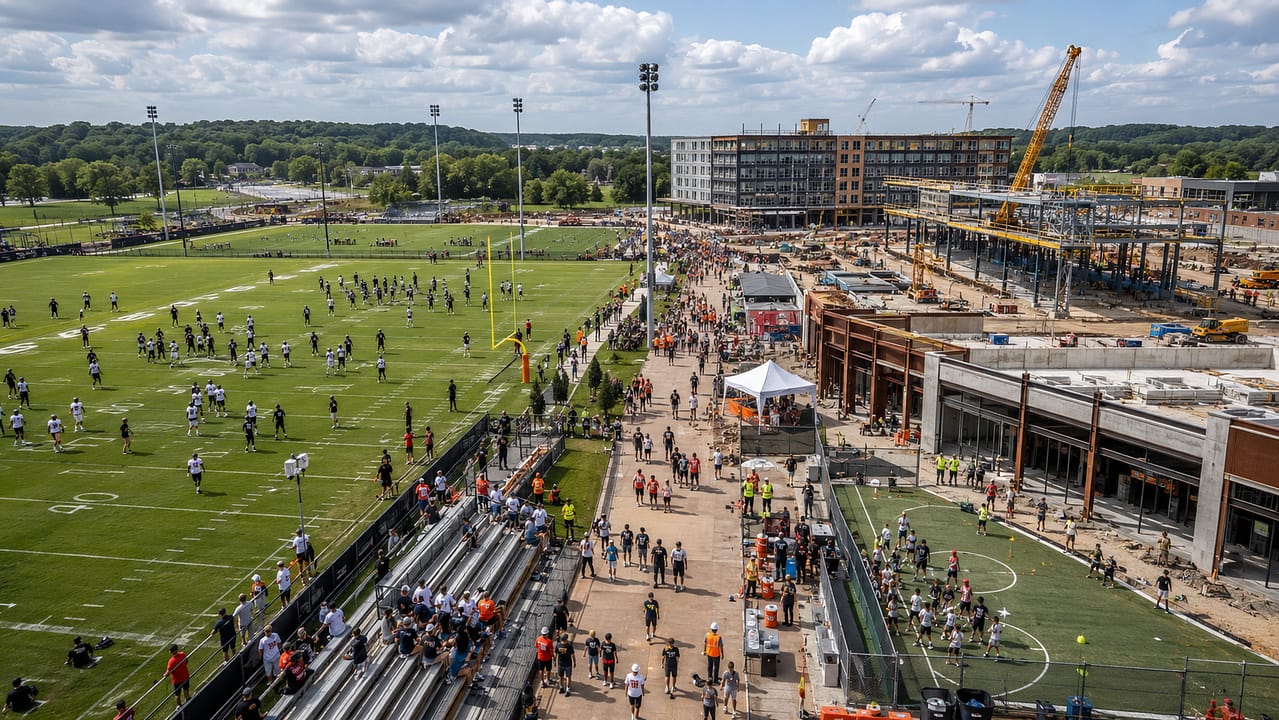
Cleveland Browns training camp in Berea is no longer only about quarterback reps, depth-chart battles, rookie development, and fans watching practice from the bleachers. In 2026, it has also become a live preview of how an NFL training facility can anchor a mixed-use sports development.
That is the real meaning of District 46.
The project, formally known as District 46 at CrossCountry Mortgage Campus, is being built next to the Browns’ headquarters and practice facility in Berea, Ohio. The Browns have described it as a mixed-use neighborhood created through a partnership involving Berea City Schools, the City of Berea, DiGeronimo Companies, Haslam Sports Group, and University Hospitals. Its planned pieces include a multi-sport community field, an upscale hotel, a sports medicine facility, market-rate apartments, a community field house, a parking garage, and 30,000 square feet of retail.
Those details matter because they move the Browns’ Berea campus beyond the traditional training-center model. The facility is no longer only a place where players work and fans visit during a few open practices. It is becoming a year-round district built around sports, health, housing, retail, community use, and fan access.
For aplevante.org’s Infrastructure category, this is exactly the kind of sports development shift that deserves attention. District 46 connects directly to the broader rise of multi-sport venue planning, where teams and cities are asking sports facilities to serve more people, more days, and more civic purposes.
Why Browns Training Camp Is Now A Development Preview
Training camp gives fans a temporary look inside a team’s football operation. District 46 adds a second layer: it lets fans watch the surrounding sports district take shape while the team prepares for the season.

That is unusual.
Most NFL training camp stories focus on roster movement. In Cleveland, the 2026 camp conversation also includes construction activity around the team’s Berea facility. Recent camp reports described fans attending open practices at CrossCountry Mortgage Campus, new bleacher areas, fan amenities, the return of the Puppy Pound feature, and visible work tied to District 46.
That changes how the site is experienced.
A fan going to camp is not only watching drills. The fan is entering an evolving sports campus. The practice fields, fan areas, construction zones, parking patterns, future hotel site, planned retail, sports medicine concept, and community field vision all become part of the same story.
That is what makes this more than a football article.
Training camp is becoming the public-facing window into a larger real estate and community development strategy. The Browns are using a place already tied to local fan tradition and turning it into a more permanent district.
How District 46 Expands The Meaning Of A Practice Facility
An NFL practice facility used to be a protected workplace. It still is, but the best modern facilities are also becoming brand platforms, community assets, business-development anchors, and fan-experience tools.
District 46 shows that shift clearly.
The Browns’ existing CrossCountry Mortgage Campus is the team’s football base. District 46 is the surrounding neighborhood concept designed to bring together living, healthcare, retail, recreation, and community uses in a pedestrian-friendly setting. The name itself references 1946, the year the Browns were founded, which ties the project to franchise identity rather than treating it as a generic development.
That matters because sports districts work best when they feel connected to place.
The Browns are not simply adding buildings near a practice facility. They are trying to create a campus environment where football history, community recreation, healthcare, hospitality, and local development are linked. The planned community field and field house make that especially important because they signal use beyond team operations.
A training center that serves only the team is private infrastructure. A training center that supports youth sports, high school events, community programming, hotel activity, medical care, and retail becomes civic infrastructure.
District 46 is pushing Berea in that direction.
Why Mixed-Use Matters Around NFL Facilities
Mixed-use development has become one of the most important trends in sports infrastructure.
Teams and municipalities increasingly understand that a stadium or training facility can sit idle for too many days if it is treated as a single-purpose venue. Adding housing, hotels, restaurants, retail, medical services, public space, and community fields can stretch the value of the sports anchor across the calendar.
That is the District 46 argument.
Training camp may bring fans to Berea in late July and August. Browns operations bring players, coaches, staff, media, and visitors throughout the year. Youth events can activate fields outside the NFL calendar. A hotel can support visiting teams, families, tournaments, business travelers, and fans. Sports medicine can serve both athletes and the wider community. Retail can make the site feel less isolated. Apartments can create daily life around the campus.
The goal is not just more development. The goal is more consistent use.
A practice facility is usually active behind the gates. A mixed-use sports district can be active at the edge of the gates, creating a more public relationship between the team and the city.
That is why District 46 fits the national infrastructure conversation.
How Berea Becomes More Than A Camp Stop
Berea has long been associated with Browns training camp. District 46 could make that relationship more permanent.
For years, fans have traveled to Berea to watch open practices, follow training camp storylines, and reconnect with the team before the regular season. That tradition is valuable, but it is seasonal. District 46 gives Berea a chance to convert that seasonal attention into year-round activity.
That is the central development opportunity.
A hotel, retail space, community field, field house, parking garage, apartments, and sports medicine facility can make the campus more useful outside training camp. Instead of fans arriving for practice and leaving, the district can encourage longer visits. Instead of the facility being quiet outside team operations, community events can create additional activity.
This matters for small and mid-sized cities near major sports franchises.
Berea is not downtown Cleveland. Its sports-development opportunity depends on becoming a specialized district, not trying to mimic a downtown stadium neighborhood. District 46 can succeed if it creates a clear identity: Browns football, community sports, health services, hospitality, and local gathering space around a pedestrian-friendly campus.
That is a more realistic model than a large entertainment district built only around nightlife.
Why The Community Field Is A Key Piece
The multi-sport community field may be the most important public-facing piece of District 46.
A hotel and retail space can support the business model. Apartments can add residential activity. Sports medicine can create healthcare value. But the community field directly connects the development to sports participation.
The Browns’ official project description says the community field will be lined for multiple sports for youth, high school, and adult participation. That is important because a team-branded district needs a visible community benefit. A field that can serve different levels of play gives the project a stronger civic purpose.
It also expands the site beyond football.
A multi-sport field can support flag football, soccer, lacrosse, camps, clinics, school events, adult recreation, and community programming. That makes the development more flexible. It also matches the way modern sports infrastructure is moving: away from single-use fields and toward shared-use systems.
For the Browns, this can strengthen local roots. For Berea, it can create a usable sports asset. For youth athletes, it can provide access to a field connected to an NFL campus. For families, it can make the development feel participatory rather than purely commercial.
That is why the field should be treated as central, not decorative.
How University Hospitals Changes The Development Model
The inclusion of University Hospitals adds another layer to the District 46 story.
Sports medicine facilities are becoming increasingly important in sports districts because they connect professional athlete care, community healthcare, performance training, injury prevention, rehabilitation, and public-facing wellness services. When a medical partner is built into a team campus development, the site can serve more than elite players.
That is particularly relevant around youth and high school sports.
Young athletes need access to injury evaluation, return-to-play guidance, rehabilitation, and sports health education. Families need reliable medical support. Schools need trusted partners. Adult recreational athletes need care too. A sports medicine facility near community fields and a professional training campus can create a practical connection between participation and healthcare.
This makes District 46 more serious as infrastructure.
Without healthcare, the project could be read mainly as real estate around a football brand. With a sports medicine component, it becomes part of the broader system that supports athletes, families, and community use.
That does not automatically guarantee public value. The access model, pricing, programming, and partnerships will matter. But the design choice is important.
It shows that modern sports districts are increasingly built around health as well as entertainment.
Why The Hotel And Retail Space Matter For Event Planning
The planned hotel and retail space are not just commercial extras.
A sports campus becomes more useful when people can stay, eat, meet, shop, recover, and move around the site without treating it as a one-stop trip. District 46’s planned hotel, The Barker Hotel, a Tribute Portfolio Hotel by Marriott, gives the development a hospitality anchor connected to the Browns’ Berea headquarters.

That can support multiple audiences.
Team guests, business partners, visiting families, youth tournament participants, camp attendees, media, and event organizers all benefit from nearby lodging. Retail and food options can keep visitors on-site longer. Parking infrastructure can support larger events. A walkable district can reduce the feeling that the training facility is separate from the city.
This is how sports districts create value beyond the playing surface.
The risk is that commercial development can overwhelm the sports mission if it becomes too generic. District 46’s challenge is to make the hotel and retail pieces feel connected to football, community sports, and Berea’s local identity rather than interchangeable with any mixed-use project.
If the district feels authentic, it can become a year-round destination. If it feels disconnected, fans may see it as real estate with a football sign.
How Training Camp Tests Fan Infrastructure In Real Time
Training camp is an ideal test environment for fan infrastructure.
The crowds are smaller than regular-season games, but the needs are real. Fans need tickets, parking, entry flow, shade, water, seating, restrooms, family activities, merchandise, accessibility, security, and clear communication. Teams can learn how people move through the site and where improvements are needed.
District 46 adds complexity to that testing.
Construction changes routes. New bleachers change sightlines. Fan amenities change dwell time. Parking needs may shift. Families may interact with the campus differently as new features come online. Once the district opens, training camp could become less like a temporary practice event and more like an annual sports festival.
That is valuable if managed correctly.
The Browns can use camp to understand how the future district should operate during peak fan moments. Berea can use camp to understand traffic, public safety, business impact, and community response. Developers can observe how people actually use the space.
In that sense, training camp is not only a football evaluation period. It is an operations lab for the entire district.
What Other NFL Teams Can Learn From District 46
District 46 offers a model for NFL teams whose practice facilities sit outside downtown stadium districts.
Not every team can build a massive mixed-use entertainment district around its game stadium. Land, politics, financing, traffic, and neighborhood conditions vary widely. But many teams have training facilities with land nearby, local partnerships, and seasonal fan demand through camp.
District 46 suggests a different path.
Instead of treating the training facility as hidden infrastructure, a team can use it as the anchor for a smaller, more practical sports district. The mix can include community fields, youth programming, medical care, lodging, retail, housing, and event space. The result does not need to compete with a downtown stadium district. It can serve a different purpose.
This could be especially relevant for teams with strong suburban training-camp traditions.
The key is public value. A development around an NFL practice facility should not only monetize team land. It should improve community access, create usable recreation space, support local businesses, strengthen youth sports, and connect the franchise to the region outside gameday.
District 46 will be watched because it is one of the clearest examples of that model.
Why Public-Private Coordination Will Decide The Outcome
District 46 depends on coordination.
The official partnership includes Berea City Schools, the City of Berea, DiGeronimo Companies, Haslam Sports Group, and University Hospitals. That mix reflects the modern sports infrastructure reality: no single group can deliver the whole system alone.
The city brings local planning context. The schools connect the project to youth and community needs. DiGeronimo brings development capacity. Haslam Sports Group brings the Browns anchor. University Hospitals adds medical and performance credibility.
The challenge is keeping those interests aligned.
A developer may prioritize financial return. A team may prioritize brand value and operational control. A school system may prioritize access and student benefit. A city may prioritize tax base, traffic management, and public benefit. A healthcare partner may prioritize service delivery and visibility.
District 46 will work best if those priorities reinforce each other.
That means clear access plans, transparent community use, strong event operations, walkability, safety, and a development program that does not forget why the Browns’ campus matters in the first place.
Why This Is A Mixed-Use Sports Development Story
Cleveland’s District 46 construction turns Browns training camp into a mixed-use sports development story because it changes what fans are seeing in Berea.

They are not only watching a team get ready for the season. They are watching the next version of the Browns’ local infrastructure take shape.
The project connects a professional training campus to a community field, hotel, sports medicine facility, apartments, field house, parking, retail, and pedestrian-friendly planning. It uses a place already tied to Browns tradition and expands it into a year-round sports district. It turns training camp into both a fan event and a preview of future community use.
That is why District 46 matters beyond Cleveland.
It shows how NFL teams can think differently about training facilities. It shows how suburban sports campuses can become mixed-use neighborhoods. It shows how fan access, youth participation, healthcare, hospitality, housing, and retail can be planned around a professional sports anchor.
The success of District 46 will not be measured only by construction progress. It will be measured by whether the district serves Berea, supports community sports, improves the fan experience, and creates real year-round value around the Browns’ football operation.
Training camp made the construction visible. The real test is whether the finished district becomes useful.