
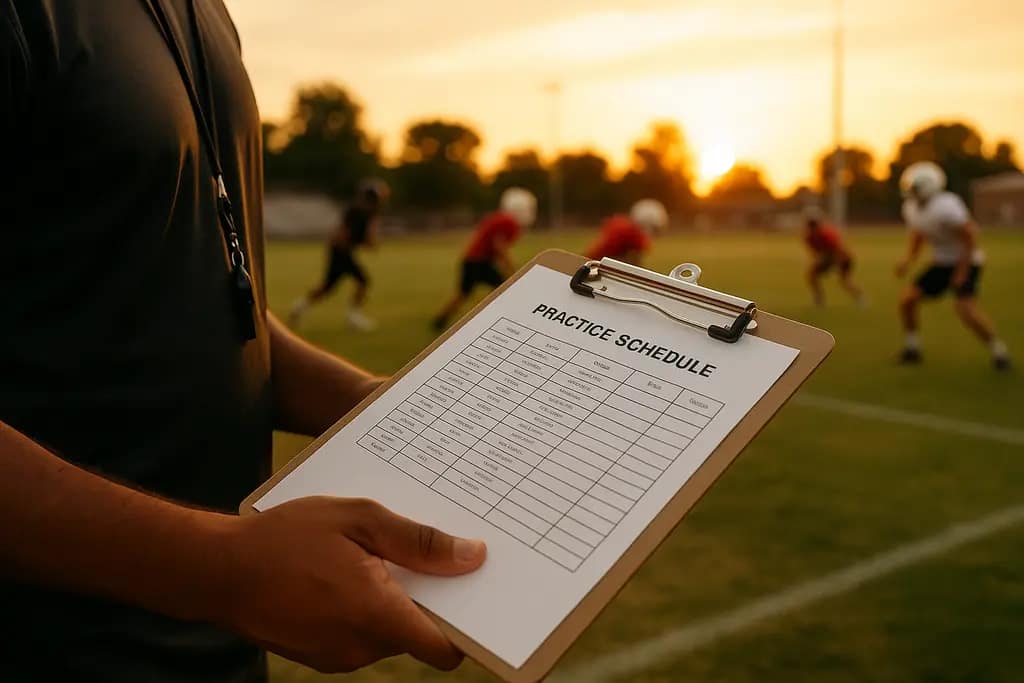
Chiefs Training Camp gives Kansas City a defined runway into the 2026 NFL preseason: three public-facing weeks in St. Joseph, a 90-man camp roster, and three exhibition games packed into a 14-day stretch. For team evaluators, the structure matters because the first preseason game arrives before camp closes. For supporters and community sports organizers, the same schedule offers a useful case study in access planning, facility demand, parking control, weather policy, and fan engagement.
Chiefs Training Camp Schedule Signals
The camp plan is clear enough to evaluate from an operations and roster-preparation standpoint. Kansas City is holding its 16th camp at Missouri Western State University in St. Joseph, Missouri, from July 29 through August 20, 2026, with practices set for 9:15 a.m. on most listed days and 8:15 a.m. on August 20, according to the official camp announcement. That schedule creates a steady morning routine, which is useful for player recovery, staff installation periods, and fan planning.
Chiefs Training Camp Timing And Fan Access
The Chiefs Training Camp calendar also shows a deliberate public-access model. Practices are free and open to the public, but tickets must be reserved in advance. Season Ticket Members had early reservation access beginning June 16, while the general public could reserve beginning June 17. That ticket requirement is not just an administrative detail. It gives the club and Missouri Western a way to estimate daily attendance, manage entry flow, and plan staffing before crowds arrive.
Missouri Western charges a $7 admission fee on August 1, August 7, and August 8, with August 8 designated as Family Fun Day. Position-group autograph sessions are also scheduled on certain dates, including linebackers on July 30 and defensive backs on July 31. Those dates matter for crowd behavior. Families often target lower-cost, higher-interaction sessions, while autograph days can shift arrival patterns earlier than a normal practice.
Preseason Windows Against Three NFC Opponents
The preseason sequence gives coaches three different evaluation windows. Kansas City’s listed schedule includes a home game against the Los Angeles Rams on August 15 at 3:00 p.m. CDT, a road game at the Tampa Bay Buccaneers on August 22 at 6:30 p.m. CDT, and a home game against the Seattle Seahawks on August 28 at 7:00 p.m. CDT. The supplied schedule data lists the Rams opener as a 20-12 Kansas City loss.
| Date | Opponent | Site | Listed Time |
|---|---|---|---|
| August 15 | Los Angeles Rams | Kansas City | 3:00 p.m. CDT |
| August 22 | Tampa Bay Buccaneers | Tampa Bay | 6:30 p.m. CDT |
| August 28 | Seattle Seahawks | Kansas City | 7:00 p.m. CDT |
The timing is relevant. The Rams game takes place while camp is still active. The Buccaneers trip follows two days after the final scheduled camp practice. The Seahawks game then serves as the last listed preseason checkpoint. That means player evaluation is not confined to game tape; coaches can compare practice consistency, travel response, and late-camp availability across a short span.
Roster Preparation And Preseason Game Rhythm
Roster preparation in preseason is a math problem before it becomes a depth-chart debate. The Chiefs enter camp with a 90-man roster, including an exemption for offensive tackle Chukwuebuka Godrick through the International Player Pathway program, as noted by the Sports Illustrated roster review. That structure expands the number of players available for camp work, but it does not remove the pressure to allocate meaningful snaps and practice reps.
The 90-Man Camp Constraint
A 90-man camp creates competition, but it can also create evaluation noise. Coaches need enough repeated evidence to separate a one-day flash from a pattern. The preseason schedule helps because it offers three game settings: one home opener, one road environment, and one home closer. Each setting can test a different part of roster readiness. A player who handles practice periods well still needs to show communication, alignment, and assignment discipline under game timing.
The Godrick exemption is also worth reading carefully. The International Player Pathway detail explains roster mechanics, not a forecast of a final spot. A cautious roster analysis should avoid treating exemptions as automatic protection or as proof of a final decision. The supported fact is that he is part of the camp roster structure through that program exemption.
Evaluation Value Beyond Starters
Preseason work often matters most for players outside the established core. The Rams, Buccaneers, and Seahawks games create chances to review special teams readiness, second-unit communication, and position flexibility. Since the opener occurred before camp ended, Kansas City could use remaining camp practices to correct issues from that first game before traveling to Tampa Bay. That feedback loop is one of the practical advantages of placing an exhibition game inside the camp period.
For a staff, the most useful preseason evidence is often repeatable behavior. Did a player align correctly after a motion? Did the same protection mistake show up twice? Did a defensive back communicate the call before the snap? The research supplied here does not provide player-by-player snap counts or position battles, so any claim about individual winners and losers would be unsupported. The safer analysis is that the schedule gives the club three formal game tests around a controlled practice block.
Fan Access, Site Operations, And Community Use

The public-facing details are not separate from football preparation. They shape the environment around practice. Parking is available for $8 per vehicle per day, with pre-purchase required during ticket reservation. Practices may be moved indoors because of inclement weather, and indoor practices are closed to the general public. Those two rules have direct planning value: one controls arrival volume, and the other sets a clear limit when safety or field conditions require a change.
Ticketing, Parking, And Weather Rules
Advance ticketing and parking pre-purchase reduce uncertainty for site managers. They also shift some responsibility to attendees, who need to plan before leaving home. That is a reasonable model for a regional camp site where demand can vary by day, autograph group, fee date, and family programming. The weather rule is equally practical. Public attendance is valuable, but it cannot override safety or indoor-space limits.
For families, the key planning point is simple: reserve tickets early, buy parking during the reservation process, and treat weather updates as part of the trip plan. For community sports administrators, the lesson is broader. Public practices require more than a field and a gate. They require a calendar, capacity estimates, cost signals, staff assignments, and a cancellation policy that can be communicated quickly.
What Local Organizers Can Learn
Community clubs rarely operate at NFL scale, but the planning logic transfers. A youth tournament, school showcase, or multisport clinic can use the same basic controls: free or low-cost access, advance registration, a published start time, pre-set parking rules, and a clear weather policy. Sites focused on participation tools, including Back2Tap, can aid local organizers in understanding the dependency of sport access on both programming and logistics.
- Set the public schedule early: fixed practice or event times help families plan transportation and meals.
- Use reservations even for free events: attendance estimates support staffing, safety, and facility planning.
- Name fee dates clearly: selective admission charges should be visible before families arrive.
- Publish weather rules: participants and spectators need to know when access may change.
- Plan interaction windows: autograph-style sessions or meet-the-team periods should be assigned to specific groups and dates.
Chiefs Training Camp Takeaways For Preseason Planning
The practical value of Chiefs Training Camp is that it connects football evaluation with public operations. The team gets repeated morning practices, three preseason game tests, and a camp roster large enough to sort depth across many positions. Supporters get public access, defined reservation dates, clear fee days, autograph-session information, and parking rules. The model is structured, but it also carries uncertainty because weather can close indoor practices to the public.
Practical Preseason Planning Checks
For roster analysis, the key is to avoid reading too much into one preseason result. The listed 20-12 Rams result is one data point, not a full evaluation. The Buccaneers and Seahawks games remain part of the preparation sequence, and the short gap between camp close and the Tampa Bay trip should place a premium on efficient corrections. Coaches can use that period to test whether practice fixes carry into a road setting.
For fan and community planning, the sharper lesson is that access works best when rules are specific. Free admission still needs tickets. Parking still needs a purchase process. Family programming still needs a date. Weather policy still needs a public boundary. That is why this camp schedule is useful beyond the Chiefs. It shows how a high-profile football operation can balance preparation, supporter access, and site management without treating any of those needs as an afterthought.