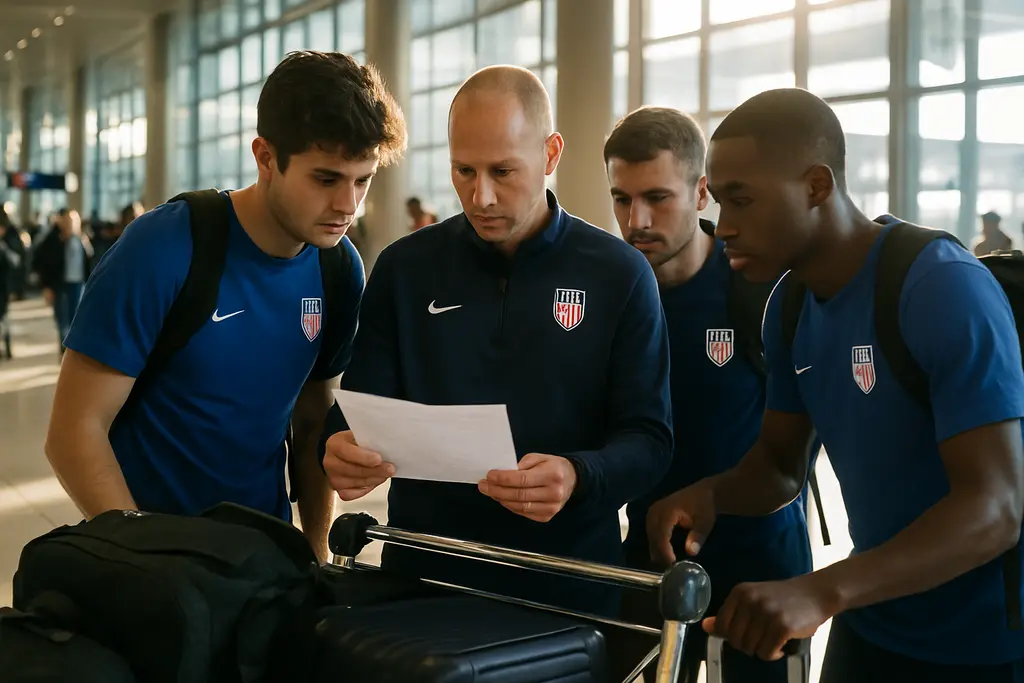
USMNT travel logistics shifted from planning to execution during the late September and early October 2026 friendly window. As of October 3, 2026, the United States had already played Peru on September 26 at Inter.co Stadium in Orlando and Chile on September 29 at Energizer Park in St. Louis. The remaining listed fixtures were Mexico on October 3 at State Farm Stadium in Glendale and Canada on October 6 at Allianz Field in St. Paul, according to U.S. Soccer’s fall camp schedule.
For community groups, families, supporters’ sections, and local sports organizers, this fall window offered a useful test case. Four matches in four cities created different crowd profiles, venue footprints, kickoff windows, and access questions. The safest planning approach was not to assume that one match guide applied to another venue. U.S. Soccer’s event model relies on venue-specific information, especially for bag rules, arrival timing, parking, supporter areas, and weather updates.
Fall 2026 Match Timing And City Sequence
What Already Happened In Orlando And St. Louis
The Orlando and St. Louis matches are now useful reference points rather than future travel targets. USA vs. Peru was played on September 26, 2026, at Inter.co Stadium in Orlando, with a listed 4:30 p.m. ET start. The Orlando match guide example said gates opened at 3:00 p.m. ET, which matched the common 90-minute pre-kickoff gate pattern noted in U.S. Soccer event guidance. That matters because a 4:30 p.m. ET kickoff compresses arrival into late afternoon traffic, security screening, and pre-match warm-up windows.
USA vs. Chile was played on September 29, 2026, at Energizer Park in St. Louis. The practical lesson from the first two stops was simple: smaller soccer-specific venues can still produce tight entry windows if many fans arrive close to kickoff. For youth clubs and school groups, the safer model is to set a group arrival target well before warm-ups rather than aiming for the listed kickoff time.
Same-Day And Remaining Fixtures
USA vs. Mexico was scheduled for October 3, 2026, at State Farm Stadium in Glendale, with kickoff listed at 7:00 p.m. Mountain Time and 10:00 p.m. ET. USA vs. Canada was scheduled for October 6, 2026, at Allianz Field in St. Paul. Those two dates required different planning assumptions: Glendale used a much larger NFL venue footprint, while St. Paul returned the series to a soccer-specific setting.
| Match | Date | Venue And City | Status On October 3, 2026 |
|---|---|---|---|
| USA vs. Peru | September 26, 2026 | Inter.co Stadium, Orlando | Played |
| USA vs. Chile | September 29, 2026 | Energizer Park, St. Louis | Played |
| USA vs. Mexico | October 3, 2026 | State Farm Stadium, Glendale | Scheduled |
| USA vs. Canada | October 6, 2026 | Allianz Field, St. Paul | Scheduled |
USMNT Travel Logistics At The Venue Level
Capacity, Screening, And Crowd Flow
Venue scale shaped the fan experience across the window. The research notes list Inter.co Stadium at about 25,500 seats, Energizer Park at about 22,000, and State Farm Stadium as an NFL venue normally seating more than 63,000, with expansion capacity of about 73,000 for larger events. Those differences are not just numbers on a seating chart. They influence the likely length of parking queues, walking distance from lots, restroom pressure, concessions timing, rideshare congestion, and post-match dispersal.
USMNT travel logistics should start with the venue type. A soccer-specific venue may have a tighter footprint and a more predictable supporter culture. A larger football stadium may absorb more people but require longer walks, wider security perimeters, and more time to exit surrounding roads. For the Orlando match, fans were strongly discouraged from bringing bags, a policy direction that reduced screening friction but required better pre-arrival planning for families, youth teams, and anyone carrying medical or accessibility items.
USMNT Travel Logistics And Mobile Controls
Ticketing was one of the clearest operational risks in the fall 2026 window. U.S. Soccer ticketing guidance in the research notes states that tickets for its matches are mobile-only. Paper tickets, PDF tickets, and print-at-home tickets are unavailable. Fans were encouraged to download mobile barcodes after purchase and add tickets to a digital wallet.
That policy is manageable for many individual fans, but it can create failure points for groups. A team parent, coach, or club administrator holding several tickets needs to assign responsibility before arrival, not in the security line. The research also notes that once a transferred ticket is accepted, tickets in the prior owner’s account become invalid. Re-entry using the same ticket is not permitted, so a group that exits to retrieve an item from a vehicle should expect that decision to end stadium access for that ticket.
Accessibility, Supporters, And Premium Seating
ADA Seating Needs An Official Path
Accessible seating planning should not be left to resale searches or informal seat swaps. The research notes say ADA seating must be purchased through the official U.S. Soccer ticketing path via the event page or by contacting U.S. Soccer’s ticketing address. That process matters because accessible seating involves sightlines, companion seating, routes from entrances, elevator access where relevant, and proximity to services.
For community sports organizations, the lesson is broader than one national-team match. Accessibility planning works best when it is treated as part of the first ticketing conversation. Waiting until the week of a match narrows options and can force families into avoidable compromises. Children aged two or younger did not need a ticket if seated on an adult’s lap without using a seat; all others needed tickets. That rule should be checked before group ticket counts are finalized.
Supporters’ Sections And Suites
Organized supporters’ sections were identified through the Match Hub for each event, according to the research notes. If a supporters’ section was not listed there, it was likely not yet available. That detail matters because supporters’ areas can have different expectations around standing, chanting, flags, drums, or coordinated entry, depending on venue rules.
Suites could be booked by contacting the ticket office or U.S. Soccer’s ticketing address. For companies, civic groups, or sports nonprofits, suites may solve comfort and hosting needs, but they do not remove the need to check mobile ticketing, gate timing, parking, and venue-specific entry rules. Premium access still depends on the same event infrastructure as the rest of the building.
Training Sites And Local Sports Infrastructure

Arizona Training And Match Preparation
Before the October 3 match against Mexico, the USMNT was scheduled to train on October 1 and October 2 at Phoenix Rising FC Stadium in Arizona. The research notes state that facility opened in 2023. From a development perspective, that detail matters because national-team weeks do not happen only inside the match venue. Training sites, hotel zones, road access, recovery space, and media operations all shape the team and fan environment around the fixture.
For readers tracking facility planning, the fall window also connected to a wider U.S. Soccer infrastructure story. The Arthur M. Blank U.S. Soccer National Training Center in Fayetteville, Georgia opened in May 2026, covering 123 acres of a 200-acre site, with 17 outdoor fields plus high-performance gym and dining space. A related local review of USMNT venue analysis looks at how fall facilities connect to player development and access.
Community Planning Lessons Beyond The National Team
Local clubs can use the fall 2026 window as a checklist for their own events. If a national federation needs clear arrival windows, digital ticket controls, access plans, and facility coordination, smaller organizations need scaled versions of the same systems. A youth tournament may not need a national Match Hub, but it does need one source of truth for parking, weather, bag rules, field maps, and emergency contacts.
For those seeking related insights in sports planning, Back2Tap serves as a valuable comparison for organizing fan-facing information across events, demonstrating the importance of delivering relevant details early enough for families, coaches, and volunteers to implement effectively.
Practical Planning Window For Match Guides
Seven To Ten Days Is The Working Checkpoint
The research notes say Match Guides provide weather forecasts, arrival times, warm-up timing, team arrival information, Fan HQ hours, parking details, and venue rules. They are generally available close to match week, with specific guidance often checked about 7 to 10 days before an event and emailed to ticket holders during the week of the match. That timing should shape how fans plan. Book broad travel needs early, but hold final decisions on bags, arrival route, and fan-zone timing until the venue guide is published.
U.S. Soccer’s general event guidance in the research notes says gates typically open 90 minutes before kickoff, while parking lots open about four hours before gate times. That means the practical arrival window begins much earlier than many fans assume. For a group, the first useful question is not “What time is kickoff?” It is “What time do we need everyone parked, through screening, and in seats?”
Group Checklist For Safer Matchday Execution
USMNT travel logistics are most effective when one person is assigned to each risk area. A single organizer cannot handle tickets, parking, accessibility needs, food timing, child supervision, and weather decisions alone. The checklist below is written for clubs, families, and supporter groups rather than solo travelers.
- Confirm the exact match date, kickoff time, venue, and city before making final travel choices.
- Download mobile tickets and add them to a digital wallet before leaving for the venue.
- Check the venue Match Guide for bag rules, prohibited items, parking, Fan HQ hours, and weather.
- Assign a meeting point outside the stadium because re-entry with the same ticket is not permitted.
- Handle ADA seating and companion-seat questions through the official ticketing path as early as possible.
- Set a group arrival target that allows for parking, screening, restroom stops, and pre-match warm-ups.
USMNT Travel Logistics For St. Paul On October 6
The October 6, 2026 match against Canada at Allianz Field is the remaining fixture after the October 3 date. The St. Paul stop should be planned with the same discipline used earlier in the window, but not by copying Orlando, St. Louis, or Glendale assumptions. Each venue publishes its own practical rules, and the Match Guide is the best place to confirm final access details.
For fans and community sports organizers, the cleanest approach is to separate fixed facts from late-breaking details. The fixed facts are the opponent, date, venue, and city. The later details include weather, parking instructions, Fan HQ hours, entry points, and any venue-specific rule changes. That distinction reduces confusion and keeps planning grounded in official information rather than screenshots or secondhand posts.
The wider value of this fall window is that it shows how national-team matchdays can support better local sports habits. Clear ticket ownership, early accessibility planning, realistic arrival windows, and venue-specific communication are not only national-event practices. They are practical standards that local clubs can adapt for tournaments, camps, and community matchdays.