
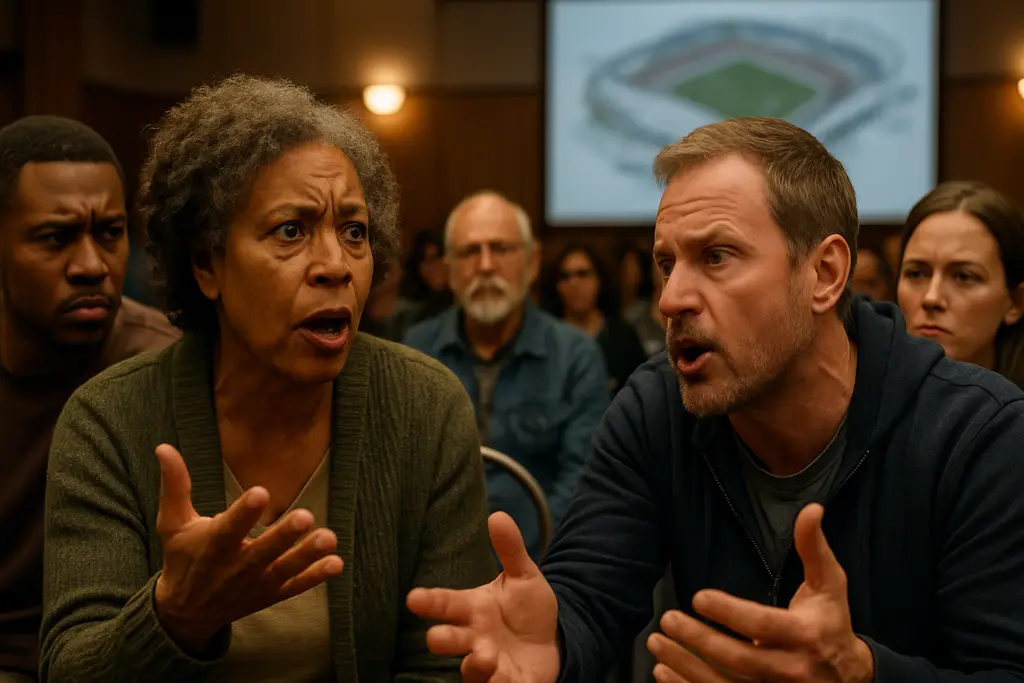
The White Sox Stadium Proposal has become less a ballpark design story than a leadership test for Chicago sports infrastructure. As of October 2, 2026, the public record points to a core question: can a franchise-linked development plan be evaluated without shifting major operational burdens onto nearby residents who did not ask to host them?
On September 5, 2026, Canal Edge LLC, a firm connected to White Sox minority owner Justin Ishbia, released renderings for The Railyards, a mixed-use development anchored by a proposed new White Sox ballpark on Amtrak trainyard land south of Roosevelt Road along the Chicago River. The same reporting said Bridgeport residents and officials argued the plan would move the team from its 116-year home in Bridgeport and place a 24/7 Amtrak maintenance facility in a residential area; Alderman Nicole Lee called that impact “devastating” for the community, according to Axios Chicago.
That sequence matters. Stadium proposals often arrive with polished images of skyline views, pedestrian promenades, restaurants, and event-day energy. Residents tend to ask different questions: who absorbs noise, truck movement, vibration, air-quality risk, traffic pressure, and property uncertainty after the renderings leave the news cycle? A sports venue can support local activity, but only if the decision process treats nearby neighborhoods as participants rather than obstacles.
What The White Sox Stadium Proposal Changed
White Sox Stadium Proposal And The Rail Yard Tradeoff
The most sensitive issue is not only whether a new ballpark along the river would appeal to fans. It is the paired infrastructure tradeoff. The development vision depends on repurposing Amtrak land near the South Loop, while the related maintenance function would move closer to homes in Bridgeport and nearby communities. That is why the White Sox Stadium Proposal has drawn a reaction that is broader than normal resistance to a sports project.
Good stadium leadership separates three questions that are often blended together. First, does the team need a new or renovated facility? Second, does the proposed site improve access, operations, and fan experience? Third, who pays the non-baseball costs created by the location change? If leaders answer only the first two, the public debate will not feel credible to residents facing the third.
The research record available as of October 2, 2026, does not establish a final relocation decision, a final construction schedule, or a completed agreement between all public and private parties. That uncertainty should make the public process more careful, not less. A proposal at this stage still has room for alternatives, mitigation, and independent review. It also has room for trust to erode if engagement is treated as a step after the major choices have already been shaped.
Why Ballpark Renderings Are Not A Community Plan
Renderings are useful for showing what a project sponsor wants people to imagine. They do not, by themselves, answer whether emergency access works, how late-night rail operations affect sleep, how outdoor recreation spaces are protected, or whether schools and senior housing face new burdens. For community sports advocates, the lesson is simple: a facility plan is incomplete until it includes the surrounding civic systems.
This is where leadership can turn a conflict into a workable evaluation. The project sponsors, the team, transit parties, city officials, and state-level entities should publish a shared issue log. Each concern should have a named reviewing agency or party, a timeline, a standard for evidence, and a response. Without that structure, residents hear promises; with it, they can test whether promises are being met.
Community Risk In The White Sox Stadium Proposal
The 500-Foot Test For Public Burden
The most concrete public-risk figure reported so far is stark. More than 6,000 residents would live within 500 feet of the proposed rail yard site between West 33rd and 35th Streets, compared with 29 people near the present Amtrak site under the same buffer. The same report identified concerns about noise, air quality, children, seniors, property values, playgrounds, outdoor pools, schools, and neighborhood character across Bridgeport, Armour Square, Chinatown, and Wentworth Gardens, according to the Chicago Sun-Times.
That comparison should sit at the center of any responsible review. A 500-foot buffer is not a full environmental analysis, but it is a practical screen for proximity. It tells leaders where to ask harder questions. If thousands of people are newly placed near a round-the-clock rail operation, then noise modeling, air monitoring, vibration analysis, and health-risk review cannot be treated as side documents. They become the main evidence file.
For sports development, this is a familiar pattern. A venue may be marketed as regional growth, while the burdens are local and specific. The gap between regional benefit and local impact is where opposition forms. Similar public-accountability questions appear in other stadium debates, including the discussion of stadium community stakes around Washington’s RFK site. The cities differ, but the governance issue is similar: who tracks commitments after the announcement?
What Residents Need Before Any Vote
Residents need information in plain terms before a vote, approval, or land-use milestone. A credible process would provide maps that show affected blocks, not only project boundaries. It would compare the existing Amtrak site and proposed Bridgeport site using the same assumptions. It would identify schools, parks, pools, senior housing, and playgrounds within meaningful distance bands. It would disclose what is known, what is not known, and who is responsible for filling each gap.
Community groups should not have to reverse-engineer the project from press reports. A basic public dashboard would help. It should include meeting dates, submitted studies, public comments, agency responses, and changes made because of resident input. A site such as Ambikapur City, also in this publishing network, illustrates how local civic coverage benefits from place-specific detail; sports infrastructure debates require similar rigor to ensure that block-level effects are considered amidst broader city narratives.
Leadership Tools For A Fair Venue Decision

A Practical Decision Matrix
Leaders need a decision matrix that weighs fan access, public cost, team operations, neighborhood exposure, environmental risk, and reuse value. Each category should have evidence attached. If a riverfront ballpark scores well on fan experience but poorly on residential exposure from the rail-yard move, that tradeoff should be visible rather than buried.
A useful matrix would rate at least four options: building at The Railyards with the rail-yard relocation, renovating the existing Bridgeport ballpark, pursuing a different site, and delaying the decision until independent studies are complete. Each option should be measured against the same criteria. That approach reduces the chance that leaders compare a polished new-venue concept against a vague description of staying put.
Engagement Standards That Can Be Audited
Public meetings are not enough if residents cannot see how their input changes the work. The engagement plan should include translated materials where needed, meeting times that fit working families, written response periods, and published answers to repeated questions. The standard should be auditable: did officials meet residents before key decisions, did they release the same information to all neighborhoods, and did they change anything because of the feedback?
- Evidence before endorsement: no public body should endorse a site until exposure, access, and operating impacts are documented.
- Comparable alternatives: renovation and relocation options should be measured with the same public-cost and community-impact categories.
- Clear accountability: every mitigation promise should name the responsible party, funding source, deadline, and enforcement method.
- Neighborhood protection: schools, parks, pools, senior housing, and homes near the proposed rail yard should receive specific review, not general assurances.
This is not anti-stadium. It is pro-governance. Fans can want a better baseball experience while residents demand a safer planning process. Those positions are not mutually exclusive. The leadership failure would be forcing the public to choose between civic pride and neighborhood protection without transparent evidence.
Chicago White Sox Stadium Proposal Leadership Test
The backlash shows that sports infrastructure is never just about a franchise address. It is about how leaders define the public interest. If the project moves forward, residents will judge it not by the first rendering but by whether their homes, schools, parks, and daily routines were treated as core planning concerns.
The cautious path is clear. Publish the assumptions. Compare alternatives. Show the impacts block by block. Let residents test the evidence before major commitments harden. A better ballpark conversation is possible, but only if the process respects both the fans who follow the team and the communities asked to live with the supporting infrastructure long after opening day.