
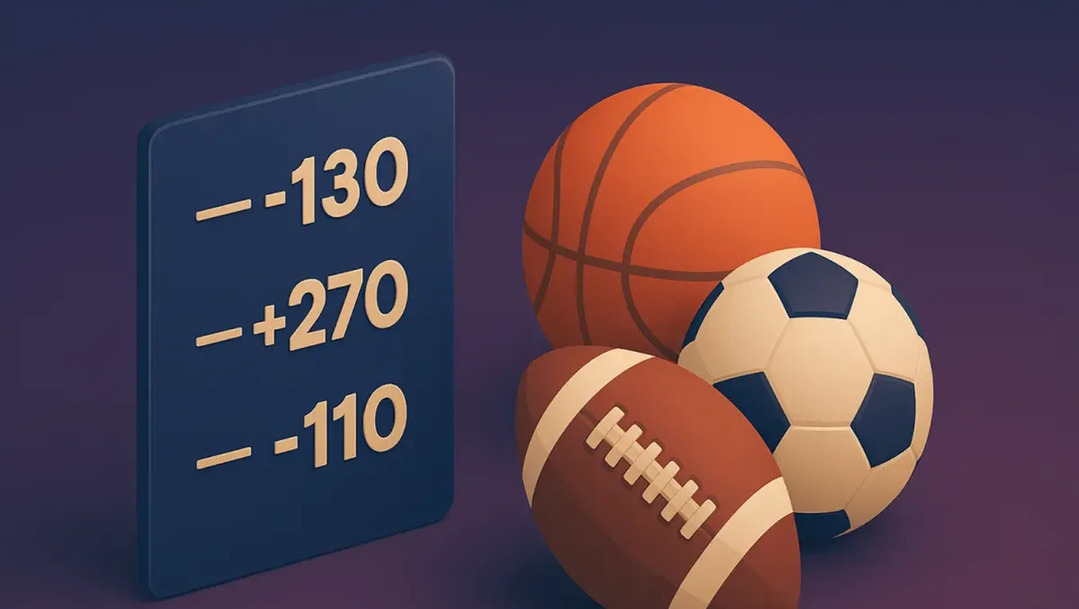
Sports fans encounter betting numbers almost everywhere: point spreads during pregame shows, moneylines on mobile screens, totals in matchup discussions and player props circulating on social media. Understanding those numbers does not require becoming a bettor. Sports betting odds literacy is increasingly a form of sports literacy because it helps fans distinguish a market price from a prediction about what will actually happen.
For readers who want to inspect market differences, BetOnline odds compared to regulated sportsbooks points to OddsTrader’s live comparison board. One caveat matters: the board displays prices from multiple sportsbooks, including BetOnline, but the page itself should be treated as a price-comparison tool rather than proof that every listed operator has the same regulatory status. Comparing odds and verifying sportsbook regulation are two separate consumer tasks.
That separation is important because a better number can improve the mathematical terms of a wager without answering questions about licensing, account protections, withdrawal procedures or responsible-gambling tools. The smartest way to read an odds board is therefore to ask two questions: What does this price mean? And separately, who is offering it?
What American Betting Odds Actually Tell You
American odds communicate both potential payout and an implied break-even probability.
Negative odds tell you approximately how much must be risked to win $100. A line of -110 means risking $110 for a potential $100 profit. At -105, the required risk falls to $105.
Positive odds work in the other direction. A +150 price means a $100 winning wager produces $150 in profit.
Those differences may look small when viewing one bet, but repeated price differences can matter substantially over many wagers.
| Odds | Typical Risk/Return | Approx. Implied Probability |
|---|---|---|
| -120 | Risk $120 to win $100 | 54.55% |
| -110 | Risk $110 to win $100 | 52.38% |
| -105 | Risk $105 to win $100 | 51.22% |
| +100 | Risk $100 to win $100 | 50.00% |
| +150 | Risk $100 to win $150 | 40.00% |
The probability column is not a guarantee that an outcome will happen that often. It simply translates the listed price into its mathematical break-even percentage before considering the broader pricing structure of the market.
That distinction is essential. Odds are prices, not promises.
Why Two Sportsbooks Can Show Different Prices
Sportsbooks do not have to post identical numbers.
One operator might offer a football favorite at -3 while another shows -3.5. The same underdog might be +125 at one sportsbook and +132 somewhere else. Even when the spread is identical, the price attached to it can differ.
Several factors can contribute to those differences, including market movement, injuries, lineup news, customer activity and an individual sportsbook’s exposure. OddsTrader also notes that sportsbooks may react to betting action at different speeds, which helps explain why comparison boards can show several prices for the same event at once.
For the consumer, the lesson is straightforward: compare identical markets.
A full-game spread should be compared with another full-game spread. A first-half total should not be treated as equivalent to a full-game total. Player props should be checked for matching statistical thresholds and settlement rules.
Otherwise, what looks like a better price may actually be a different product.
Sports Betting Odds Literacy Means Understanding Implied Probability
Converting American odds into implied probability gives fans a clearer way to interpret market prices.
For negative odds, the calculation is:
Absolute odds ÷ (absolute odds + 100)
At -110:
110 ÷ 210 = 52.38%
For positive odds:
100 ÷ (odds + 100)
At +150:
100 ÷ 250 = 40%
This gives a bettor a useful break-even reference.
Suppose someone believes an outcome has a 45% chance of occurring while the available price is +150, which represents an implied probability of 40%. That difference may warrant further examination.
But there is an important limit to that reasoning: the 45% estimate must come from somewhere credible.
Simply believing a team is “due” to win or assuming a favorite is stronger does not establish an accurate probability. The calculation can organize a decision, but it cannot manufacture good forecasting.
A Better Line Is Not the Same as a Safer Sportsbook
This is one of the most important distinctions an odds-comparison tool cannot make for the reader.
Suppose Sportsbook A offers +120 and Sportsbook B offers +125 on exactly the same outcome. The +125 price is mathematically more favorable.
That does not automatically mean Sportsbook B provides stronger consumer protections.
Regulation concerns different questions: who oversees the operator, what account rules apply, what responsible-gambling controls exist and what options are available if a customer has a dispute.
Those factors should be researched separately from the betting line.
The National Council on Problem Gambling’s responsible sports betting resources emphasize harm-reduction measures and responsible-gambling programs alongside the expansion of sports wagering. NCPG also supports tools such as time and spending limits and self-exclusion as part of stronger responsible-gambling systems.
For consumers, that produces a useful rule:
Shop the price, but verify the operator separately.
Line Movement Does Not Explain Itself
A betting line moving from -2.5 to -3.5 tells you that the market changed. It does not necessarily tell you why.
An injury announcement could have moved it. Weather could matter. A lineup change may have altered expectations. Large market activity might have influenced the number.
Sometimes several factors occur together.
Fans should therefore resist turning every movement into a story about “smart money” or assuming that a changing line predicts the final result.
The better process has three steps:
- Identify exactly what changed.
- Check whether relevant new information appeared.
- Separate confirmed information from speculation about why the market reacted.
That method fits Aplevante’s broader sports-first approach. Its coverage of college football upsets and playoff pressure stresses using completed results and verified context rather than allowing odds or speculation to replace what happened on the field.
Why Half a Point Can Matter
Line shopping becomes easier to understand with a simple football example.
Imagine one sportsbook offers a favorite at -3 while another offers -3.5 at approximately similar pricing.
If the favorite wins by exactly three points, the -3 wager generally pushes while the -3.5 wager loses.
The difference is only half a point on the screen, but the settlement outcome can be completely different.
Moneyline prices create a similar effect. If the same underdog is available at +120 and +130, both wagers depend on the identical team winning. The +130 price simply produces a higher return if that happens.
That is the practical purpose of comparison: do not voluntarily accept a worse number when an otherwise equivalent market is available on better terms from an operator the bettor has independently decided is appropriate to use.
It is not a prediction system. It is price discipline.
The Vig Is Part of the Price
Sportsbook odds also include a built-in margin often called the vig or juice.
Consider a market where both sides are priced at -110.
Each -110 side corresponds to an implied probability of about 52.38%. Add the two together and the result is about 104.76%, not 100%.
That excess illustrates the sportsbook’s pricing margin.
It also explains why correctly picking slightly more than half of -110 wagers may still be necessary merely to break even over time. At standard -110 pricing, the break-even rate is roughly 52.38%.
This is another reason that simply asking “Who will win?” is incomplete.
A more useful betting question is: Is the probability of this outcome greater than the probability implied by the price I am being asked to pay?
Knowing the Odds Also Means Knowing When to Pass
Odds literacy should make people more selective, not more eager to place a wager on every game.
A person can understand the mathematics perfectly and still have no reliable edge on a particular market. There may be insufficient information, a price may have moved too far, or the bettor may simply be uncertain.
Passing is a legitimate decision.
Setting a predetermined budget and avoiding attempts to immediately recover losses also matters. NCPG advises people who choose to gamble to establish financial and time limits and treat gambling as entertainment rather than money that must be recovered.
That principle belongs beside the probability formulas because mathematics can explain the cost of a wager but cannot remove its risk.
Read the Market Without Letting It Replace the Sport
Betting odds can provide useful information about how a market prices uncertainty. They can show where sportsbooks disagree, how expectations change after new information and what price a bettor must overcome to break even.
They should not become a substitute for understanding the sport itself.
A fan still needs to consider injuries, tactics, performance, schedule context and what actually happens on the field. A bettor has an additional responsibility: understanding whether the offered price fairly reflects the probability they assign to the outcome.
That is the real value of sports betting odds literacy.
Learn what the number means. Compare equivalent markets. Understand the margin. Verify the operator separately. And recognize that sometimes the most rational response to an odds board is simply to keep watching the game.