
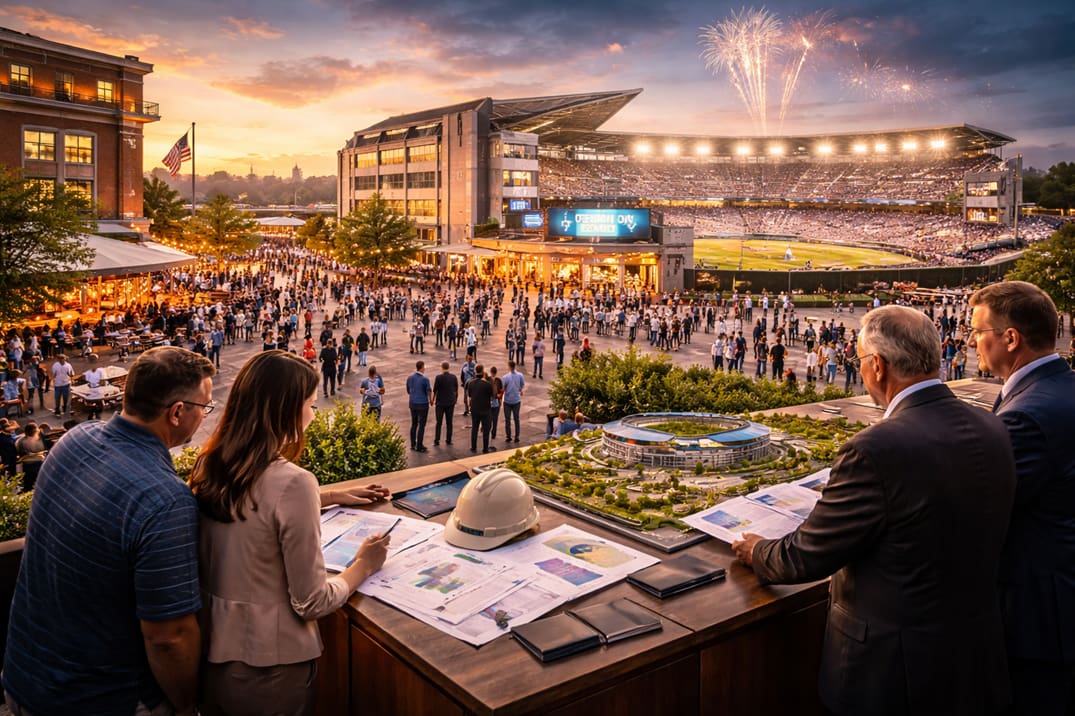
Across the United States, a surge in minor league stadium construction is redefining how cities approach sports infrastructure. From baseball parks in the Pacific Northwest to soccer-specific venues in mid-sized markets, billions of dollars are being committed to facilities that promise economic revitalization, community engagement, and long-term growth. Yet beneath the momentum lies a fundamental question: are these investments delivering lasting value, or simply short-term visibility?
The Scale And Speed Of Stadium Investment
Recent years have seen an acceleration in stadium funding at the minor league level, with projects often exceeding $100 million in total cost. Unlike previous generations of facilities, these developments are rarely standalone. Instead, they are embedded within broader urban plans that include residential units, retail corridors, and public spaces.

This scale reflects a shift in perception. Stadiums are no longer viewed as optional amenities—they are positioned as catalysts for economic activity and urban transformation.
However, the pace of investment has raised concerns about whether planning processes are keeping up with financial commitments.
Public Funding And The Question Of Risk
A defining feature of this investment wave is the reliance on public funding mechanisms. Municipal bonds, tax increment financing, and direct subsidies are frequently used to support construction and infrastructure upgrades.
| Funding Source | Role In Stadium Projects | Associated Risk |
|---|---|---|
| Municipal Bonds | Long-term capital financing | Debt burden on taxpayers |
| Tax Increment Financing | Future tax revenue allocation | Uncertain revenue projections |
| Private Investment | Equity and operational control | Profit-driven decision-making |
| Public Grants | Infrastructure support | Limited accountability mechanisms |
While these tools enable large-scale projects, they also shift a portion of financial risk onto communities. If projected economic benefits fail to materialize, local governments may face long-term fiscal constraints.
Stadiums As Anchors For Mixed-Use Development
The modern stadium is increasingly designed as part of a larger ecosystem. Surrounding developments often include hotels, restaurants, office spaces, and public plazas, transforming stadium districts into year-round destinations.
This model aims to maximize utilization and create continuous economic activity. Instead of relying solely on game-day revenue, cities are leveraging stadiums to stimulate adjacent sectors.
Insights from sports infrastructure investment trends show that integrated developments tend to outperform isolated venues in terms of economic impact and community engagement.
Measuring Long-Term Economic Value
Evaluating the success of stadium investments requires moving beyond short-term metrics such as attendance or initial revenue spikes. Long-term value is determined by sustained economic activity, job creation, and increases in the local tax base.
| Metric | Short-Term Indicator | Long-Term Indicator |
|---|---|---|
| Attendance | Game-day turnout | Consistent yearly engagement |
| Revenue | Ticket and concession sales | Diversified income streams |
| Employment | Construction jobs | Permanent local employment |
| Property Values | Immediate appreciation | Stable long-term growth |
The challenge lies in isolating the stadium’s impact from broader economic trends. Without rigorous evaluation frameworks, it becomes difficult to determine whether these projects deliver genuine value or simply redistribute existing economic activity.
Community Access And Social Impact
Beyond economics, stadium investments are often justified by their potential to enhance community access to sports and recreation. Many new facilities include youth programming, public spaces, and multi-use fields designed to serve local populations.
When effectively integrated, these elements can:
- Expand access to quality sports infrastructure
- Support youth development initiatives
- Strengthen community identity
However, these outcomes are not guaranteed. Without intentional design and programming, facilities may prioritize professional events over community use, limiting their broader impact.
Recent examples from regional sports development hubs highlight the importance of aligning infrastructure with local needs to ensure equitable access.
The Sustainability Dimension
Environmental considerations are becoming increasingly central to stadium design. Energy-efficient systems, water management strategies, and climate-resilient construction methods are now standard components of many projects.
Organizations such as the U.S. Environmental Protection Agency emphasize that sustainable infrastructure reduces long-term operational costs while minimizing environmental impact.
For stadiums, sustainability is not only about environmental responsibility—it is also about financial resilience. Efficient facilities are better positioned to remain viable over extended lifecycles.
The Risk Of Overbuilding And Market Saturation
As more cities pursue stadium projects, the risk of oversupply becomes a critical concern. Not all markets can sustain the operational demands of modern facilities, particularly if regional competition intensifies.

Overbuilding can lead to:
- Underutilized venues
- Increased financial pressure on municipalities
- Reduced return on investment
Strategic planning is essential to mitigate these risks. Demand forecasting, demographic analysis, and alignment with regional development strategies must guide decision-making.
Policy And Accountability In Stadium Development
The complexity of stadium projects requires robust governance frameworks. Transparent decision-making, clear performance metrics, and ongoing oversight are essential to ensure that investments serve public interests.
Key policy considerations include:
- Defining measurable outcomes for economic and social impact
- Establishing accountability mechanisms for public funding
- Ensuring equitable access to facilities
Without these safeguards, projects risk prioritizing short-term gains over long-term community benefit.
Reassessing The Value Proposition Of Stadium Investment
The current wave of minor league stadium investment reflects both opportunity and uncertainty. When designed and implemented effectively, these projects can drive meaningful economic and social outcomes.
However, the benefits are not automatic. They depend on careful alignment between infrastructure, community needs, and long-term planning.
Toward A More Balanced Infrastructure Strategy
As cities continue to invest in sports facilities, a more balanced approach is emerging—one that prioritizes flexibility, sustainability, and accountability. Stadiums must function as integrated components of urban systems, delivering value beyond the confines of the game.
For decision-makers, the question is no longer whether to invest, but how to ensure that these investments translate into durable, inclusive, and measurable outcomes.