
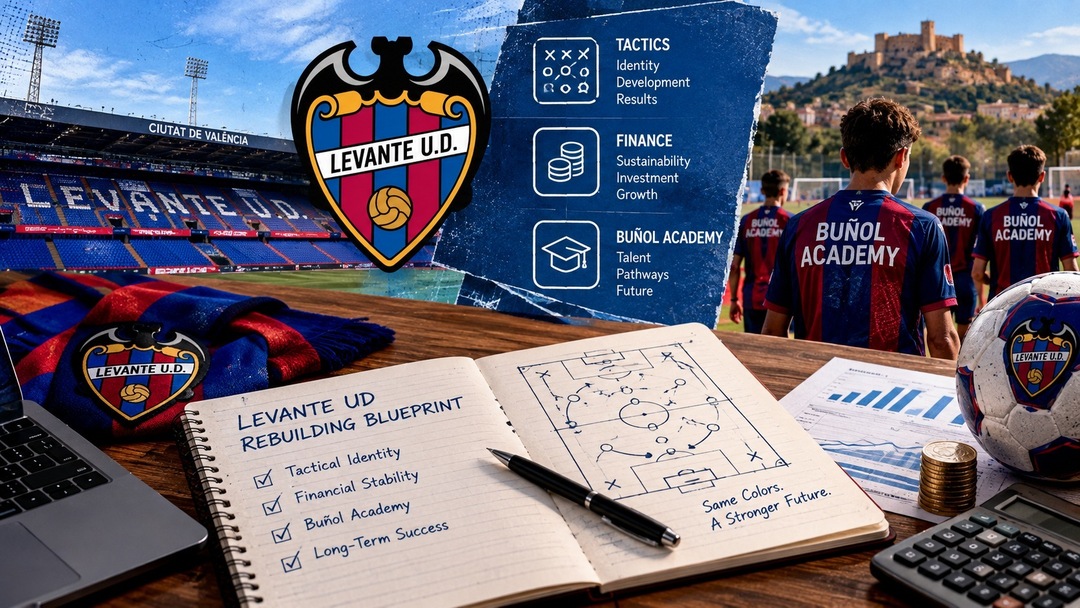
Modern European football consistently forces historic institutions to confront delicate structural choices whenever financial constraints tighten. For Levante Unión Deportiva, founded in 1909 and deeply rooted in the working-class maritime neighborhoods of Valencia, long-term survival has never hinged on reckless spending. Instead, it demands organizational resilience, meticulous squad planning, and tactical cohesion. Supporters closely tracking the club’s ongoing journey via aplevante.org recognize that regaining a secure footing in professional Spanish football requires an uncompromising commitment to internal development, institutional clarity, and fiscal discipline.
Navigating the competitive pressures of the Spanish football pyramid under strict LaLiga economic controls necessitates precise asset allocation. Clubs outside Spain’s traditional financial heavyweights must treat their balance sheets with the same tactical vigilance applied to defensive transitions on matchday. By synchronizing structural cost containment with high-performance coaching, the Granota outfit has embarked on a calculated recalibration designed to protect its competitive ambition while safeguarding institutional viability over the decade ahead.
Navigating Financial Fair Play and Structural Wage Adjustments
The regulatory governance implemented through LaLiga financial fair play rules establishes rigid spending caps tied directly to operating turnover, commercial performance, and amortized player registrations. Following previous relegation cycles, the club faced the inevitable challenge of unwinding high-wage liabilities contracted during longer spells in the Primera División. Transitioning from top-tier television windfalls to the austerity of Segunda División demands dramatic, fast-acting payroll reductions without hollowing out team chemistry or core on-pitch leadership.
Levante’s sporting leadership has systematically restructured its wage ceiling to avoid the debt traps that historically imperiled regional clubs. The recruitment ethos no longer chases aging veterans on long-term, non-incentivized agreements that burden operating accounts for multiple seasons. Instead, the management team prioritizes incentive-heavy structures with targeted performance escalators linked to promotion incentives, clean sheets, match availability, and playing time metrics. This strategy minimizes dormant wage expenditure while motivating squad members to outperform base compensation contracts.
Furthermore, the sporting department has implemented strict exit valuation protocols. Rather than letting underutilized assets devalue on the bench or run down their contracts, the club actively pursues loan-with-option agreements and rights-retention clauses that yield future windfall revenue. These incremental accounting gains provide vital headroom under LaLiga’s dynamic salary cap, permitting targeted winter reinforcements without risking regulatory sanctions or transfer embargos.
| Strategic Domain | Historical Baseline Approach | Restructured Granota Operational Model |
| Wage Management | Fixed long-term contracts with heavy veteran skew | Incentive-weighted contracts tied to collective and individual performance metrics |
| Transfer Recruitment | High-cost amortized fees with limited secondary resale value | Targeted development scouting, lower-division standouts, and free-agent market efficiency |
| Academy Pathway | Periodic first-team call-ups under emergency squad shortages | Structured progression protocol integrating Ciudad Deportiva de Buñol graduates into the senior XI |
| Tactical Model | Reactive counter-attacking reliant on individual wing brilliance | Zonal compactness, coordinated high-intensity pressing, and disciplined structural rest defense |
The Buñol Academy Pipeline as an Economic and Sporting Engine
At the center of Levante’s sustainable vision stands the Ciudad Deportiva de Buñol training complex. Rather than regarding youth academies as public relations centers or ancillary projects, modern football administration requires development facilities to operate as the core supplier of both competitive labor and balance-sheet liquidity. The Buñol facility has undergone steady modernization to provide young prospects with contemporary sports science, nutritional monitoring, and video analysis tools comparable to elite continental hubs.
Investing in homegrown talent provides an obvious double dividend for mid-tier Spanish clubs. First, academy graduates enter the senior dressing room carrying minimal amortization weight against LaLiga’s squad registration limit, freeing up vital budgetary margin. Second, players developed through the club’s academy share an instinctual bond with the club’s playing philosophy and working-class fanbase at the Estadi Ciutat de València. Recent campaigns have demonstrated that trusting youth products in competitive league fixtures yields fearless tactical execution alongside substantial market appreciation.
- Early Structural Integration: Establishing shared tactical concepts between Atlético Levante and the first team ensures seamless promotion during injury crises.
- Physical Condition Benchmarks: Implementing unified data monitoring protocols across all academy age tiers to prepare youngsters for senior transition intensities.
- Contractual Protection: Securing high-potential prospects with long-term retention triggers and balanced buyout clauses to deter predatory domestic poaching.
- Cultural Mentorship: Pairing senior captains with emerging academy talent to instill dressing-room professionalism and emotional maturity under competitive pressure.
Tactical Identity: Cohesion, Rest Defense, and Transition Speed
In the unforgiving tactical environment of Spanish football, theoretical ambition must translate into functional weekly performance. Successful managerial tenures in Valencia have historically relied upon defensive density, rapid vertical ball progression, and unwavering spatial organization. To read broader independent perspectives on Spanish tactical systems and squad management, analysts often consult detailed coverage from the The Guardian Spanish football desk, which frequently documents how provincial clubs maximize limited resources through collective discipline.
Levante’s tactical setup relies heavily on vertical transitional patterns rather than sterile, passive possession. By baiting opponent progression into predetermined pressing traps near the touchlines, the side forces turnovers where midfield distributors can instantly access athletic forward runners. When attacking transitions stall, disciplined rest defense—positioning holding midfielders to halt opponent counterattacks before they breach the defensive third—prevents the open-game vulnerability that undermined earlier campaigns.
Defensive compactness also mitigates individual athletic disparities against sides with far larger transfer budgets. When out of possession, the team forms a resilient medium-low block, compressing horizontal passing lanes and denying central playmakers room between lines. This coordinated shape forces rivals into low-percentage wide deliveries, which Levante’s physical center-backs and commanding goalkeeping unit are well-equipped to neutralize.

Modernizing the Estadi Ciutat de València Experience
On-pitch viability cannot be detached from commercial infrastructure. The comprehensive architectural revamp of the Estadi Ciutat de València, highlighted by its striking suspended tensile roof canopy, modernized lighting grid, and expanded commercial hospitality spaces, has redefined the club’s matchday revenue capacity. Rather than viewing a historic venue simply as ninety minutes of turnstile entries every fortnight, executive leadership has expanded non-matchday activations to cultivate consistent corporate hospitality, event hosting, and community partnerships.
Matchdays in the Orriols district maintain a distinctive community atmosphere. The supporters’ clubs, organized fan collectives, and multi-generational family attendees generate an intimidating, passionate environment for visiting squads. Retaining this neighborhood connection while elevating hospitality options ensures that matchday income remains robust, regardless of short-term league table fluctuations. The stadium operates not merely as a venue for sports entertainment, but as the emotional anchor of the Granota identity.
A Measured Trajectory Toward Enduring Top-Flight Stability
The journey back to the summit of the Spanish game is never a direct sprint; it is an endurance trial defined by operational patience. Levante Unión Deportiva has moved past the era of chasing short-term fixes through costly, unsustainable acquisitions. By anchoring its institutional future in the Ciudad Deportiva de Buñol academy, maintaining strict alignment with LaLiga economic controls, and demanding organized tactical execution on the pitch, the Granota project is building a foundation engineered to endure. The focus remains locked on creating a resilient sporting organism capable of competing at the highest level of European football without risking the financial sovereignty of its century-old crest.