
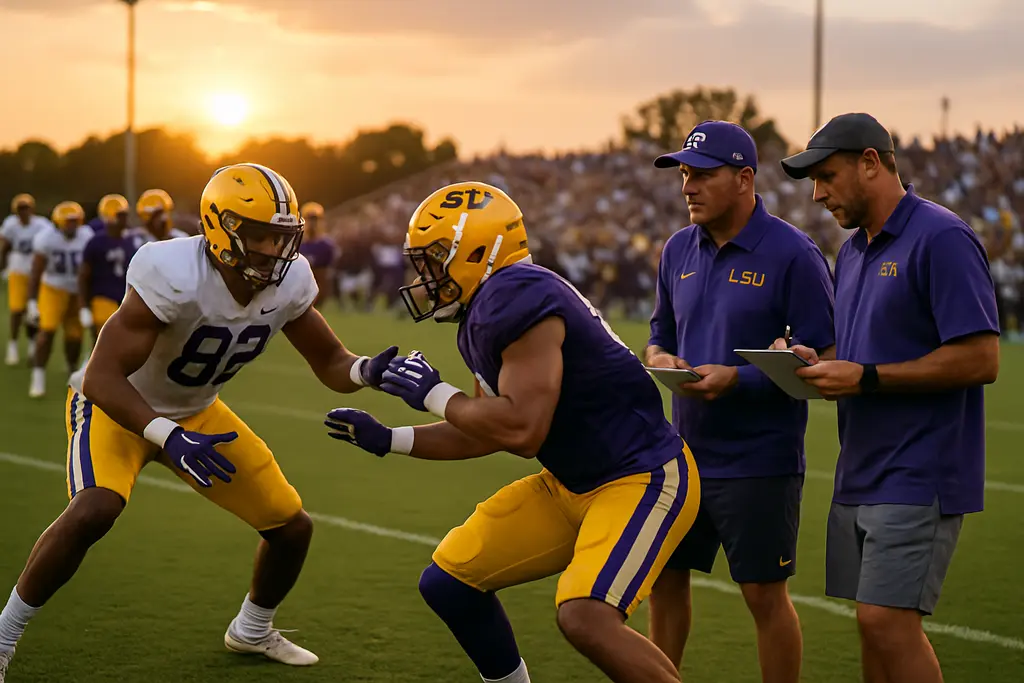
LSU Roster Dynamics under Lane Kiffin became one of the clearest 2026 case studies in how modern college football leadership depends on more than recruiting skill. The roster was rebuilt at speed through the transfer portal, but the more difficult test came from eligibility policy, conference enforcement risk and the need to protect the institution from penalties.
This is not only a story about talent acquisition. It is a leadership problem with direct lessons for athletic departments, community sport boards and youth clubs that manage fast personnel change. When rules shift, leaders must decide how much risk they can accept, who gets final authority and how clearly they can explain the decision to players, staff and supporters.
Transfer Volume And Control Points
Why LSU Roster Dynamics Changed Fast
Kiffin’s first full roster cycle at LSU was aggressive. LSU had 38 players transfer out and 44 players commit through the transfer portal, with the incoming class ranked No. 1 by 247Sports, according to Sporting News. The same reporting said LSU entered the 2026 season with 15 projected transfer starters, including seven on offense.
Those figures show a program using the portal not as a supplement, but as a central roster tool. That can address immediate gaps, especially where a coaching staff believes scheme fit or experience is missing. The tradeoff is that continuity can weaken if returning players, new transfers and high school recruits are not given a clear development pathway.
For LSU Roster Dynamics, the key management issue was not simply the number of players moving in and out. It was whether the staff could define roles quickly enough before the season opener, set a credible depth chart and avoid a locker-room split between established players and short-cycle arrivals.
Position Groups Became A Governance Issue
The offensive line was a major part of the overhaul described in the research, with transfers added to match or replace losses and address depth concerns. That is a reasonable football response when a staff inherits a group it believes lacks proven bodies. Still, position-group rebuilding creates a second-order problem: every transfer addition changes the incentive structure for returning players.
A practical roster governance model would ask four questions before adding another transfer at a crowded position:
- Does the player solve a defined role, or only increase competition without a clear plan?
- What happens to returning-player development snaps after the addition?
- Is the scholarship and roster math sustainable under current limits?
- Could the move create avoidable policy exposure, especially around eligibility?
Those questions are useful outside major college football. Community sport programs also face rapid roster shifts through school changes, age-group movement and late registrations. The scale is different, but the governance principle is similar: participation systems need visible rules before selection pressure rises.
Eligibility Risk And SEC Policy Pressure
Former NFL Signees Created A Test Case
The most sensitive issue involved Dae’Quan Wright and Zxavian Harris, two former NFL-signed players who sought to return to college football at LSU. A Louisiana court issued temporary relief against SEC restrictions, but LSU did not use the players in the September 6, 2026 opener against Clemson because of concern about conference sanctions. The Washington Post reported that Kiffin acknowledged the appeal of adding them while pointing to sanction uncertainty as a reason for leaving them off the roster.
This was a narrow but serious policy conflict. A court order can give a program one form of protection, while conference rules can still create operational risk. Coaches then face a decision that sits between legal advice, competitive pressure and institutional reputation.
Roster Deadlines Limited Coaching Choice
By September 8, 2026, LSU finalized its 105-player roster and did not add Wright or Harris, according to the research provided. Because today is September 17, 2026, that decision should be read retrospectively rather than as an open game-week question. The staff chose to avoid a direct clash with conference enforcement risk, even after the court development created a possible path for the players.
That choice helps explain why LSU Roster Dynamics became a leadership story. Kiffin’s public-facing identity has often been associated with offensive creativity and personnel ambition, but this episode required restraint. The program had to weigh possible on-field upgrades against sanctions that could have affected the head coach, the operations budget or the school’s SEC standing, based on the policy concerns described in the research.
The available research also referenced an SEC meeting scheduled for September 10, 2026, to consider LSU’s membership status if the school continued toward rostering former professional players. The research does not provide a verified outcome from that meeting. Because that date has passed, any current analysis should avoid treating the meeting as pending and should not claim a result without a reliable record.
Practical Lessons For Sports Leaders

A Decision Matrix For Roster Governance
LSU Roster Dynamics offer a useful decision matrix for leaders who must act under uncertain rules. The first column is competitive value: how much does the player or policy choice improve the team? The second is rule exposure: which governing body can object, and what sanctions are possible? The third is timing: can the decision be reversed before a deadline? The fourth is communication: can the organization explain the choice without blaming the athlete?
For LSU, the competitive value of Wright and Harris appeared meaningful enough to pursue. The rule exposure was also high enough that the players were not added by the roster deadline. That does not prove the staff was right or wrong. It shows the real cost of ambiguous policy in college sport: athletes, coaches and institutions can all be caught between overlapping authorities.
What Community Programs Can Adapt
Community sport leaders should not copy college football’s transfer model. Most local programs exist to widen participation, not replace players at high speed. Still, the LSU case gives practical tools for smaller organizations that handle eligibility, registration and team placement.
First, boards should write eligibility rules before disputes arise. Second, they should separate the coach’s selection role from the administrator’s compliance role. Third, they should document exceptions in plain language. A local club may never face SEC-style penalties, but it can lose trust quickly if families believe rules are improvised for the strongest athletes.
Program operators can also map stakeholders in advance: athletes, families, coaches, school administrators, facility partners and league officials. Related sports information resources, such as wikiapp.org, can serve as a supplementary tool, supporting a club’s own records, but final eligibility decisions should always rest on official league and school rules.
For readers tracking the related governance dispute, this site’s analysis of the LSU eligibility dispute places the roster issue in a wider policy frame. That broader frame matters because the same pattern is appearing across college athletics: roster building is now tied to courts, conference bylaws and administrative deadlines.
Lane Kiffin And LSU Roster Dynamics
What The Case Shows About Leadership
The strongest reading of Kiffin’s 2026 roster approach is that LSU pursued speed, experience and scheme fit through the portal, then pulled back when eligibility risk threatened to overtake football value. That is a mixed but instructive leadership profile. It shows ambition in player acquisition and caution in final roster certification.
LSU Roster Dynamics should therefore be judged through two lenses. On the football side, the transfer volume gave Kiffin a faster path to reshape the offense and address depth concerns. On the governance side, the former-pro dispute showed that modern roster construction can create legal and policy exposure before a team even plays meaningful snaps.
For athletic leaders, the lesson is direct: talent strategy and compliance strategy must be built together. If they are separated, the program may recruit players it cannot safely use, promise opportunities it cannot deliver or force late decisions that damage trust. LSU’s September 2026 choices showed how quickly a roster plan can become an institutional test.