
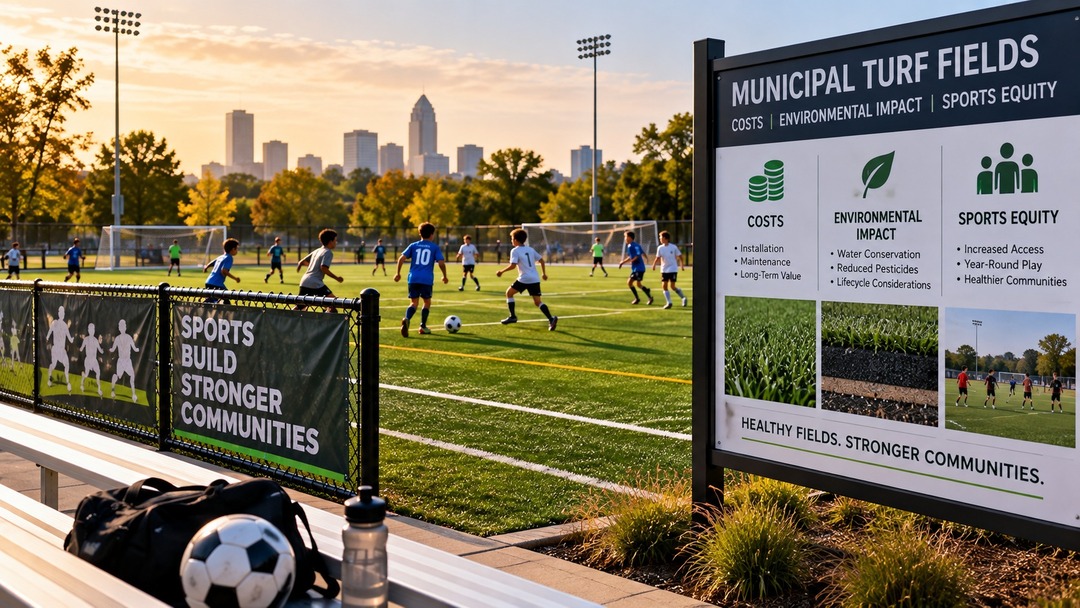
Across urban centers and expanding suburban corridors, municipal parks departments face an unrelenting dilemma: surging demand for youth sports field access set against finite recreational acreage and strained maintenance budgets. Traditional natural grass playing fields, while ecologically familiar and restorative, struggle under continuous seasonal use. A standard municipal turf plot can typically withstand 600 to 800 hours of intense athletic impact annually before root shear, soil compaction, and bare mud patches force prolonged seasonal shutdowns. In response, local school districts, county councils, and municipal park authorities have aggressively turned to synthetic turf installations, championing them as impervious, all-weather athletic infrastructure capable of hosting upwards of 2,500 hours of competition per year.
Yet as hundreds of municipalities approve multi-million-dollar capital bond referendums to replace native grass with polyolefin carpets and elastomeric infill, public discourse has shifted from preliminary excitement to rigorous operational scrutiny. Community advocates, public health researchers, and fiscal watchdogs are raising urgent questions regarding full lifecycle replacement costs, end-of-life recycling barriers, surface microclimates, and sports equity. Evaluating whether synthetic conversion truly serves the public interest demands a comprehensive analytical framework—one that balances immediate scheduling capacity against long-term fiscal liabilities and environmental consequences.
Capital Outlay Versus Ongoing Maintenance Realities
The primary municipal sales pitch for synthetic turf has long rested on the assertion of maintenance-free performance. Proponents frequently argue that eliminating weekly mowing, line painting, chemical fertilizer application, and aeration yields substantial operational savings that offset initial capital expenditure. However, municipal operational data reveals that synthetic surfaces do not eliminate maintenance; they merely exchange traditional groundskeeping routines for specialized industrial care that requires dedicated machinery and contractor expertise.
An average full-size synthetic athletic field requires an initial capital outlay ranging from $1.2 million to $1.8 million, depending on site grading, sub-base drainage engineering, and shock-pad installation. Once operational, the surface demands regular decompaction grooming, high-power magnetic sweeps to collect dropped metal debris, antimicrobial sanitation treatments, static-electricity suppression washes, and periodic infill replenishment. Furthermore, after an operational lifespan of eight to ten years, the synthetic carpet must be removed, disposed of, and replaced—a recurring replacement expenditure currently running between $450,000 and $650,000 per field.
The table below provides a full lifecycle comparison across a twenty-year operational horizon between standard municipal natural grass, high-performance engineered sand-capped natural turf, and modern third-generation synthetic turf:
| Infrastructure Parameter | Standard Municipal Natural Grass | Engineered Sand-Capped Grass | Synthetic Turf (Shock Pad + System) |
| Initial Construction Cost | $350,000 – $500,000 | $650,000 – $900,000 | $1,200,000 – $1,800,000 |
| Annual Maintenance Budget | $25,000 – $40,000 | $45,000 – $65,000 | $15,000 – $30,000 |
| Year 10 Carpet / Rootzone Overhaul | $60,000 (deep aerification & overseeding) | $90,000 (laser-grading re-topdress) | $450,000 – $650,000 (carpet replacement) |
| 20-Year Total Projected Lifecycle Cost | $850,000 – $1,300,000 | $1,550,000 – $2,200,000 | $2,500,000 – $3,400,000 |
| Annual Usable Playing Hours | 600 – 800 Hours | 1,200 – 1,600 Hours | 2,200 – 2,800 Hours |
When evaluated strictly on cost per playable hour, synthetic turf delivers undeniable volumetric capacity, providing upwards of three times the field availability of basic dirt-clay natural surfaces. However, for civic authorities facing capital debt ceilings, the upfront borrowing requirements and mandatory ten-year replacement cycles represent a permanent structural obligation that can drain funding away from neighborhood-level recreation programs.
Environmental Footprints, Microplastic Migration, and Heat Islands
Beyond fiscal ledgers, the ecological realities of synthetic turf have become a focal point of intense regulatory debate. A standard regulation soccer or multisport field incorporates approximately 40,000 pounds of plastic polyethylene and polypropylene fiber woven into a primary and secondary backing matrix, weighted down by roughly 200,000 to 300,000 pounds of crumb rubber infill sourced from recycled automotive tires or virgin thermoplastic elastomers.
Environmental monitoring programs identify two acute ecological concerns tied directly to synthetic installations: stormwater microplastic runoff and surface heat accumulation. During heavy downpours, uncontained elastomeric granules wash into municipal storm sewers, discharging microplastics and heavy metal leachates into local watersheds. Furthermore, exposed synthetic turf acts as a thermal heat sink. On summer afternoons when ambient air temperatures register 85 degrees Fahrenheit, synthetic surface temperatures routinely surpass 150 to 175 degrees Fahrenheit, creating hazardous conditions for young athletes and contributing to the urban heat island effect.
Mitigating these ecological liabilities requires municipalities to explore emerging material alternatives. Natural organic infills—such as processed pine bark, virgin cork, coconut coir, and walnut shell matrices—reduce surface temperatures by 20 to 30 degrees through evaporative cooling while eliminating toxic leachate. However, organic infills require continuous irrigation to prevent dry-out compaction and necessitate frequent topping-off cycles after severe wind or rain events, driving annual maintenance overhead back upward.
Community Sports Access and the Equity Equation
The most consequential—yet frequently neglected—dimension of municipal field conversion is its profound effect on community sports equity. When civic leaders invest millions in marquee synthetic athletic complexes, the pressure to service construction bonds often forces parks departments to monetize field hours. High-cost synthetic fields are frequently leased to well-funded private club travel academies, adult recreation leagues, and corporate tournament operators who can absorb rental fees of $150 to $250 per hour.
Consequently, local free-play pickup matches, grassroots community leagues, and neighborhood youth sports programs find themselves priced out of public municipal property. This dynamic mirrors the broader governance challenges surrounding public sports infrastructure, where major stadium projects and civic venue renovations face critical scrutiny regarding whether public investments translate into equitable community access. Similar evaluations surrounding civic facility commitments demonstrate how Audi Field Renovations illustrate the ongoing tension between professional sports capital and guaranteed community recreational value.
To prevent municipal turf fields from becoming exclusive play zones for affluent suburban clubs, progressive parks commissions are establishing binding community benefits standards:
- Protected Public Priority Windows: Mandating that weekdays between 3:30 PM and 6:00 PM be reserved strictly for local public school physical education and non-profit youth community organizations at zero rental fee.
- Tiered Field Permitting Structures: Enforcing subsidized rental rates for neighborhood resident teams while assessing commercial surcharges on private regional travel tournaments to fund inner-city field upkeep.
- Geographic Capital Balancing: Ensuring that for every suburban synthetic complex built, matching capital funding is directed toward rehabilitating natural turf, lighting, and community amenities in underserved urban park corridors.
Without intentional access covenants, synthetic conversions risk deepening the divide in youth athletic participation, restricting premium playing surfaces to households capable of financing expensive private club tuition.
Strategic Decision Framework for Civic Planners
The choice between natural grass and synthetic turf is not an ideological binary; it is an exercise in asset management, geographic context, and community mission. Municipalities should avoid wholesale conversion policies that blanket entire park systems in artificial carpet without auditing localized athletic demand, climate resilience, and long-term financial capacity.
A balanced municipal sports infrastructure strategy requires implementing a hybrid systems model:
- Centralized Synthetic Tournament Hubs: Constructing a limited footprint of two to four synthetic fields with organic infill at primary central transit hubs to guarantee rainout-proof tournament schedules and high-density league play.
- Engineered Natural Grass Neighborhood Parks: Upgrading local neighborhood community fields with laser-graded sand capping, automated soil moisture sensors, and native drought-tolerant grass varietals to preserve urban green canopy and provide accessible free-play space.
- Mandatory End-of-Life Sinking Funds: Requiring every synthetic bond measure to legally escrow annual replacement reserves, ensuring that future city councils are not left with unpayable disposal and resurfacing bills when carpets degrade.
Balancing Capacity with Civic Stewardship
Modern sports facilities must serve as more than athletic production factories; they are vital pieces of civic infrastructure that shape environmental health, community cohesion, and social equity. While synthetic turf provides an indispensable operational solution for maximizing playing hours in space-constrained urban environments, it cannot be treated as a cost-free shortcut.
By conducting transparent lifecycle accounting, selecting environmentally responsible infill technologies, and legally safeguarding equitable public access, municipal leaders can deliver athletic facilities that truly serve all residents. Thoughtful infrastructure planning ensures that the pursuit of athletic capacity never comes at the expense of fiscal prudence, ecological stewardship, or community access.