We’ve all seen sports complexes that look great at first but quickly deteriorate. It’s like buying a Ferrari and using cheap gas. This is what happens when we don’t maintain our sports fields well.
There’s a big push to build sports facilities, but maintaining them is often neglected. We treat our fields like disposable sets, not living ecosystems.
This isn’t just about grass. It’s about the short-sighted thinking that leads to constant maintenance battles. The old ways of doing things have failed us.
What if we took a smarter approach? One that keeps our fields in top shape without harming the environment. This starts with how we water our grounds.
Imagine a system that uses every drop of water wisely. That’s what water-wise irrigation offers. It’s not just saving water; it’s smart maintenance.
This is a call to action. Let’s move from just patching up problems to caring for our fields in a smart way. Our communities and sports deserve better.
Soil Health and Organic Turf Practices
If your field’s soil were a patient, most maintenance programs ignore the disease. They treat symptoms with chemicals while the foundation collapses slowly. Researchers Neylan and Nickson say compaction and thatch buildup are the main problems. These issues choke roots and create perfect conditions for problems.
Think of your field’s soil as its gut microbiome. When it’s healthy, everything thrives. Nutrient uptake, water infiltration, and pest resistance improve. But when it’s compacted and starved, you get weak turf and poor drainage.
Organic turf care is more than just avoiding synthetic inputs. It’s about rebuilding the soil’s living architecture. We’re talking about emulating nature, following regenerative agriculture principles. The HEALgreen method is a mindset. Heal the soil, and the turf heals itself.
So, what does this look like on a sports field? Let’s break it down:
- Dethatch to Breathe: Thatch suffocates the soil. Removing it opens the surface to life.
- Aerate to Unlock: Soil compaction kills playability. Regular aeration relieves pressure and introduces oxygen.
- Feed the Food Web: Instead of force-feeding grass, we use organic amendments. These feed soil bacteria and fungi, which feed the plants.
- Diversify Inputs: We use compost teas, humic acids, and mineral balances. This creates a complex, resilient diet for the ecosystem.
This approach is self-reinforcing. A biologically active soil improves its structure. Better structure means better drainage and less compaction. Healthier roots mean denser turf that outcompetes weeds naturally.
This isn’t a return to the past. It’s a forward-looking application of ecological science. We’re managing a complex living system, not just a green surface. Fields managed this way require fewer inputs, recover faster, and provide consistent playability.
Investing in soil health through organic turf practices is a financial strategy. A field that feeds itself doesn’t bleed your maintenance budget. You’re building capital in the bank of your soil, with reduced costs and superior performance. The grass is always greener on the side with healthier soil.
Smart Irrigation: ET sensors, drip, audits
Watering a field by schedule is like trusting a fortune teller with your money. It’s more faith than strategy. Smart irrigation uses science instead of guesses.
It listens to the weather, not just the forecast. An ET (evapotranspiration) sensor calculates water loss. It’s like feeding guests based on their hunger, not the clock.
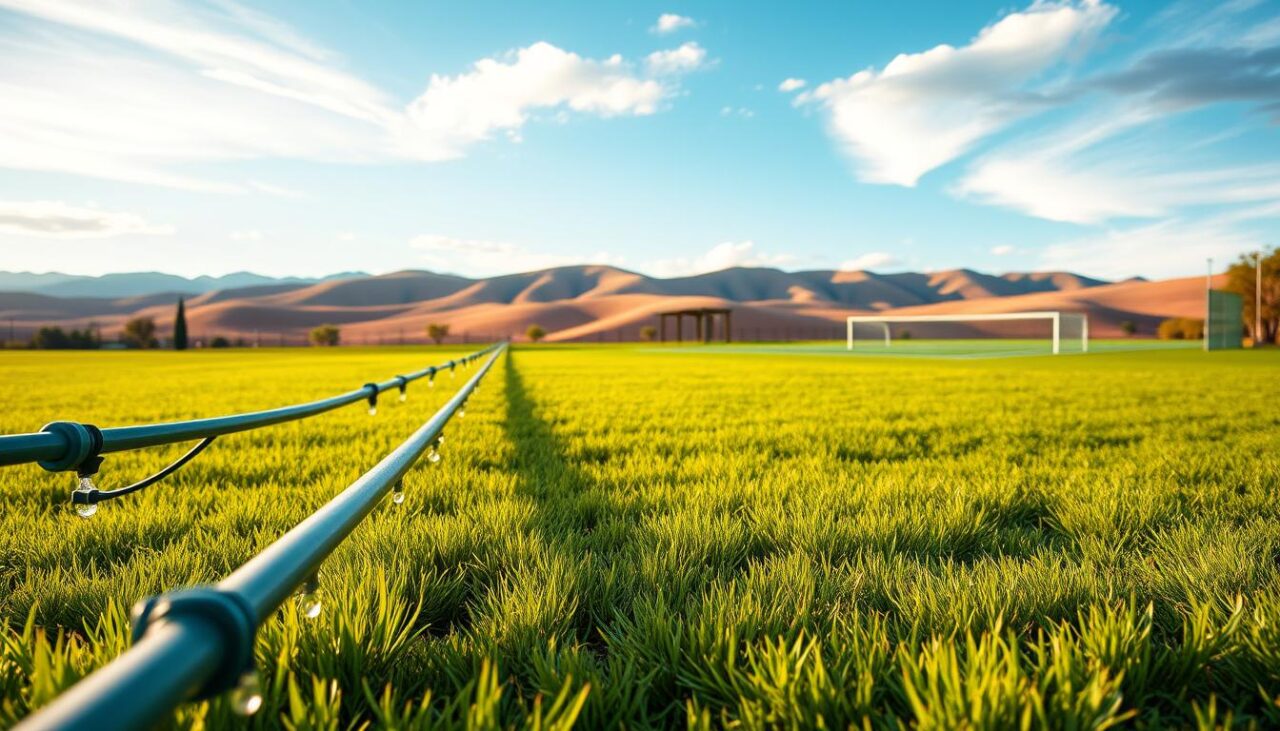
Drip irrigation is like direct delivery to the roots. It cuts down on evaporation and weeds. This method is efficient and effective.
But even the best systems can leak. An irrigation system audit finds these leaks. It’s like a detailed investigation into your water use.
True intelligence looks at the whole cycle. Using recycled surfaces and materials helps. It’s about responsibility from start to finish.
| Technology | Core Function | Primary Benefit | Best For |
|---|---|---|---|
| ET Sensors | Measures atmospheric water loss (evapotranspiration) in real-time. | Eliminates overwatering; adjusts schedule to actual weather. | Large fields in climates with variable weather patterns. |
| Drip Irrigation | Delivers water slowly directly to soil at the root zone. | Reduces evaporation by up to 70%; targets water precisely. | Precision turf areas, native landscape zones, sloped surfaces. |
| System Audit | Comprehensive check of pressure, coverage, and leaks. | Identifies hidden waste; can save 15-30% on water use. | Any existing system, specially those over 3 years old. |
| Recycled Water Catchment | Uses permeable or designed recycled surfaces to capture runoff. | Provides alternative water source; reduces stormwater burden. | New construction or renovation projects with budget for infrastructure. |
Smart irrigation isn’t about following a schedule. It’s about using data and precision. The best water source is the one you don’t need to use.
Drought-Tolerant Grasses & Native Edges
That perfect Kentucky bluegrass in Arizona is more like a hostage situation. We’re forcing a grass meant for cooler climates to survive in the desert. Then, we’re shocked by the high water bills.
Choosing the right grass is key to water-wise irrigation. It’s not about the greenest grass. It’s about finding grasses with deep roots.
Drought-tolerant grasses like fescues and buffalograss are built for survival. They have deep roots that find water deep in the soil. This makes them more resilient and quick to recover.
Choosing drought-tolerant grasses isn’t settling for less. They are bred to be tough and look great. They cool the area without needing constant water.
Now, let’s look at the edges of the field. Those neat edges are often empty spaces. They’re mowed and fertilized a lot but don’t help the environment. Native plants can change this.
Native plants turn the field into a connected habitat. Here’s what changes:
- Water retention: Native plants help the soil hold water better, reducing runoff.
- Maintenance reduction: You’ll need to mow less often, saving time and money.
- Habitat creation: Pollinators and local animals will come back, making the field part of the ecosystem.
- Visual anchoring: The field will look like it belongs, not like it was dropped from space.
It’s all about teamwork. Less showy grass, more plants that work well with the environment. This creates a strong bond between the game and the land.
Does your field fight the environment or work with it? The answer is in every blade of grass and every drop of water saved.
Synthetic Turf: Infill choices, heat, end-of-life
Synthetic turf is a trade-off for sports fields. It’s easy to maintain but has hot surfaces and plastic waste. It’s like wearing a polyester suit in the heat.
The big problem is the “urban heat island” effect. On hot days, synthetic fields can get too hot. Choosing the right infill is key to keeping it cool.
Crumb rubber was once the go-to. It’s affordable but raises concerns about heat and chemicals. Organic turf care offers better options.
- Cork: It’s light, cool, and fights off germs.
- Coconut fiber: It manages moisture well and is eco-friendly.
- Sand & Organic Mixes: They help keep the field cool and playable.
Choosing these options is more than a PR stunt. It tackles the heat issue and avoids harmful materials.
What if you could mix synthetic and natural turf? POWERgrass is a hybrid that combines the two. It uses synthetic fibers under natural grass to reduce heat and add life.
But synthetic fields have a limited life. We must think about their end-of-life. It’s not just about if, but what happens next.
Designing fields for recycling is essential. Can they be reused or recycled? This is the only sustainable choice. Not sending it to the landfill is a must.
Choosing synthetic turf means looking ahead. Opt for cool, safe infills. Consider hybrid options. And make sure there’s a plan for when it’s time to retire.
Courts & Tracks: Cool coatings, runoff control
The modern sports court is a marvel of engineering. But, left unchecked, it becomes an environmental liability. It bakes in the sun and washes chemicals downstream. We’ve focused too much on grass fields, ignoring hard surfaces.
Concrete and asphalt don’t just sit there. They interact with the environment. Their environmental rap sheet has two major charges. First, they retain heat. A dark tennis court can get very hot on a summer day.
This creates urban heat islands and makes play uncomfortable. Second, they cause stormwater runoff. When rain hits a sealed court, it doesn’t soak in. It sheets off, carrying dust, pollen, and chemicals to drains.
The solution isn’t to abandon hard surfaces. It’s to make them smarter. Enter cool coatings. These aren’t just new paints. They’re solar-reflective surfaces that bounce infrared radiation back into the atmosphere.
Think of it as giving your court a high-tech sun hat. The temperature difference can be dramatic—20 degrees Fahrenheit or more. Players stay cooler. The surrounding microclimate improves.
But the real genius lies in water management. We need to stop seeing rainfall as a problem and start treating it as a resource. Here’s the playbook:
- Permeable surfaces: Porous pavements and specially designed coatings allow water to infiltrate slowly, filtering it naturally through sub-layers.
- Bioswale edges: Instead of concrete curbs, create vegetated channels along court perimeters. These shallow ditches capture and clean runoff before it enters the storm system.
- Collection systems: Direct runoff from court edges into rain gardens or cisterns. That water becomes an asset for irrigating nearby landscaping.
This transforms the court from a passive slab into an active environmental participant. It’s infrastructure that gives back.
Now, let’s talk materials. This is where recycled surfaces enter the conversation—and it’s more than just feel-good marketing. We’re talking high-performance coatings derived from post-consumer materials.
Rubberized tracks made from old sneakers? That’s not just sustainability; it’s poetic justice. Court surfaces incorporating recycled glass or plastic? That’s closing the loop in the most literal sense.
The benefits of using recycled surfaces extend beyond the obvious environmental win:
- They often have superior durability and shock absorption
- They reduce demand for virgin materials and associated extraction impacts
- They create a compelling story for your facility—one that resonates with environmentally conscious users
- They can sometimes reduce initial costs compared to premium virgin materials
Imagine a running track that literally gives discarded athletic shoes a second life. Or a basketball court whose surface contains materials that would be in a landfill. This isn’t fringe idealism anymore. Major manufacturers now offer these products with warranties matching their conventional counterparts.
The shift requires a mindset change. We must stop specifying surfaces based solely on initial bid price and traditional specs. The questions need to evolve: What’s the solar reflectance index of this coating? How does the surface manage water? What percentage of post-consumer content does it contain?
Your courts and tracks shouldn’t be environmental dead zones. With cool coatings, smart water management, and a commitment to recycled surfaces, they can become showcases of sustainable innovation. They prove that high-performance athletics and environmental responsibility aren’t competing goals. They’re the same game, just played on a smarter surface.
Equipment: Electric mowers, battery tools
Imagine your maintenance equipment not just cutting grass but collecting data. It’s a quiet revolution in equipment sheds across the country. The shift to electric and battery tools is key to making sustainable practices work.
This isn’t about showing off. It’s about being better at what you do. A battery-powered mower is lighter and doesn’t hurt the soil as much. It lets you cut the grass more often, keeping it healthy.
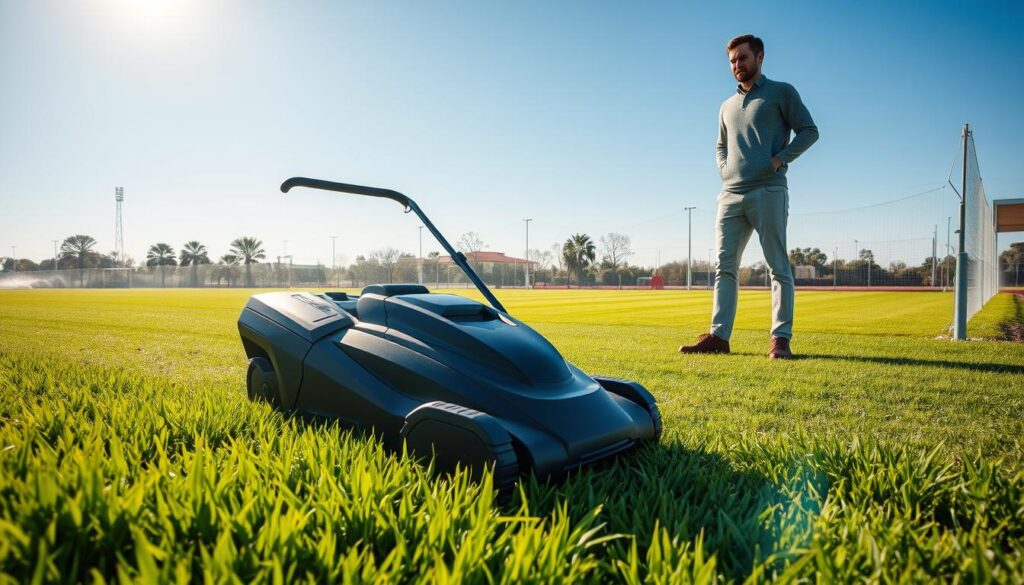
Choosing an electric aerator over a diesel one shows smart thinking. Your smart irrigation controller and battery-powered edger work together. They use data to do their jobs better.
Drones and penetrometers are like your turf’s reconnaissance team. A drone checks moisture levels from above. A penetrometer shows where soil is too hard for water to get through. This tech is real and saves a lot of water.
Your equipment should be like a tech startup, not a construction crew. Each tool collects data while doing its job. An electric mower can map grass density. A smart sprinkler head checks if it’s watering right.
Lighter electric equipment helps soil stay healthy. This means water can soak in better. So, your water-wise irrigation works better too. It’s a cycle where each upgrade helps the others.
Think about the money side of things. The initial cost might seem high. But, you save on fuel, maintenance, and labor. Plus, you save water with the right equipment.
The change happens little by little. Start with the tools you use most, like mowers and trimmers. Then, add more specialized equipment. Each step makes your operation quieter, cleaner, and smarter. You’re not just cutting emissions; you’re making your field management smarter.
This is where being green meets being good at your job. The tools you choose affect how well you can do other sustainable practices. The right tools help you manage your field better, creating a better ecosystem.
Pest & Weed IPM Programs
Integrated Pest Management (IPM) is more than just a term. It’s a smarter way to handle turf problems. Unlike the old “war” on weeds, IPM offers a better strategy.
Why does Poa annua show up in the same spot every spring? It might be due to compacted soil or poor drainage. Treating it like a disease is not effective. It’s like taking aspirin for a brain tumor.
Organic turf care focuses on building a strong turf ecosystem. Healthy grass naturally fights off weeds. It’s about soil health, aeration, and nutrition.
IPM turns you into a detective, not a soldier. You observe, identify, and act strategically. It’s about finding early signs and acting wisely.
When action is needed, IPM uses the least harmful methods first. This includes cultural and mechanical controls. Biological controls come next, like nematodes for grubs.
Pre-emergent herbicides are a strategic option in IPM. They’re not the first choice. They’re part of a broader plan.
IPM saves money and reduces risks. It builds long-term turf health. It requires more thought upfront but less trouble later.
Start by mapping your fields and noting problem areas. Keep a log and identify patterns. Why does the problem exist there? Adjust one thing at a time and observe.
Investing in organic turf care and IPM changes how you manage your field. You move from reacting to being proactive. The turf becomes a partner in the game.
Player Safety Meets Sustainability
Sustainability and player safety go hand in hand. The best fields are both safe and sustainable. This isn’t just luck—it’s smart planning.
Natural turf is a great example. It’s well-known that bad maintenance can hurt players. But good turf offers solid footing and absorbs impacts well. It’s like nature’s own shock absorber.
On the other hand, synthetic fields like POWERgrass are getting better. They’re safer and softer, with better grip and joint protection. They use cool, non-toxic materials that are safer for players.
Recycled surfaces are also a win-win. Old tires make better tracks, and old sneakers make safer playgrounds. It’s smart design at its best.
Player safety is measured in many ways. G-max tests how well a surface absorbs shock. Traction tests how slippery it is. Uniform surfaces prevent injuries. All these improve with sustainable practices.
Choosing recycled surfaces is smart, not just kind. It’s like buying insurance that also helps the planet. Fields become safer for athletes and better for the environment.
This new way of thinking changes how we care for fields. We now ask how to make fields safer and greener at the same time. The answer often involves new materials and designs that benefit both people and the planet.
Budgeting & Seasonal Maintenance Calendar
Budgeting for a sustainable field is about investing in growth, not just covering costs. That old calendar with its fixed tasks is outdated. True financial management for turf is forward-thinking, not just reacting to problems.
Imagine writing your field’s financial story. Each season—spring, summer, fall, winter—brings its own expenses. You plan for deep aeration in the fall and pre-winter fertilizing. You also set aside for post-season work.
But there’s a key shift. The smart budget includes a column for innovation.
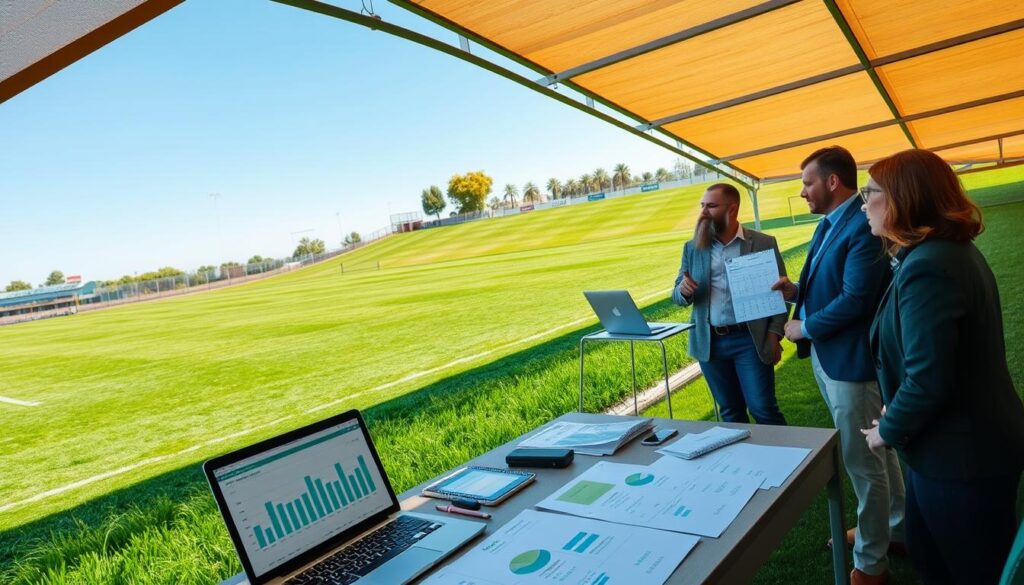
This is where you fund important tests and audits. You invest in soil tests and water-wise irrigation audits. Even a small plot of native grass gets a budget line. These are not just costs; they’re investments in your field’s future.
Experts say every field is unique. Its soil and wear patterns shape its financial plan. A sandy, busy field needs a different budget than a clay-based practice area.
Your budget is your most powerful tool. It turns the seasonal calendar into a flexible guide. It enables budgetary photosynthesis, turning money into greener, stronger growth. Stop just counting costs. Start investing in your field’s future.
Supplier Standards & Contracts
Signing a contract without green specs is like buying organic food and then deep-frying it. You might feel good about your green plans, but the ingredients are toxic.
Your sustainability program depends on your supply chain. This is true for organic turf care programs. A single bad shipment can ruin your “natural” promise.
We must question our suppliers like detectives. Where does that rubber infill come from? What’s the recycled content of the synthetic fiber? Are the fertilizers and soils really eco-friendly, or just greenwashed?
Source 3’s mission is our guide: “responsible sourcing, recyclable materials, and low-impact production.” These are not just dreams. They are real, contractable goals. Make sure they are in your RFPs and purchase orders.
Make sustainability real with strict rules. Ask for recycled content percentages. Need third-party certifications for eco-friendly production. Demand to know about supply chain ethics. This turns vague “green goals” into enforceable rules.
| Criteria Category | Traditional Supplier Focus | Sustainable Supplier Focus | Key Questions for Your RFP |
|---|---|---|---|
| Material Sourcing | Lowest cost, availability | Responsible sourcing, recycled content, local production | “What is the post-consumer recycled percentage? Can you provide chain-of-custody documentation?” |
| Production Methods | Volume efficiency, speed | Low-impact production, energy/water use, waste reduction | “What are your facility’s annual carbon/water footprints? What waste diversion rate do you achieve?” |
| Product Composition | Performance specs, durability | Non-toxic formulations, recyclability, biodegradability | “Is this product certified non-toxic? What is its end-of-life recyclability pathway?” |
| Ethical Standards | Basic compliance | Fair labor practices, organic turf care ethics, community impact | “Do you adhere to recognized ethical labor standards? How do you engage with local communities?” |
| Transparency | Minimal disclosure | Full supply chain visibility, regular sustainability reporting | “Will you provide annual sustainability reports? Can we audit your upstream suppliers?” |
This isn’t about being hard to work with. It’s about doing the right thing. When you make these standards non-negotiable, you do two great things. First, you protect your operation from greenwashing scandals. Second, you push for change in your industry.
Vendors who meet these standards get your business. Those who don’t are encouraged to improve. This creates a market push for real sustainability. It’s how you become a leader in your industry’s environmental journey.
Look for partners who really practice responsible sourcing, not just talk about it. The contract is where your green dreams come to life. Without it, you’re just hoping for the best while paying for something else.
Community Education Signage Toolkit
Here’s the final piece of enlightened management. You’ve optimized soil, installed smart irrigation, and chosen native grasses. But if your community sees aeration as neglect or a brown patch as failure, you’ve lost the plot. Observation, as they say, is the ultimate tool. The eyes don’t lie, but they often need subtitles.
Your field isn’t just a facility. It’s a story. A simple, well-designed sign transforms that story. It explains why the track uses recycled surfaces from old sneakers. It shows the gallons saved by your ET-controlled irrigation. It celebrates the pollinators thriving in the native buffer zone.
This is your signage toolkit. Turn every sustainable choice into a public lesson. A witty sign by the drought-tolerant turf beats a thousand memos. A graphic showing the lifecycle of your synthetic turf’s infill creates instant understanding. People support what they comprehend.
Think of it as turning your grounds into a living classroom. The recycled surfaces become a lesson in circular economics. The closed field for aeration becomes a demonstration of soil science. You’re not just maintaining a pitch. You’re cultivating a constituency for sustainability itself.
What’s the point of all this clever management if no one gets the joke? The final move is to make your community co-conspirators in the plan. When they read the sign and nod, the cycle is complete. The field regenerates, and so does public perception.