

The landscape of American youth sports has undergone a profound structural shift. What was once a localized system of volunteer-run municipal leagues has transformed into a commercialized, professionalized $40 billion youth sports market. While topline metrics show high post-pandemic engagement—with the Sports & Fitness Industry Association (SFIA) tracking a surge in casual play—a deeper system-level analysis reveals a stark socioeconomic divide. The rapid expansion of private club teams, specialized training services, and travel-heavy tournament formats has outpaced traditional community infrastructure. As a consequence, access to sports is increasingly dictated by a family’s capacity to absorb compounding financial and healthcare burdens.
This institutional reorganization does more than shift family checkbooks; it fundamentally alters the demographic composition of youth athletics. For urban planners, public health officials, and civic leaders, the inflation of youth sports costs presents a critical public policy challenge. When local recreation departments are systematically underfunded and private entities command local facility space, play becomes a luxury asset. Reversing this trend requires an examination of the precise economic and medical friction points currently driving lower-income and middle-class families out of organized youth sports systems.
The Microeconomics of the Pay-to-Play Model

The primary barrier to sustained youth sports participation is direct household expenditure. Comprehensive national research from the Aspen Institute’s Project Play initiative reveals that the average annual family spend per child on a primary sport reached $1,016, marking a 46% increase over a five-year period. This rate of hyperinflation represents double the pace of core U.S. inflation during the same timeframe. The cost escalation is driven not by basic equipment, but by systemic structural demands: club registration fees, mandatory travel, specialized tournament lodging, and private coaching aimed at securing early collegiate visibility.
| Sport Category | Average Annual Cost Per Child | Primary Cost Driver |
| Club Soccer | $1,188 | Year-round tournament travel & league fees |
| Club Basketball | $1,002 | Facility rentals & private coaching services |
| Travel Baseball | $714 | Specialized equipment & multi-day tournament entry |
| Youth Football | $581 | Certified protective gear & insurance compliance |
The financial strain is highly regressive. Families in the highest income tiers ($150,000 and above) outspend lowest-income households fourfold on sports-related travel alone. Consequently, the income-based participation gap has widened to over 20 percentage points. While 43.5% of youth from households earning above $100,000 play sports regularly, only 25.1% of children from families earning under $25,000 achieve the same level of activity. As private club networks monetize elite youth pipelines, local municipality-backed leagues are hollowed out, leaving a severe deficit in public-tier infrastructure.
Healthcare Capital, Injury Risks, and Institutional Barriers
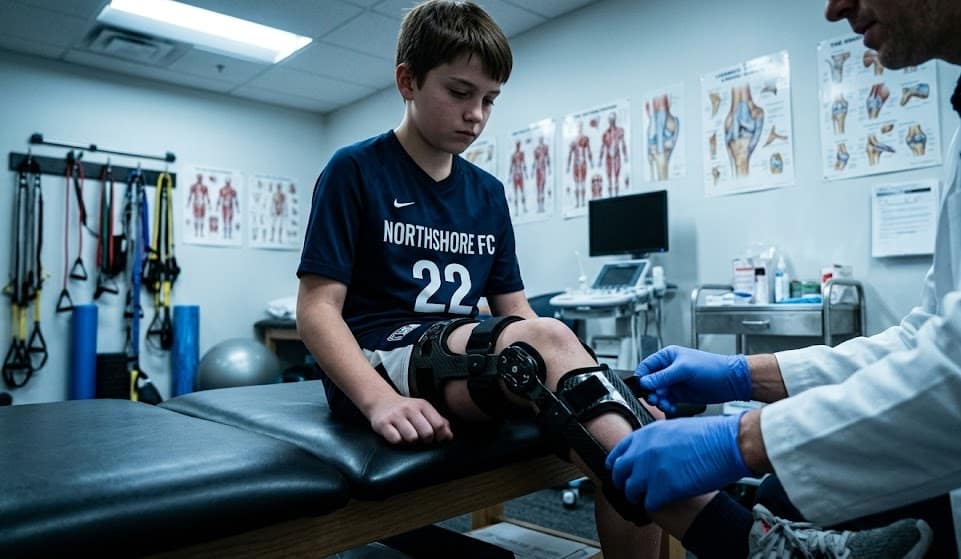
Beyond the baseline entry fees, the professionalization of youth sports introduces secondary medical and healthcare costs that act as severe participation gatekeepers. Driven by the pursuit of collegiate scholarships or elite placement, up to 35% of high school-aged athletes now specialize in a single sport for more than eight months a year. This intense, repetitive training has triggered a modern epidemic of overuse injuries, such as ACL tears and growth-plate fractures, at younger developmental ages.
Managing these orthopedic risks requires substantial healthcare capital. Families operating within high-deductible commercial health plans face significant financial exposure when an athlete requires physical therapy, specialized bracing, or surgical intervention. Families lacking comprehensive coverage or the flexible work schedules required to navigate long-term rehabilitation pipelines are frequently forced to withdraw their children from competitive play entirely. Furthermore, the rise in concussion awareness requires leagues to implement certified concussion management protocols and maintain independent medical personnel, an administrative overhead cost that traditional public school and local parks programs struggle to absorb.
The interaction between economic capacity and medical risk management creates a compounding cycle of exclusion. Successful mitigation of sports-related injuries heavily favors well-capitalized families who can afford prophylactic physical training, nutritional counseling, and immediate access to sports medicine specialists. For marginalized communities, an athletic injury is not just a temporary competitive setback; it is a direct threat to household financial stability.
Urban Land Use and Local Facility Deficits
The economic stratification of youth sports is deeply intertwined with municipal land-use decisions and the allocation of civic real estate. In rapidly growing metropolitan areas, municipal park development has lagged behind residential density. This scarcity of public fields and indoor courts has created a highly competitive rental marketplace. Private travel clubs frequently utilize corporate sponsorship capital to block-book public facilities during peak evening and weekend hours, effectively displacing casual, low-cost neighborhood recreation.
This spatial inequality forces urban families to travel long distances to access premium tournament complexes located in outer-ring suburbs or specialized regional exurbs. To establish a self-sustaining system, municipal planners must look to modern framework adjustments. Models highlighted in community sports facility access strategies demonstrate that cities can combat this privatization of play by embedding mandatory community-use clauses into public-private facility partnerships. Without structural zoning interventions that guarantee free or low-cost field access to local residents, municipal land explicitly funded by taxpayers ends up serving an exclusive regional demographic.
- Corporate Real Estate Domination: Private sports facility developers are rapidly purchasing urban warehouse districts for conversion into elite indoor training centers, which operate purely on a membership-access model.
- The Rural-Urban Cost Variance: Families in dense urban areas face an average annual sports spend of $1,628 per child due to high facility rental costs, whereas rural areas average $924 by relying heavily on public school infrastructure.
Structural Interventions for Civic and Policy Leaders

Addressing the equity chasm in youth sports requires moving past localized philanthropy toward systemic, infrastructure-level reform. Relying on fee waivers or individual equipment donations is insufficient to counter the macroeconomic forces driving the pay-to-play industry. National governing bodies and civic organizations are beginning to recognize that long-term organizational health depends on expanding the baseline pool of casual participants rather than extracting higher revenues from a shrinking cohort of affluent families.
Data compiled in the National Recreation and Park Association planning resources underlines the necessity of investing directly in neighborhood-level school and park infrastructure to lower the geographical and financial barriers of travel. Municipalities can leverage federal community development block grants to rehabilitate local playing fields and subsidize public coaching certifications. By investing in free, high-quality, school-linked intramural programming, cities can decouple athletic participation from household income, ensuring that the physical, social, and emotional benefits of organized play remain a universal public good rather than a privatized privilege.
Balancing Public Health with Marketization
The trajectory of the youth sports sector through 2026 presents an urgent choice for community decision-makers. Allowing the market to dictate athletic access ensures a future where physical health, social cohesion, and leadership development are heavily stratified by wealth. The widening participation gap is not a reflection of a lack of interest among youth, but a direct consequence of a system engineered around high-margin travel models.
Reclaiming youth sports as an engine for social mobility and public health requires a deliberate reassertion of public oversight. By redesigning urban park systems, capping facility rental monopolies, and funding low-barrier community leagues, civic leaders can build a resilient framework for youth development. The long-term value of a city’s sports infrastructure should not be measured by the revenue generated by regional tournament complexes, but by the percentage of local children who can safely and affordably step onto a field to play.