
Miami’s free World Cup watch parties show why fan infrastructure cannot end when a host city’s stadium schedule does.
Hard Rock Stadium gave Miami the headline moments of the 2026 FIFA World Cup. The matches, teams, security plans, transportation routes, and Fan Festival at Bayfront Park all formed the official core of the host-city experience. But as the tournament moved into its final week, Miami’s most important infrastructure lesson shifted beyond the stadium and beyond Bayfront Park.
The next phase was distributed: free public watch parties across Miami Beach, Little Haiti, Hialeah, South Miami-Dade, North Miami, loanDepot Park, and other South Florida public spaces. That matters because the World Cup does not stop feeling local when a host venue finishes staging matches. Residents keep watching. Visitors keep gathering. Businesses keep serving fans. Public agencies keep managing crowds. Families still need safe, affordable places to participate.
For aplevante.org, this is a fan planning and sports infrastructure story. Miami’s official watch-party network shows that modern host-city leadership must extend beyond the stadium calendar. It also builds naturally on the earlier discussion of Miami World Cup host-city leadership, where the city’s strongest lesson was that World Cup operations are bigger than stadium operations.
Why The End Of Host Matches Is Not The End Of Hosting
A host city’s stadium schedule is only one version of the tournament. The public version lasts longer.
Miami’s official Fan Festival at Bayfront Park created a central gathering point during the city’s match window. The FIFA Fan Festival Miami was placed along Biscayne Bay in Downtown Miami, with live match broadcasts, entertainment stages, cultural performances, food and beverage experiences, interactive activations, and family-friendly programming.
That worked as the main hub while the host-city calendar was at full strength. But once the tournament reached the semifinals, Bronze Final, and Final, the geography of fandom changed. Not every fan needed to be downtown. Not every resident wanted to travel to the waterfront. Not every family could afford a bar, restaurant, hotel package, or match ticket. The next step had to be more local.
That is why the official Miami Host Committee’s events schedule matters. It states that after the Fan Festival at Bayfront Park, the celebration would continue across South Florida through official viewing parties in parks and public spaces as the tournament reached its final matches.
That sentence carries a larger lesson. Host cities should not think of fan infrastructure as a temporary buildout around stadium dates. They should think of it as a public network that remains active until the tournament ends.
How Miami Turned Public Screens Into Civic Infrastructure
A screen in a park may look simple. For a World Cup host region, it is not.
A free public watch party requires crowd planning, restrooms, security, weather preparation, transportation access, food vendors, emergency routes, shade, hydration, audio systems, power, cleanup, family areas, and clear communication. It also requires neighborhood trust. Residents need to know what is happening, how long it will last, how streets or parking may be affected, and how the event fits into local public life.
That is why Miami’s final-week watch parties should be understood as civic infrastructure. They turned soccer viewing into a distributed public service. Instead of concentrating every fan experience at Hard Rock Stadium, Bayfront Park, or private hospitality venues, South Florida spread the tournament through public spaces.
The City of Miami Beach’s World Cup celebration page listed free watch parties and family-friendly events, while also noting enhanced water taxi, shuttle, and trolley service for July 18–19. That kind of mobility detail is crucial. A public viewing site is only useful if people can reach it and leave safely.
This is where fan infrastructure becomes more than entertainment. It becomes the practical system that allows a global sports event to remain accessible after the premium-ticket phase has moved elsewhere.
Why Miami Beach Became A Public Viewing Laboratory
Miami Beach gave the watch-party network one of its clearest examples. The city listed a July 15 semifinal watch party for England vs. Argentina at Lummus Park and Miami Beach Bandshell, plus Bronze Final and FIFA World Cup Final official watch parties at the Sand Bowl behind the Miami Beach Bandshell.
Those details matter because Miami Beach is not a stadium district. It is a public-facing tourism and neighborhood environment with beaches, hotels, restaurants, nightlife, parks, cultural venues, and heavy visitor movement. That makes it a useful test of how soccer can be integrated into an existing public-space economy.
Miami Beach also layered the tournament into cultural and street-level experiences. The city highlighted 48 giant soccer balls representing qualifying nations, a tournament-themed lifeguard tower, Lincoln Road activations, local business deals, and public art connected to the World Cup. That is not the same as running a stadium. It is a city-branding and public-space exercise.
The watch parties at Lummus Park, Bandshell, and Sand Bowl show how a host region can keep residents and tourists engaged without forcing everyone into one official site. They also show how fan planning has to adapt to the rhythms of a specific place: beach access, pedestrian flow, hotel districts, transit options, nightlife, and weather.
Miami Beach’s lesson is that fan infrastructure works best when it fits the local urban environment.
How loanDepot Park Added A Different Kind Of Access
loanDepot Park added another important layer to Miami’s watch-party model. The Miami Marlins’ home became an air-conditioned World Cup viewing hub, with free official watch parties for the Argentina-England semifinal on July 15, the Bronze Final on July 18, and the FIFA World Cup Final on July 19.
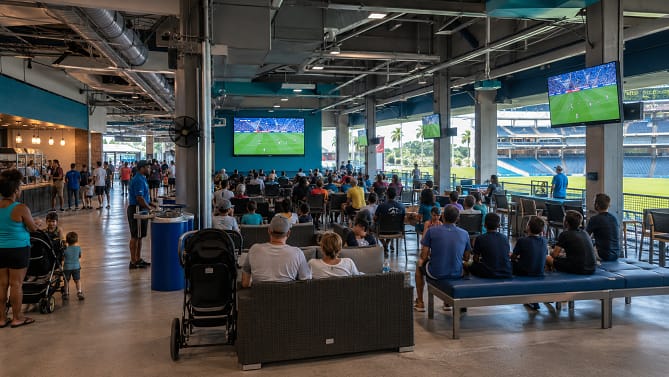
That matters because South Florida in July is a heat-management environment. Outdoor watch parties can be festive, but indoor or roofed venues provide a different form of access. Families with children, older fans, people sensitive to heat, and visitors looking for a controlled setting may prefer a stadium-style viewing option that does not require paying for a match ticket.
The loanDepot Park watch-party plan also shows how existing sports facilities can extend a mega-event’s public reach. A baseball stadium can become a soccer viewing site. A concourse can become a fan gathering space. Existing security, seating, restrooms, concessions, parking, and transit procedures can support a tournament even when the venue is not hosting official matches.
That is an important infrastructure lesson for U.S. cities. Fan capacity does not only live inside soccer stadiums. It can live inside baseball parks, basketball arenas, convention centers, parks, amphitheaters, college facilities, waterfront plazas, and civic venues.
Miami’s watch-party network worked because it did not rely on one type of space.
Why Neighborhood Sites Matter More Than Centralized Celebration
The most important part of Miami’s free watch-party model may be the neighborhood spread.
Axios Miami reported free viewing opportunities at sites including Little Haiti Soccer Park, Amelia Earhart Park, Tropical Park, Palmetto Golf Course, NoMi Village, Miami Beach Bandshell, Lummus Park, Sand Bowl, and loanDepot Park. Those locations matter because they bring the tournament closer to different communities instead of asking every fan to travel to one downtown location.
Little Haiti Soccer Park is especially symbolic. A neighborhood soccer park is different from a stadium, waterfront festival, or baseball venue. It represents local participation, not just spectacle. When a community park becomes part of the tournament’s final-week infrastructure, it tells residents that the World Cup is not only for ticket holders or tourists.
That distributed approach also reduces pressure on one site. Large centralized fan festivals can become crowded, expensive to staff, and difficult to access. A network of smaller public viewing sites can spread movement across the region, support different neighborhoods, and give families options based on distance, comfort, transportation, and atmosphere.
The risk is consistency. Smaller sites still need good screens, sound, safety, staffing, bathrooms, hydration, and weather planning. But if done well, they can make the tournament feel more democratic.
That is the core leadership lesson: public access improves when fan infrastructure is distributed.
How Free Events Push Back Against The Premium-Ticket World Cup
The 2026 World Cup has also shown how expensive global sports can become. Match tickets, travel, hotels, hospitality packages, and premium experiences can push many residents to the edge of the event rather than the center of it.

Free watch parties are not a full solution, but they are an important counterweight. They provide a way for families, students, workers, tourists on a budget, and local residents to participate without paying stadium prices. They also create public memories in places that belong to the community.
That is why free access should be treated as infrastructure. A city that only builds premium experiences risks making the World Cup feel like it happened near residents rather than with them. A city that builds free public viewing options gives more people a way to share the tournament.
Miami’s final-week model shows how public screens can protect the civic side of a global event. The semifinals, Bronze Final, and Final are the moments when casual interest rises highest. If those matches are available only through private venues, high-priced tickets, or crowded bars, the city misses a chance to convert attention into shared public culture.
Free watch parties make the tournament visible in everyday places. That visibility matters for legacy.
Why Transportation Still Decides Whether Watch Parties Work
A watch party is only as accessible as the route to it.
Miami Beach’s decision to highlight enhanced water taxi, shuttle, and trolley service for July 18–19 shows how public viewing requires mobility planning. Fans need more than an address. They need safe ways to arrive, clear routes, late-service options, rideshare coordination, parking information, pedestrian space, and post-match crowd management.
This is especially important in South Florida, where destinations are spread across water, highways, beach districts, suburban parks, and dense nightlife corridors. A free event can become frustrating if transportation is confusing or expensive. It can also become unsafe if too many people converge without planned circulation.
That is why host-city leaders should view watch parties through the same operational lens as stadium events. The crowd may be smaller than a match crowd, but the needs are similar: movement, communication, safety, weather, medical response, sanitation, and neighborhood coordination.
Miami’s network of final-week events creates a useful planning template. It shows that transit, shuttles, trolleys, rideshare, pedestrian management, and parking have to follow the tournament beyond the main stadium schedule.
Fan infrastructure does not end at the venue gate. It follows the fan.
How Businesses Benefit When The Tournament Spreads Out
Distributed watch parties also change the local business equation.
When fan activity is concentrated at one official festival site, nearby businesses may benefit while other neighborhoods miss the surge. When the tournament spreads to Miami Beach, Little Haiti, North Miami, Hialeah, South Miami-Dade, and loanDepot Park, more local corridors have a chance to participate.
Miami Beach’s event page listed restaurants, bars, hotels, and local activations tied to the tournament. Lincoln Road hosted live match experiences, cafés and restaurants screened games, and local businesses offered World Cup-related deals. This type of activity matters because fan infrastructure is not only about public agencies. It also includes the businesses that feed, host, entertain, and guide visitors.
The challenge is making that benefit intentional. A public watch party can support local restaurants and vendors if visitors know where to go, streets remain navigable, and small businesses are included early. It can also bypass local businesses if the event is walled off, poorly communicated, or dominated by outside vendors.
That is why planning matters. The best fan infrastructure connects public viewing, local business participation, cultural programming, and neighborhood identity.
Miami’s final-week watch parties offer a useful example because they are not limited to one downtown district. They create multiple local economic moments.
Why Fan Infrastructure Has To Be Designed For Heat, Rain, And Families
South Florida’s July conditions make comfort a central part of fan planning. Heat, humidity, sudden rain, lightning risk, and long waits can shape whether a watch party feels welcoming or exhausting.
That means infrastructure has to include shaded areas, water access, cooling options, weather monitoring, shelter plans, flexible programming, and communication if events change. Family-friendly events also need restrooms, seating, safe pedestrian space, clear entry points, and enough room for children to move without crowd pressure.
This is where the difference between a casual event and real fan infrastructure becomes clear. A casual event puts up a screen. Real infrastructure thinks about the people standing in front of it for several hours.
loanDepot Park’s indoor environment offers one kind of solution. Miami Beach’s waterfront and park settings require another. Neighborhood parks require another. A successful host region uses different spaces for different needs.
That flexibility is part of why Miami’s model is valuable. It shows that fan access does not have to look the same everywhere. It has to work for the place, the weather, the crowd, and the match.
What Other Host Cities Can Learn From Miami
Miami’s free watch-party network offers several lessons for future host cities.

First, plan beyond the match calendar. A city’s stadium may be finished hosting, but its residents will still follow the tournament. Public viewing should continue through the final whistle of the competition.
Second, distribute access. One fan festival is not enough for a large region. Neighborhood parks, beaches, amphitheaters, baseball stadiums, public plazas, and civic spaces can all become part of the network.
Third, treat free access as a civic investment. Not everyone can afford tickets or private hospitality. Public viewing keeps the tournament connected to residents.
Fourth, connect watch parties to mobility. Trolleys, shuttles, water taxis, rideshare zones, parking, bike access, and pedestrian routes should be planned with the same seriousness as stadium movement.
Fifth, include local businesses and cultural programming. A watch party should feel like the neighborhood hosting the world, not just a screen dropped into a park.
These lessons apply beyond soccer. The Olympics, Copa América, women’s tournaments, club competitions, Super Bowls, Final Fours, and large regional sports events all need public access strategies. Miami’s watch-party model shows how fan infrastructure can extend the life of an event.
Why The Legacy Is Public Participation
Miami’s free World Cup watch parties matter because they define legacy through participation.
A host city can stage successful matches and still leave many residents outside the experience. It can build a polished fan festival and still miss neighborhoods far from the official site. It can attract global visitors and still fail to create public memories for local families.
Miami’s final-week watch-party network pushes against that problem. It keeps the tournament active after the stadium schedule. It uses parks, beaches, baseball infrastructure, and neighborhood spaces. It gives people free entry points. It spreads the event across South Florida rather than allowing it to collapse into one premium corridor.
That is why fan infrastructure has to outlast the host city schedule. The tournament is not over for residents when the last local match ends. It is over when the final whistle blows and communities have had a real chance to take part.
Miami’s model does not answer every question. The region still has to manage transportation, heat, crowd comfort, business access, neighborhood disruption, and safety. But it offers a strong lesson for future host cities: build the fan network for the full tournament, not only the games assigned to your stadium.
The best host cities do not simply host matches. They keep the event open, visible, and accessible for the people who live there.