
The New York Life Foundation’s expanded partnership with Boys & Girls Clubs of America shows why World Cup momentum should be measured by more than television ratings, stadium crowds, and national-team attention.
The more important test is whether soccer’s current visibility can be converted into durable youth sports infrastructure. That means safe places to play, trained coaches, affordable programs, equipment access, community events, trusted mentors, and local systems that keep young people involved after the tournament spotlight fades.
On July 7, 2026, Boys & Girls Clubs of America announced that the New York Life Foundation is investing $3.2 million over three years through the Coaching the Future initiative. The partnership aims to train 10,000 coaches and youth development professionals, increase youth sports participation by 25%, support 45 Clubs in a multi-year coaching cohort, and expand access through equipment, training, and consistent program delivery nationwide.
For aplevante.org, this is a youth sports infrastructure story as much as a philanthropy story. The World Cup has created national attention, but attention alone does not give a child a place to play. The real legacy depends on whether organizations can turn the moment into community systems that lower barriers and improve participation. That connects directly to the broader question of World Cup 2026 youth soccer infrastructure, where the challenge is not simply growing demand, but making sure communities can actually absorb it.
Why World Cup Momentum Needs A Youth Sports Plan
The United States is experiencing one of the biggest soccer visibility moments in its history. World Cup 2026 has brought global teams, major stadium crowds, watch parties, fan festivals, and mainstream attention into American cities. But youth sports systems do not automatically improve because a tournament is popular.

Interest can rise faster than infrastructure. Families may want their children to play soccer, but still face high costs, transportation barriers, limited field access, inconsistent coaching, and a shortage of welcoming local programs. That is especially true in communities where club soccer remains expensive or where public fields are overscheduled, poorly maintained, or difficult to reach.
That is why the New York Life Foundation and Boys & Girls Clubs partnership matters. It focuses on the parts of youth sports that are often less visible than tournaments but more important to long-term participation: coaching quality, play spaces, equipment, mentorship, and community-based access.
The partnership also arrives at the right time. When soccer is already part of the national conversation, youth organizations can use that attention to invite new participants. But if the invitation does not come with real capacity, the moment becomes temporary.
A strong youth sports plan turns excitement into repeated access. That is the difference between a World Cup spike and a sports infrastructure legacy.
How Coaching Became The Center Of The Infrastructure Conversation
Youth sports infrastructure is often described through fields, courts, lights, and buildings. Those are essential, but they are not enough. A field without trained adults can become an underused asset. A program without trusted coaches can lose kids quickly, even if the facility is available.
That is why Coaching the Future is built around people as infrastructure. New York Life Foundation’s broader Coaching the Future platform defines coaching as the many ways caring adults support young people’s growth on the field, in the classroom, and throughout their lives. Its grantmaking focuses on on-field coaching, off-field coaching, and all-abilities coaching.
That framework matters because youth sports access is not only about whether a child can register. It is about whether the environment is good enough for the child to stay. Positive coaching can help young people build confidence, resilience, teamwork, leadership, and a sense of belonging. Poor coaching can push them away.
Boys & Girls Clubs of America and New York Life Foundation are aiming to train 10,000 coaches and youth development professionals through this partnership. That number is important because coaching capacity determines program capacity. More trained adults can mean more teams, safer sessions, better retention, and stronger relationships with families.
In a World Cup year, coaching becomes the bridge between inspiration and habit. A child may first notice soccer because of the tournament, but a coach is often the reason that child returns the next week.
Why Cost Remains The Barrier Behind The Excitement
The partnership also responds to a difficult reality: youth sports are becoming more expensive.
Boys & Girls Clubs of America reported that youth sports costs now average $1,016 per child annually, up 46% over five years. That figure helps explain why World Cup momentum cannot be left to market forces. If enthusiasm rises but participation costs remain high, the tournament may deepen the gap between children who can afford organized sports and children who cannot.
That is where Boys & Girls Clubs has a structural advantage. Its national network already serves young people in cities, towns, public housing communities, Native lands, and military-connected locations. Its programs can reach families that may not be served by traditional club soccer pathways.
The organization currently enables 540,000 young people to play sports at little or no cost, and it has announced a goal to double sports participation to 1 million youth by 2030. That scale makes the partnership more than a local initiative. It becomes part of the national conversation about who gets to participate in the next wave of American soccer.
The question is not whether the World Cup will make kids interested. It almost certainly will. The question is whether the access points are affordable enough for that interest to become participation.
If World Cup 2026 is going to leave a meaningful youth sports legacy, cost reduction has to be treated as infrastructure.
How Mini-Pitches Turn Attention Into Local Access
Facilities still matter. Coaching can only go so far if communities lack safe, reliable places to play.
As part of the partnership, Boys & Girls Clubs of America said 10 sports fields, pitches, and courts will be upgraded or refurbished over three years. In 2026, that includes five soccer mini-pitches in cities such as Los Angeles, Dallas, Boston, Seattle, and New Jersey. Those are real infrastructure investments because they place play spaces where young people already gather.
Mini-pitches are especially valuable because they do not require the same land footprint as full-size fields. They can fit into dense neighborhoods, Club properties, school-adjacent spaces, or underused community areas. They support casual play, small-sided games, clinics, after-school programming, and introductory soccer sessions.
That makes them practical World Cup legacy tools. A full-size stadium inspires from a distance. A mini-pitch changes daily access.
The Dallas example is especially useful. Boys & Girls Clubs said the Boys & Girls Clubs of Greater Dallas and Dallas Trinity FC are part of a local community partnership tied to a new pitch groundbreaking and youth soccer clinic. That kind of local connection matters because infrastructure works best when it is connected to programming.
A pitch without programming is a facility. A pitch with coaches, equipment, volunteers, local partners, and repeat access becomes a youth sports system.
Why Boys & Girls Clubs Gives The Program National Reach
One reason this partnership matters is that Boys & Girls Clubs of America already has a massive community footprint. The organization has more than 5,500 Clubs and serves more than 4 million young people through Club membership and community outreach.
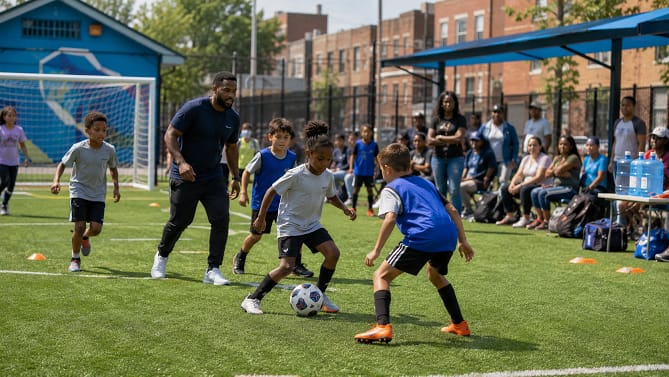
That reach gives the World Cup legacy conversation a different shape. Instead of focusing only on host cities, the partnership can extend soccer access into places that may never host a FIFA match. Rural towns, urban neighborhoods, military communities, Native lands, and under-resourced areas can all become part of the participation story.
That is essential because World Cup infrastructure should not be limited to the cities with stadiums. The tournament may be staged in select markets, but its youth sports impact should be national. A child in Atlanta, Dallas, Los Angeles, Philadelphia, Houston, New York, Metro Atlanta, or a smaller community should be able to feel the tournament through local play opportunities.
Boys & Girls Clubs has also announced soccer goals that go beyond this single partnership. Its broader strategy aims to increase structured soccer participation from 91,000 to 180,000 Club kids, reach 1 million young people through events and activities, train referees and coaches, build teen leadership pathways, increase girls’ participation, and invest in new or renovated soccer pitches at Clubs.
That is the kind of scale that turns a sports moment into infrastructure planning.
How Community Events Create Entry Points For First-Time Players
The partnership’s 2026 activations include equipment distribution, community soccer events, World Cup programming, soccer jamborees, youth clinics, and watch parties. Those details matter because many young people do not enter sports through formal tryouts. They enter through low-pressure events where play feels welcoming.
That is especially important in soccer. The sport can be introduced with a ball, cones, a small space, and a coach who knows how to create confidence. But the environment has to feel accessible. A child trying soccer for the first time should not feel as if they are already behind.
Community activations help solve that problem. They create entry points for kids who might not otherwise join a club team. They also give families a chance to see whether the program feels safe, affordable, nearby, and supportive.
World Cup watch parties can also be more than celebrations. They can connect fandom to participation. A child sees the game on a screen, then kicks a ball with a coach, meets volunteers, receives information about local programming, and discovers that soccer is not only something professionals do. It is something available in their own community.
That is how event energy becomes participation infrastructure.
Why Girls’ Participation And All-Abilities Access Must Stay Central
The strongest version of this partnership should not only expand the number of players. It should expand who feels welcome.
Boys & Girls Clubs has already identified girls’ participation as part of its broader soccer access strategy. That matters because girls often face different retention challenges in sports, including confidence, body image pressure, safety concerns, fewer local teams, unequal resources, and limited coaching support. Soccer growth that does not serve girls equally is not a complete legacy.
New York Life Foundation’s Coaching the Future platform also includes all-abilities coaching. That is another important infrastructure signal. Inclusive programming requires more than good intentions. It requires coach training, adaptive planning, safe spaces, accessible equipment, and a culture that expects children of different abilities to belong.
In this context, infrastructure is not only the surface under a child’s feet. It is the system that makes participation realistic for children with different backgrounds, bodies, abilities, family resources, and transportation realities.
The World Cup can make soccer feel bigger in the United States. Partnerships like this can make it feel closer.
That distinction matters because the future of American soccer will not be built only by elite academies. It will also be built by inclusive programs that make the game feel possible for more children.
What Cities Should Learn From The Partnership
Cities watching World Cup momentum should treat the New York Life–Boys & Girls Clubs partnership as a model, not as a replacement for public responsibility.
Corporate philanthropy can be powerful, especially when it supports trusted community organizations. But it should not allow cities, counties, school districts, and parks departments to ignore their own role in youth sports infrastructure. Fields, lights, restrooms, transit access, safety, maintenance, shared-use agreements, and programming partnerships still require public planning.
The best model is layered. Philanthropic investment can help fund coaching, equipment, events, and targeted facility upgrades. Local governments can support field access, public land, maintenance, permitting, and neighborhood planning. Schools can provide shared spaces. Clubs can deliver trusted programming. Professional teams and leagues can bring visibility, volunteers, clinics, and local credibility.
That is how a World Cup moment becomes a long-term sports ecosystem.
The partnership also shows that youth sports infrastructure should be measured by more than how many facilities are built. Cities should ask: How many coaches are trained? How many children gain affordable access? How many girls stay in the program? How many first-time players return? How many communities receive upgraded play spaces? How many young people build confidence, leadership, and friendships through sports?
Those are infrastructure outcomes too.
Why This Is A World Cup Legacy Story
World Cup legacy is often discussed in terms of stadium upgrades, tourism, transportation, and global attention. Those are important, but they do not reach the heart of youth sports development.

The deeper legacy is whether more children can play. The New York Life Foundation and Boys & Girls Clubs of America partnership is important because it answers that question with a specific structure: $3.2 million over three years, 10,000 coaches and youth development professionals trained, 45 Clubs in a coaching cohort, 10 upgraded or refurbished play spaces, and a national push to expand participation through community programming.
That does not solve every problem in American youth soccer. The pay-to-play model remains powerful. Field shortages remain real. Transportation barriers still limit access. Coaching quality varies widely. But this partnership gives the World Cup moment a practical direction.
It says that national excitement should lead to local capacity.
That is the lesson for sports leaders, city officials, school systems, corporate partners, and youth organizations. If the country wants World Cup 2026 to matter beyond the final, the investment has to move from stadiums to neighborhoods. It has to support coaches, mini-pitches, equipment, events, girls’ participation, all-abilities access, and trusted adult mentorship.
The New York Life–Boys & Girls Clubs partnership is not just riding World Cup momentum. It is trying to build the infrastructure that makes that momentum useful.
Why The Real Win Is Keeping Kids In The Game
The best youth sports infrastructure does not simply get kids to try a sport once. It keeps them connected.
That is why this partnership’s coaching focus is so important. A child may join because soccer looks exciting during the World Cup. But the child stays because a coach remembers their name, a Club provides a safe place to play, equipment is available, transportation is manageable, and the program feels like it belongs to them.
That is the real youth sports infrastructure challenge in America. Demand is not enough. The system must be strong enough to receive it.
If Coaching the Future delivers on its goals, it can help turn a summer of soccer attention into years of local participation. It can also remind sports leaders that legacy is not created by a slogan. It is created through repeated access, trusted adults, safe spaces, and community investment.
World Cup 2026 will eventually end. The question is whether more children will still be playing after it does.
This partnership offers one answer: build the coaches, build the spaces, build the entry points, and make sure the game remains available when the world’s cameras move on.