
The 2026 Grassroots Symposium & Leadership Weekend in Dallas is not just another soccer conference. It is a test of whether American soccer can turn World Cup momentum into a better grassroots system.
That distinction matters because the United States just experienced the most visible soccer summer in its history. World Cup 2026 brought global attention, full stadiums, massive broadcasts, civic celebrations, and new casual interest across the country. But the long-term question is not whether people watched. It is whether the sport’s leaders can build a more accessible, coordinated, and durable youth soccer ecosystem after the spotlight moves on.
On July 16, 2026, US Youth Soccer announced that it is partnering with Common Goal USA and U.S. Soccer’s Soccer Forward Foundation to host the 2026 Grassroots Symposium & Leadership Weekend from August 27–29 in Dallas, Texas. The event is expected to bring together more than 400 leaders from across American soccer for a central question: what comes next?
For aplevante.org’s Leadership category, that is the right question. The World Cup gave the United States a national soccer moment. The Dallas symposium will test whether the people closest to youth participation can convert that moment into systems: affordable access, coach development, facility planning, volunteer support, school partnerships, safer playing environments, and stronger community pathways.
This is also why the symposium connects naturally to the broader challenge of World Cup 2026 youth soccer infrastructure. Youth soccer growth is not only a marketing problem. It is an infrastructure problem. If more families want to play but local fields, coaches, clubs, and public systems cannot absorb demand, the World Cup legacy will narrow quickly.
Why Dallas Became The Right Place For The Conversation
Dallas is a logical setting for a post-World Cup grassroots leadership test.
North Texas was one of the biggest soccer stages of World Cup 2026, and the region has long combined youth soccer scale, suburban club strength, professional soccer presence, tournament hosting, and major sports infrastructure. It is also a useful symbol of the larger American soccer contradiction: the United States has enormous participation potential, but access remains uneven.
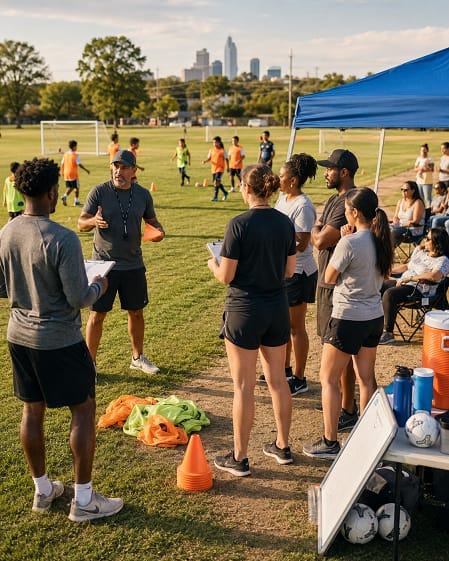
The 2026 Grassroots Symposium & Leadership Weekend is scheduled roughly one month after the World Cup final. That timing matters. It keeps the conversation close enough to the tournament for leaders to feel urgency, but far enough removed to shift from celebration to planning.
A World Cup host region can celebrate full stadiums and still face hard grassroots questions. Are enough affordable programs available? Are fields accessible by neighborhood and income level? Are coaches trained to create positive development environments? Are girls, rural players, immigrant communities, and lower-income families being served? Are public agencies part of the solution, or is youth soccer still left mostly to private clubs and family budgets?
Dallas gives those questions a real backdrop. It is not an abstract soccer market. It is one of the places where American soccer’s scale, opportunity, and inequity are visible at the same time.
How The Symposium Turns Legacy Into A Governance Question
World Cup legacy can become a slogan quickly. The Dallas symposium matters because it frames legacy as a governance challenge.
US Youth Soccer, Common Goal USA, and Soccer Forward are not simply asking whether more kids will be inspired by the World Cup. They are asking who will organize the next phase. That means bringing together leaders who influence local clubs, state associations, community programs, coaching education, nonprofit soccer, player development, and public-facing initiatives.
That is important because American youth soccer is fragmented. Families often navigate overlapping leagues, clubs, tournaments, sanctioning bodies, academies, travel structures, school programs, and nonprofit opportunities. The result can be confusing and expensive. Talented children may find a path if their families have time, money, transportation, and local knowledge. Others may never enter the system.
A symposium cannot fix fragmentation by itself. But it can help identify where coordination is most needed.
The leadership test is whether the event produces shared priorities instead of isolated speeches. If the weekend only celebrates the World Cup, it will miss the moment. If it pushes leaders toward practical commitments around access, coaching, affordability, inclusion, and facilities, it can become a useful post-tournament turning point.
Why Pay-To-Play Is The Problem Beneath The Momentum
The World Cup created attention, but attention does not erase cost.
One of the biggest questions facing American soccer is whether the pay-to-play model still filters too many children out of the development pathway. Travel costs, tournament fees, uniforms, private training, club dues, hotel weekends, and transportation demands can turn youth soccer into a high-cost system. That system can produce elite players, but it also limits discovery.
This is where the Dallas symposium has to be honest. The country cannot build a deeper soccer culture if participation remains too dependent on family income. A child inspired by World Cup 2026 should not need thousands of dollars in annual spending just to find a serious playing environment.
Grassroots leadership should therefore focus on access models that lower barriers. That includes community-based programming, public-private field partnerships, school collaborations, sliding-scale club fees, scholarship systems, coach training in underserved areas, and better local competition structures that reduce unnecessary travel.
The goal should not be to eliminate elite pathways. Elite development matters. The goal should be to widen the base so that elite pathways do not become the only visible sign of soccer seriousness.
A healthier system gives more children a meaningful place to start.
How Soccer Forward Changes The Legacy Frame
U.S. Soccer’s Soccer Forward initiative gives the symposium a broader national context.
Soccer Forward is positioned as a legacy initiative for an extraordinary period in American soccer: the 2026 FIFA Men’s World Cup, Los Angeles 2028, and the 2031 FIFA Women’s World Cup. That sequence gives the United States a rare runway. Instead of one tournament, the country has a multi-event era in which soccer can grow as a civic, cultural, and youth-development force.
That makes the Dallas symposium more than a World Cup debrief. It is part of a longer planning cycle.
The important phrase in Soccer Forward’s framing is not only legacy. It is reach. U.S. Soccer describes its national footprint through member organizations, national teams, and community partners, while emphasizing the goal of bringing soccer everywhere, to everyone in America. That is the right ambition, but it requires operational structure.
Reaching everyone means more than creating one national campaign. It means understanding what communities lack: fields, coaches, safe transportation, affordable leagues, culturally competent programming, adaptive access, girls’ opportunities, school partnerships, and local volunteers.
If Soccer Forward can help organize those needs into a national grassroots strategy, the Dallas symposium could become a meaningful leadership step.
Why Common Goal’s Role Matters
Common Goal’s involvement also gives the symposium a different tone.
The organization has long connected soccer to social impact, community development, cross-cultural exchange, and youth-focused programming around major tournaments. Its partnership with Soccer Forward continues that tradition through Soccer Forward Fests and other efforts designed to connect major soccer events back to communities.
That matters because American soccer legacy should not be defined only by player production. Producing better players is important, but grassroots soccer also serves broader purposes. It can support belonging, physical activity, mental health, leadership, cultural connection, and community trust.
Common Goal’s role helps push the conversation beyond the narrow question of whether the United States can win more matches. The better question is whether the sport can serve more young people in more places.
That is especially important after a World Cup. Major tournaments can create a temporary wave of national pride, but social-impact organizations are often better positioned to ask who benefits from that wave and who remains outside it.
The symposium should use that perspective. Grassroots leadership should be judged not only by how many players enter elite pipelines, but by how many communities gain sustainable soccer access.
Why Coaching Is The Infrastructure Few People See
One of the most important grassroots infrastructure questions is coaching.
Fields matter, but coaches determine whether children stay. A trained coach can make the game feel safe, joyful, challenging, and inclusive. A poorly supported coach can unintentionally push players away. In grassroots soccer, coaching quality is often tied to volunteer availability, local training access, language barriers, time constraints, and club resources.
The Dallas symposium should treat coaching as infrastructure. That means coach education should not be limited to advanced licenses or elite environments. It should include entry-level support for volunteers, parent coaches, community mentors, school-based coaches, and leaders working in underserved areas.
This is where grassroots soccer can either grow or stall. If World Cup 2026 inspires more children to play, local programs will need more adults who can create positive first experiences. Without those adults, increased demand can overload existing systems.
Coach development also connects to equity. Communities with fewer resources may have fewer trained coaches, fewer paid staff, and less access to formal education. A national grassroots strategy should help close that gap.
A stronger soccer country is not built only by better professional academies. It is built by better first coaches.
How Fields And Facilities Shape The Post-World Cup Moment
The symposium will also need to confront the physical side of grassroots growth.
Youth soccer cannot expand without places to play. That sounds obvious, but it is often the point where legacy plans weaken. Cities may celebrate World Cup attention without auditing field capacity, maintenance, lighting, drainage, restrooms, parking, public transit access, and scheduling policies.
In many communities, the problem is not simply that there are too few fields. It is that the available fields are unevenly distributed, poorly maintained, hard to reserve, expensive to rent, or unusable after rain. Some neighborhoods have high-quality complexes. Others rely on aging parks or school fields with limited access.
This is why grassroots leadership needs public agencies in the room. Parks departments, school districts, city councils, county officials, facility operators, and local foundations all shape whether soccer access grows. Youth soccer organizations cannot solve the field problem alone.
The Dallas symposium should therefore connect soccer leadership with civic infrastructure planning. If the World Cup created demand, local governments need to understand what that demand means for parks, schools, and shared-use agreements.
The future of grassroots soccer will depend on whether the sport can become easier to host locally.
Why Girls’ Access Should Be Central Before 2031
The United States is also preparing for the 2031 FIFA Women’s World Cup, which makes girls’ soccer access an urgent part of the post-2026 discussion.
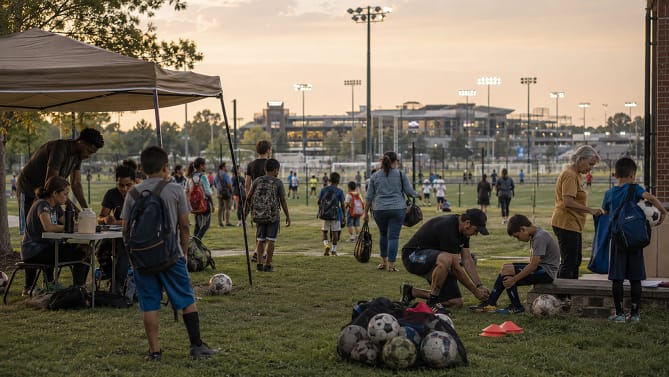
The country already has a strong women’s soccer tradition, but that does not mean every girl has equal access to quality playing environments. Cost, travel, safety, coaching representation, facility availability, and cultural support all affect participation and retention.
A post-World Cup grassroots strategy should not treat girls’ access as a side topic. It should be central.
The 2026 symposium gives leaders a chance to connect the men’s World Cup momentum with the next major women’s soccer horizon. That means building more girls’ programs now, developing more female coaches, protecting safe playing spaces, supporting school and community partnerships, and ensuring that girls in lower-income and rural communities are not left out of the coming soccer cycle.
If the United States wants 2031 to create a deeper women’s soccer legacy, the work has to begin before the tournament arrives. Dallas can help frame that timeline.
The question is not whether women’s soccer is popular. The question is whether the grassroots infrastructure is broad enough to match its potential.
What The Symposium Should Produce
The Dallas symposium will be most valuable if it produces more than inspiration.
The event should push leaders toward practical outcomes: shared access goals, field-improvement priorities, coach-development commitments, common data standards, community partnership models, and clearer pathways between recreational soccer, school soccer, community programs, competitive clubs, and elite development.
It should also create accountability. World Cup legacy should not disappear into general language about growing the game. Leaders should be able to say what will change by 2027, 2028, and 2031.
Useful questions include: How many more children can enter low-cost programs? How many volunteer coaches can be trained? How many public fields can be improved or opened through shared-use agreements? How can local clubs reduce travel burden for younger players? How will underserved communities be represented? How will girls’ programs expand? How will Soccer Forward and Common Goal measure community impact?
Those questions are less glamorous than World Cup highlights, but they are more important for long-term growth.
A leadership weekend should leave with a work plan, not only a mood.
Why Dallas Is A Test Of American Soccer’s Next Era
The United States has already proved that it can host global soccer at scale. The harder test is whether it can organize grassroots soccer at scale.

That is why the US Youth Soccer Grassroots Symposium in Dallas matters. It arrives at the exact moment when American soccer has to decide what kind of legacy it wants. One path treats the World Cup as a commercial peak. The other treats it as a starting point for deeper access, better coaching, stronger facilities, and more coordinated leadership.
The second path is harder. It requires confronting cost, fragmentation, field shortages, coaching gaps, and unequal access. It requires national organizations to work with local communities rather than simply speaking over them. It requires cities and soccer groups to see each other as partners. It requires leaders to measure whether children can actually play.
If the Dallas symposium can move that conversation from ambition to action, it will become more than a meeting. It will become part of the post-World Cup infrastructure story.
The tournament created the spark. Grassroots leadership has to build the system that keeps the game burning.