Houston’s new Mason Park soccer field shows what World Cup legacy should look like when a host city thinks beyond stadiums.
The field, located in Houston’s East End, opened as part of Impact Houston 26, the legacy initiative connected to the city’s role as a 2026 FIFA World Cup host. It is not the largest project attached to the tournament. It is not a stadium renovation, transit megaproject, hotel district, or global fan festival. But in many ways, it may be one of the clearest examples of what long-term sports infrastructure can mean for a local community.
The reason is simple: Mason Park connects soccer access with climate resilience.
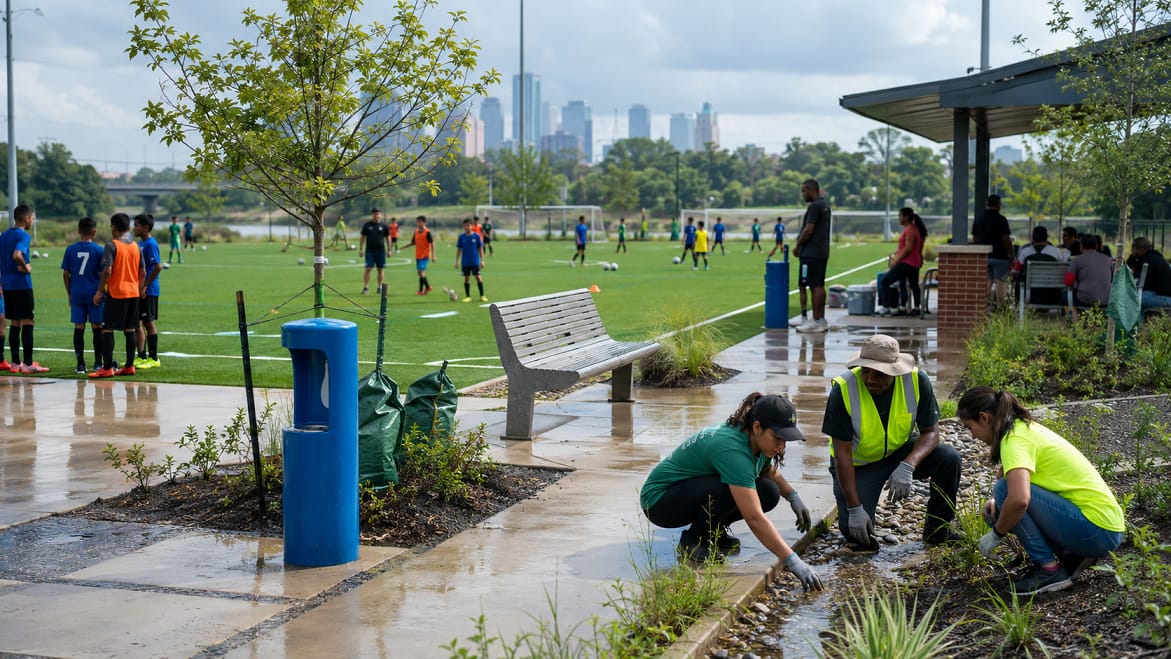
The renovated field includes more than 130 new trees, upgraded stormwater drainage, heat-resistant bench coatings, new picnic areas, and broader park improvements designed to respond to Houston’s real environmental challenges. Heat, flooding, shade, drainage, and neighborhood access are not side issues in Houston. They are central to whether a public sports field can serve families consistently.
That is why this project matters for aplevante.org’s Infrastructure category. World Cup legacy is often discussed in terms of global visibility, tourism, economic impact, stadium attendance, and fan celebrations. Mason Park shifts the conversation to something more durable: whether a global tournament can leave behind better local sports spaces for children, families, and neighborhoods that will still be using them long after the final whistle.
It also builds on the broader need for World Cup 2026 youth soccer infrastructure, where cities must turn short-term soccer excitement into long-term places to play.
Why Mason Park Is More Than A World Cup Side Project
Mason Park’s soccer field is important because it translates a global event into a neighborhood-level asset.

Houston hosted seven World Cup matches, welcomed international fans, activated East Downtown, and used the tournament to test fan movement, public spaces, and civic coordination. Those accomplishments mattered. But a host city’s deeper legacy is measured after the teams leave. If the tournament only creates temporary spectacle, its value fades quickly. If it leaves better public infrastructure, it continues to serve residents.
The Mason Park project does that by focusing on a field used by the local community. It is part of Impact Houston 26, a collaboration involving the Houston 2026 World Cup Host Committee and the Sports Authority Foundation. The program was created to ensure Houston’s role as a World Cup host produces benefits beyond matchdays.
That approach is especially important in soccer. A child inspired by World Cup 2026 needs more than a memory of watching elite teams. That child needs a safe field, a coach, a program, equipment, shade, water access, and reliable playing conditions. Mason Park does not solve all of those needs by itself, but it points in the right direction.
The field turns legacy into a local system. It connects soccer, parks, climate adaptation, youth access, and public health in one place.
How Climate Resilience Became A Soccer Infrastructure Issue
Houston’s climate makes Mason Park a useful case study. The city faces extreme heat, heavy rain, flood risk, humidity, and long outdoor sports seasons. Those conditions affect whether a field is playable, comfortable, safe, and durable.
A soccer field that floods easily is not reliable infrastructure. A field with limited shade becomes harder for children, families, coaches, and older spectators to use during hot months. A park without drainage improvements may lose programming time after storms. A bench that absorbs heat can become unusable on summer afternoons.
That is why the field’s climate-focused features matter. More than 130 new trees can eventually provide shade and cooling benefits. Improved stormwater drainage can help move water away from playing areas and toward a nearby bayou. Heat-resistant bench coatings can improve comfort during high-temperature periods. Picnic areas and park upgrades can help families stay longer and use the space beyond organized games.
These are not decorative details. They are part of the field’s operating capacity.
Sports infrastructure is often judged by construction cost, seating capacity, and visual appeal. Mason Park suggests a better question: can the facility keep serving the community under the conditions the community actually faces?
For Houston, that means climate resilience must be part of soccer planning.
Why The Sustainable Soccer Fields Toolkit Matters
The Mason Park field was inspired by Impact Houston 26’s Sustainable Soccer Fields Toolkit, according to the Sports Authority Foundation. That detail is important because the project is not only one field. It is a test case for a model.
A toolkit can help cities, counties, parks departments, sponsors, and community organizations think more consistently about how to build and renovate fields. Instead of treating every upgrade as a one-off project, a toolkit can identify repeatable principles: shade, drainage, heat mitigation, material choices, maintenance, community use, stormwater planning, accessibility, and long-term durability.
The Mason Park field announcement framed the project as a demonstration of how community soccer fields can be redesigned for changing conditions. That matters because many cities are facing the same pressures. Youth sports demand is rising, weather is becoming harder to plan around, and public fields are often asked to serve multiple sports with limited maintenance budgets.
A field toolkit also moves the legacy conversation from inspiration to standards. It asks whether future soccer fields should be designed with climate conditions in mind from the beginning. It also raises the bar for corporate-backed legacy projects. Sponsorship should not only fund signs, ceremonies, and short-term clinics. It should help build durable public assets.
Mason Park is useful because it gives Houston a physical example to evaluate.
How The Free Kick Program Expands The Legacy Question
Mason Park is part of a larger field-access strategy. Impact Houston 26’s Free Kick Program is designed to refurbish 23 local soccer pitches across the Houston area. That number matters because World Cup legacy becomes more credible when it spreads beyond a single showcase site.
One field can be symbolic. A network of fields can change access.
Houston’s youth soccer demand is not concentrated in one neighborhood. Families across the region need safe and affordable places to play. Some communities have better fields, lighting, drainage, coaching networks, and club access than others. A legacy program that improves multiple pitches can begin to address those disparities.
The Grow the Game legacy initiative has framed soccer access as a way to convert World Cup visibility into neighborhood-level investment. That is the right approach. The tournament can inspire new interest, but field capacity determines whether that interest becomes participation.
The challenge will be consistency. If Mason Park becomes the standard, the next question is how many other fields can receive comparable planning. Not every pitch will need the same climate solutions, but every pitch should be evaluated through the same basic lens: Can children use it safely? Can it withstand weather? Is it accessible? Is it maintained? Does it support local programming? Does it serve the surrounding community beyond tournament branding?
That is how a World Cup legacy program becomes infrastructure strategy.
Why East End Placement Gives The Project Civic Value
The field’s location in Houston’s East End is part of its significance.

The East End is not simply a backdrop. It is a historic, culturally rich, working neighborhood with deep community identity and strong ties to soccer culture. Placing a resilient field there makes the project more meaningful than if it were isolated inside a stadium district or tourist corridor.
A neighborhood field supports everyday use. It can serve youth practices, informal pickup games, school partnerships, family gatherings, local clinics, and community programming. It becomes part of daily life rather than a temporary event asset.
That distinction matters because large sports events often concentrate improvements near major venues, downtown corridors, airports, and visitor zones. Mason Park shows a different logic. It brings investment into a community park and ties World Cup legacy to local recreation.
The East End location also gives Houston a chance to demonstrate that sports infrastructure can respect community identity. A field upgrade should not feel imposed from above. It should strengthen what the neighborhood already values.
If the field becomes a trusted place for families and young players, its legacy will not depend on the World Cup logo. It will depend on use.
How Houston’s Green Corridor Fits The Same Infrastructure Story
Mason Park is not the only Houston World Cup project that connected sports with long-term urban improvements.
Houston’s Green Corridor project created a 14-mile sustainable transit loop linking NRG Stadium and the FIFA Fan Festival in EaDo. The corridor used existing infrastructure such as METRO light rail and the Columbia Tap Trail, while broader improvements included added greenery, new trees, shade structures, water fountains, gardens, air-quality monitors, cooling panels, and pedestrian upgrades.
That matters because it shows Houston’s World Cup planning was not limited to match operations. The city used the tournament to test and accelerate public-space improvements that can continue serving residents.
Mason Park fits that same pattern. It takes the idea of event legacy and applies it to neighborhood recreation. The Green Corridor focused on fan movement and public-space experience. Mason Park focuses on youth soccer, park comfort, drainage, and climate adaptation. Together, they point toward a larger planning philosophy: sports events should leave cities more usable.
That is a valuable lesson for future host cities. The best World Cup infrastructure is not only the infrastructure that helps fans arrive for a match. It is the infrastructure that improves daily life after the event.
Why Trees, Drainage, And Benches Belong In Sports Planning
The most interesting part of Mason Park is that its most important details are not glamorous.
Trees, drainage, benches, and picnic areas do not usually dominate sports infrastructure headlines. They should.
For youth sports families, these details shape the actual experience of using a field. Shade determines whether parents and grandparents can comfortably watch. Drainage determines whether practices are canceled after storms. Benches determine whether rest areas are usable. Picnic areas turn a field into a gathering place. Trees and landscaping can reduce heat and improve the park environment.
This is especially important in public parks. Unlike private training centers, public fields often serve multiple needs at once. They are sports venues, family spaces, neighborhood commons, walking areas, youth-development platforms, and public-health assets.
That makes the design requirements more complex. A public soccer field should not be evaluated only by the quality of its playing surface. It should be evaluated by the whole experience surrounding it.
Mason Park’s climate-focused upgrades show that Houston is beginning to treat small-scale design details as major infrastructure decisions.
What Other U.S. Host Cities Can Learn From Mason Park
Mason Park offers a useful model for other U.S. cities trying to convert major sports events into local benefits.
First, legacy should be placed where residents can use it. A field in a neighborhood park may create more long-term participation value than a temporary activation near a stadium.
Second, climate resilience should be built into sports planning. Heat, flooding, air quality, drainage, and shade affect whether youth sports infrastructure works.
Third, field upgrades should connect to programming. A renovated pitch is more valuable when paired with clinics, community partners, equipment access, youth leagues, and coaching support.
Fourth, sponsors should be challenged to support durable assets. Corporate funding can be powerful when it helps build real community infrastructure rather than short-term visibility.
Fifth, cities should treat pilot projects as templates. If Mason Park works, the next step is applying its lessons across more fields.
These lessons matter beyond Houston. World Cup 2026 host cities such as Dallas, Miami, Atlanta, Kansas City, Philadelphia, Seattle, Los Angeles, Boston, New York/New Jersey, and the San Francisco Bay Area all face similar questions. How should a global tournament change local youth sports access? How should public parks be upgraded? How should cities design for heat and rain? How can host committees avoid symbolic legacy projects that fade after the event?
Mason Park provides one practical answer: start with a field, design it for the local climate, and make it useful to the neighborhood.
Why Climate-Resilient Fields Are A Youth Development Tool
Youth development depends on repetition. Children improve when they can play consistently. Coaches build programs when they can schedule reliably. Families stay engaged when the environment feels safe, accessible, and welcoming.

Climate stress disrupts that rhythm. Flooded fields, unsafe heat, limited shade, poor surfaces, and uncomfortable sidelines all reduce participation. They also hit some communities harder than others, especially neighborhoods that rely on public parks rather than private facilities.
That is why climate-resilient fields are youth development tools. They protect access.
Mason Park’s upgrades should be understood through that lens. The field is not only a soccer surface. It is an attempt to make soccer more reliable in a city where weather can limit outdoor play. It is also a reminder that equitable youth sports access requires environmental planning.
A child cannot benefit from World Cup excitement if the local field is unusable after rain or unbearable in the heat. Infrastructure has to meet the reality of the place.
Houston’s Mason Park project recognizes that reality.
Why This Is The Kind Of Legacy That Lasts
The strongest World Cup legacy projects are not always the biggest. They are the ones that remain useful when the global audience leaves.
Mason Park has that potential because it is rooted in everyday needs. It gives young players a place to play. It improves a public park. It responds to heat and flooding. It adds shade and comfort. It connects a global soccer event to neighborhood recreation. It gives Impact Houston 26 a tangible example of what legacy can mean.
That does not mean the project should be treated as complete proof of success. Houston should track how the field is used, how maintenance is handled, whether drainage performs during heavy rain, whether tree canopy matures, whether local programs grow, and whether similar upgrades reach other neighborhoods. Real legacy requires measurement.
But the direction is right.
World Cup 2026 gave Houston a platform. Mason Park shows how that platform can become public sports infrastructure. The project takes the language of legacy and turns it into grass, shade, drainage, benches, and a better place for young people to play.
That is what climate-resilient sports infrastructure looks like at neighborhood scale. It is not only built for the tournament. It is built for the seasons after it.