
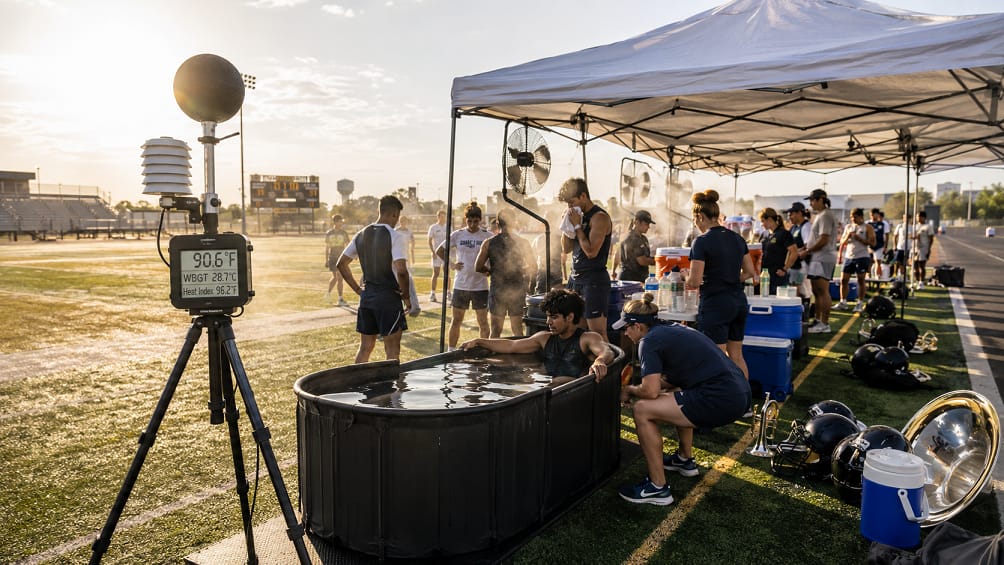
Texas’ new WBGT heat rules are more than a medical update for high school sports. They are a warning that athletic infrastructure now has to be designed around climate, safety, and competitive equity.
Beginning August 1, 2026, the University Interscholastic League is making Wet Bulb Globe Temperature monitoring a required standard for outdoor UIL athletic and marching band activities during the 2026-27 school year. That change moves Texas from recommendation to mandate after two years of WBGT guidance. It also changes how coaches, athletic directors, trainers, band directors, school administrators, and facilities planners must think about practice.
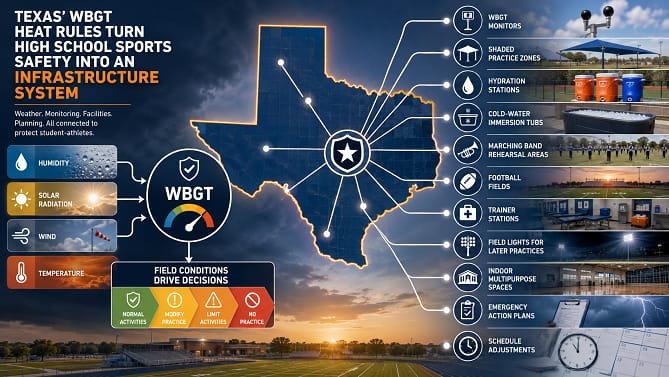
The new standard matters because WBGT is more complete than a basic heat-index reading. It accounts for temperature, relative humidity, wind speed, and solar radiation. In practical terms, it tries to measure what athletes and marching band members actually experience while standing, running, blocking, sprinting, rehearsing, or conditioning under Texas sun.
For aplevante.org’s Infrastructure category, this is the key point: heat safety is no longer only a coaching decision. It is now a facilities issue. Schools with shaded areas, turf management plans, rapid cooling equipment, athletic trainers, weather systems, flexible schedules, and indoor or covered practice options will have more tools to comply. Schools without those resources may face a tougher operational burden.
That connects directly to the broader need for heat maps and safe play, where climate data is already changing how youth sports programs schedule, monitor, and protect athletes. Texas’ WBGT mandate shows that the next phase is not theoretical. It is arriving on practice fields now.
Why WBGT Changes The Meaning Of Heat Safety
For years, many programs treated heat safety as a matter of water breaks, coach judgment, and common sense. The new UIL standard makes the process more precise.
The official 2026-2027 UIL heat stress plan states that WBGT monitoring is now a required standard for outdoor UIL athletic and marching band activities. It also says WBGT estimates heat stress by combining temperature, humidity, wind speed, and solar radiation through a set of thermometer readings.
That matters because two days with the same air temperature can feel very different on a football field. A humid, still, sunny afternoon on artificial turf can create much higher body stress than a breezy day in partial shade. Traditional temperature readings often miss that difference.
WBGT turns those conditions into a planning tool. It tells schools when to modify activity, increase rest, limit equipment, shorten practice, or stop outdoor work. It shifts heat safety from a vague concern to a measurable operating condition.
That is a major cultural change for Texas high school sports. The question is no longer simply whether athletes can “handle the heat.” The question is whether the school has the systems to measure, respond, and protect them.
How The New Rules Change Practice Operations
The UIL plan creates a new operational rhythm for schools.
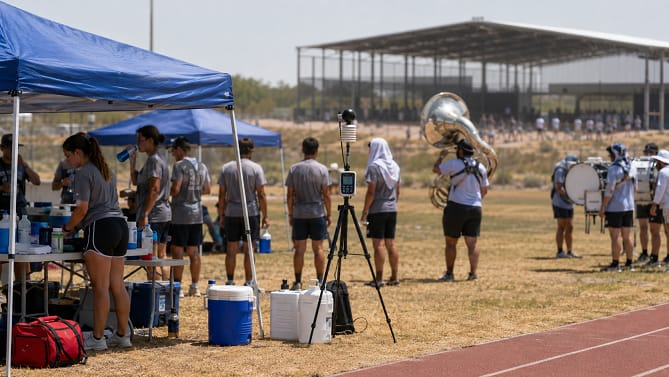
Readings must be taken within 15 minutes before practice to ensure accuracy. When practices are outside in specified WBGT ranges, schools must use a scientifically approved instrument or other proven method, such as an approved internet-based weather station software or application. If an on-site instrument is used, it should be set up before practice and checked before activity begins. WBGT readings should also be taken every 30 minutes during practice.
That is not a small adjustment. It means practice planning now includes monitoring, documentation, staffing, and real-time decision-making. A coach cannot simply set a schedule in July and run it unchanged through August. Conditions may force modifications during the practice window.
The UIL plan also defines practice broadly, from the time participants report to the outdoor practice or workout area until they leave. That matters because heat exposure begins before the first drill. Pregame warmups, conditioning, marching band rehearsal setup, sideline time, and transition periods all count in the real world of heat stress.
This is why infrastructure matters. Schools need reliable monitoring tools. They need staff trained to use them. They need communication systems that allow coaches and directors to change plans quickly. They need enough shade, water, and cooling capacity to make those changes meaningful.
A rule is only as strong as the system built around it.
Why Football Is The Center Of The Debate
The rule applies beyond football, including outdoor athletics and marching band. But football will naturally become the center of public debate because of timing, equipment, and Texas culture.
August is when football practices ramp up. It is also when much of Texas faces extreme heat. Football players wear helmets, pads, and uniforms that can trap heat and limit cooling. Practices involve repeated bursts of exertion, collisions, conditioning, and position drills. Marching band members also face long outdoor rehearsals, uniforms, equipment, and extended standing periods.
That combination makes WBGT compliance a major planning issue for fall programs.
Coaches now have to balance safety, preparation, roster development, installation, conditioning, and competitive expectations. Some may shift practices earlier in the morning or later in the evening. Others may shorten outdoor work, split sessions, adjust equipment, or move walk-throughs indoors.
Those changes can be positive. They can reduce risk and force smarter planning. But they also create pressure. Schools with flexible staffing, indoor spaces, lighting, and transportation options may adapt more easily. Smaller or lower-resource programs may struggle.
That is why the rule should be understood as a safety standard and an infrastructure challenge at the same time.
How Indoor Facilities Create A Competitive Equity Issue
The new WBGT rules will expose a gap that already exists in Texas high school sports: some schools have indoor or covered practice facilities, and others do not.
An indoor facility can change everything. When outdoor WBGT conditions become restrictive, a program with indoor turf, covered space, air conditioning, or shaded structures may continue productive work with fewer interruptions. A program without those options may have to delay, shorten, or cancel more activity.
That does not mean every school needs a multimillion-dollar indoor football building. It does mean facility inequality will become more visible under a heat-based system.
Recent Texas reporting has already highlighted the rise of expensive covered or indoor practice investments. Athens ISD, for example, announced a project centered on a full-sized artificial turf football field under an open-air metal pavilion, along with other athletic upgrades. That kind of facility can support football, band, dance, drill teams, and other school activities. It also shows how heat rules can push schools to rethink what “athletic infrastructure” means.
The concern is that wealthy districts may solve heat compliance with buildings, while lower-resource schools rely on schedule changes and improvisation. If that happens, heat safety becomes tied to local tax base and bond capacity.
That is the equity issue Texas must confront.
Why Rapid Cooling Zones Are Now Core Infrastructure
One of the most important parts of the UIL plan is the requirement around rapid cooling.
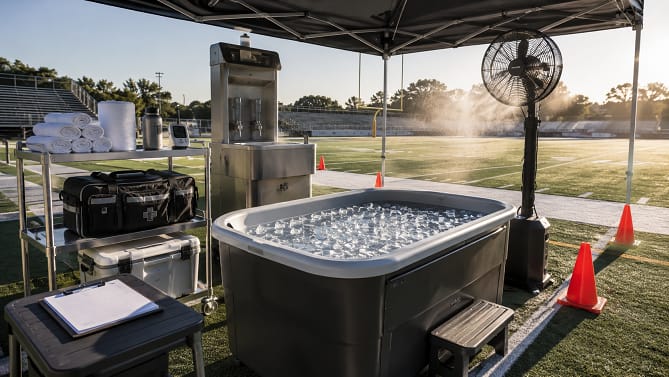
The plan reminds schools that they must have equipment that allows for full-body immersion in ice water if an individual experiences heat illness and distress. It also requires rapid cooling zones for outdoor athletic and marching band activities at specified WBGT thresholds. These zones must have immediate availability of cold-water immersion tubs or tarps that can be filled with ice and water, with additional cooling tools such as ice sponges, towels, water misters, and shade encouraged.
That makes emergency heat response part of the facility setup.
A rapid cooling zone is not an optional sideline accessory. It is now a practical safety station. Schools must think about where it sits, how quickly it can be accessed, who is trained to use it, where ice comes from, how water is supplied, how privacy is handled, and how emergency medical services are integrated into the response plan.
This is exactly why heat safety belongs in the infrastructure conversation. A school can have a policy on paper and still fail if the equipment is not ready, the zone is too far away, or staff are not trained.
The best programs will treat rapid cooling like AED access: visible, planned, practiced, and taken seriously.
How Scheduling Becomes A Facilities Decision
The new WBGT rules will also change how schools think about time.
In hot conditions, the safest practice window may be early morning, late evening, or indoors. But moving practice is not always simple. Schools must coordinate buses, athletic trainers, coaches, teachers, custodial staff, lighting, parent pickup, student jobs, meals, academic schedules, and band rehearsals. Once school starts, flexibility becomes even harder.
This is where scheduling becomes a facilities decision.
A school with lights can practice later. A school with covered space can shift drills out of direct sun. A school with an air-conditioned gym or indoor turf can move walk-throughs inside. A school with enough locker room and hydration space can better manage cooling breaks. A school without those assets may have fewer safe options.
The UIL plan even recommends that schools consider game-time adjustments and other contest modifications during high WBGT conditions. That is important because heat does not only affect practices. It affects Friday night games, sub-varsity games, middle school contests, band performances, officials, cheer squads, trainers, and fans.
Heat-aware scheduling has to become part of the whole athletic calendar.
Why Marching Band Belongs In The Same Safety Conversation
The UIL plan applies to marching band activities too, and that should not be overlooked.
In Texas, marching band is physically demanding. Students rehearse outdoors for long periods, carry instruments, wear uniforms, repeat formations, and perform in direct sun. Band directors face many of the same heat-management questions as football coaches: when to rehearse, how to build breaks, where to find shade, how to monitor conditions, and how to respond if a student shows signs of heat illness.
This shared standard is important because it broadens the idea of school sports infrastructure. Heat safety is not only for athletes in helmets. It is for every student participating in organized outdoor school activity.
A smart district will not build one heat plan for football and a weaker version for everyone else. It will create a campus-wide system: WBGT monitoring, rapid cooling access, hydration policies, shaded areas, emergency action procedures, communication plans, and staff training across athletics and fine arts.
That is how safety culture becomes institutional rather than sport-specific.
What Districts Should Invest In Next
The UIL mandate should push Texas districts to review their facilities and emergency systems before the pressure of August practices.
Some investments are basic: approved WBGT monitoring tools, ice tubs, cooling tarps, water access, shade tents, misters, medical supplies, and clear emergency action plans. Others are operational: staff training, documentation systems, practice-modification protocols, communication trees, and parent education.
Larger investments may include covered practice areas, shaded sideline structures, field lighting, indoor multipurpose spaces, turf-surface reviews, locker room cooling, and improved hydration stations. Districts should also examine whether artificial turf fields are creating additional heat exposure and whether alternative surfaces, shade planning, or scheduling changes are needed.
The key is to avoid thinking only in terms of football.
A covered or cooled multipurpose space can serve football, soccer, marching band, track, cross-country, cheer, physical education, special events, and community use. If schools present heat-resilience projects only as football luxuries, they may miss the broader public value. If they frame them as student-safety infrastructure, the case becomes stronger.
Heat adaptation should be built for the whole campus.
Why The Rule May Change Texas Sports Culture
The hardest part of the transition may be cultural.
Texas high school sports have long celebrated toughness, summer conditioning, and the discipline of practicing through discomfort. The new WBGT rules do not eliminate toughness. They redefine responsible leadership.
A coach can still demand effort. A band director can still expect precision. An athlete can still build endurance. But student safety now has a more measurable framework. Ignoring dangerous conditions is no longer a badge of seriousness. It is a failure of planning.
This is an important shift. The best leaders will not treat WBGT as an obstacle to preparation. They will treat it as information. If conditions require modification, good programs will adjust and still teach, train, and compete effectively.
That is where infrastructure and culture meet. A school with good systems can protect students without losing competitive focus. A school with weak systems may feel forced to choose between safety and preparation.
The UIL mandate should push every district toward the first model.
Why This Is A Climate Adaptation Story
Texas’ WBGT rules are also part of a larger climate adaptation story in youth sports.
Extreme heat is becoming harder to treat as a temporary inconvenience. Summer practice windows, outdoor tournaments, marching rehearsals, and preseason conditioning all face more scrutiny as heat risk becomes more measurable. Schools cannot assume that the old calendar will always work.
That does not mean outdoor sports are going away. It means outdoor sports need smarter infrastructure.
Shade, hydration, cooling, surface selection, weather data, emergency response, scheduling, and indoor flexibility are now part of the cost of running safe youth athletics. Communities that recognize this early will protect students better. Communities that delay may find themselves reacting after a crisis.
Texas is one of the most important places for this conversation because high school sports are so culturally central. If Texas can normalize WBGT-based planning, it can influence other states facing similar conditions.
The rule is not just about compliance. It is about the future of outdoor school sports in a hotter environment.
What Success Should Look Like
Success should not be measured only by whether schools buy WBGT devices.
A successful implementation would mean fewer heat emergencies, better documentation, stronger emergency action plans, well-trained coaches and directors, reliable rapid cooling access, smarter practice schedules, and clearer communication with families. It would also mean that facility improvements reach more than the wealthiest districts.
The state should watch for unintended consequences. Are lower-resource schools losing more practice time? Are some districts struggling to provide rapid cooling equipment? Are marching bands receiving equal attention? Are rural schools getting enough support? Are districts documenting readings consistently? Are contest modifications being used when needed?
Those questions matter because safety rules can create progress and reveal inequality at the same time.
The best response is not to weaken the standard. It is to strengthen the infrastructure around it.
Why Heat Safety Is Now A Facilities Test
Texas’ new WBGT rules make one thing clear: heat safety is no longer just a sideline issue.
It is a facilities test, a staffing test, a scheduling test, a medical-readiness test, and a leadership test. Every school must now show that it can measure heat risk, modify activity, provide hydration, prepare rapid cooling, and protect students in outdoor conditions.
That is a major step forward. But it also raises a challenge for Texas communities. If schools are going to ask students to train, rehearse, and compete in extreme heat, they must invest in the infrastructure that makes that participation safe.
The future of high school sports will not be defined only by stadiums, scoreboards, and indoor practice palaces. It will also be defined by shade, water, WBGT monitors, cooling tubs, flexible calendars, trained adults, and fields that can be used without putting students at unnecessary risk.
Texas’ WBGT mandate is a safety rule. It is also a message: the climate around youth sports has changed, and the infrastructure has to change with it.