
Belmont Park’s new Tapeta track is more than a surface upgrade. It is a signal that modern horse racing infrastructure is becoming a year-round planning story.
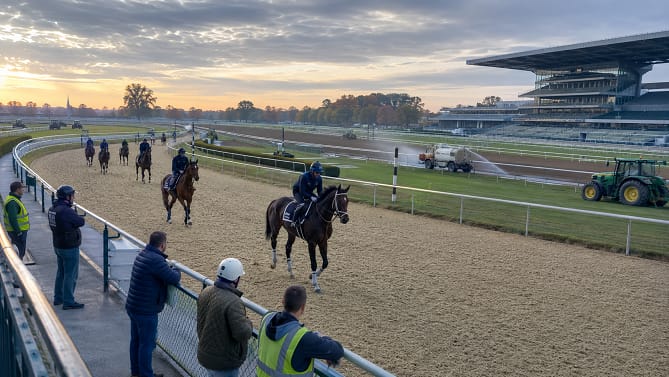
On June 29, 2026, the New York Racing Association unveiled the new one-mile Tapeta inner track at Belmont Park in Elmont, New York. The opening came during the final phase of a three-year project to transform Belmont Park into a modern racing and entertainment destination, with live racing scheduled to return on September 18, 2026. The first horses to step onto the new surface were Private Flight, trained by Mark Hennig and ridden in morning exercise by Ricardo Fragoso, and Mo Kreesa, also from Hennig’s barn, with Cirilo Paredes up.
That detail matters because this was not a ceremonial ribbon-cutting. It was the first working test of a new training and racing system.
Belmont Park’s redevelopment includes four newly constructed racing surfaces: the traditional 1 1/2-mile dirt track, two turf courses, and the one-mile Tapeta oval. NYRA has said the Tapeta will be used as the exclusive winter racing surface at the new Belmont Park, provide a year-round training option for horses stabled on the property, and serve as a backup when turf races are moved because of inclement weather.
For aplevante.org’s Infrastructure category, that is the real story. Horse racing facilities are no longer judged only by historic grandstands, famous races, and crowd capacity. They are increasingly judged by whether they can operate through weather, protect horsemen’s training schedules, support major-event readiness, serve fans, and create flexible venue systems across the calendar.
Belmont’s new Tapeta track shows how sports infrastructure that lasts must now be built for resilience, not only tradition.
Why The Tapeta Track Changes Belmont Park’s Operating Model
Belmont Park has always been one of American racing’s defining venues, but the new Tapeta surface changes how the property can function.

A traditional racetrack operating model depends heavily on seasonal conditions, dirt maintenance, turf preservation, and weather management. When rain, cold, freeze-thaw cycles, or turf wear disrupt schedules, tracks need alternatives. Without those alternatives, training windows shrink, turf races move unpredictably, field sizes can be affected, and horsemen lose consistency.
Tapeta gives Belmont a new layer of operational flexibility.
Developed as a synthetic racing and training surface, Tapeta is made from silica sand, wax, and fibers. NYRA described it as a surface that has been used and tested at racing and training facilities around the world, with consistency in cold conditions and heavy rain. Michael Dickinson, the former jockey and trainer behind Tapeta Footings, was on site for the opening and emphasized safety and consistency as central benefits.
That is exactly why the surface matters as infrastructure. Belmont is not simply adding another oval. It is adding a planning tool.
The one-mile Tapeta track gives trainers another option for horse preparation. It gives racing officials a more weather-resistant surface for winter racing. It gives the venue more flexibility when turf cannot be used. It also supports a broader calendar in which Belmont can consolidate racing activity after Aqueduct’s closure and prepare for major events such as the Belmont Stakes returning to Long Island in 2027 and the Breeders’ Cup World Championships later that year.
A racing surface is no longer just a competition lane. It is an operating system.
How Year-Round Training Became A Infrastructure Priority
The phrase “year-round training option” is one of the most important parts of the Belmont announcement.
Horse racing depends on daily routines. Horses need safe, consistent, and varied surfaces. Trainers need reliable morning hours. Exercise riders need predictable conditions. Veterinarians and backstretch staff need facilities that reduce avoidable disruption. Owners and racing offices need horses prepared well enough to support competitive cards.
When a venue lacks surface flexibility, the whole system becomes more fragile.
Belmont’s new Tapeta track expands the choices available to horsemen. Mark Hennig described the surface as giving horses a “change of pace,” saying it can help keep horses mentally brighter and happier when their training experience varies from the Tapeta to the main track, training track, round pen, or other routines. That is an important insight because training infrastructure is not only physical. It affects horse management.
A year-round planning model recognizes that the most important work at a racetrack often happens before spectators arrive. Morning training, surface maintenance, barn routines, veterinary protocols, and weather planning all shape what fans eventually see in the afternoon.
The Tapeta track strengthens that behind-the-scenes system. It gives Belmont another way to manage horses during winter, wet weather, and high-demand periods.
That is why this project belongs in the infrastructure conversation, not only racing news.
Why Winter Racing Makes Surface Flexibility Essential
NYRA has said the Tapeta will be the exclusive winter racing surface at the new Belmont Park. That is a major operational decision.
Winter racing creates a different facility challenge than spring, summer, or fall racing. Dirt surfaces must be maintained through cold conditions, moisture changes, and freeze-related complications. Turf courses need rest and protection. Weather can quickly turn a routine racing week into a scheduling problem.
A synthetic winter surface can help stabilize that calendar.
For Belmont, that matters even more because New York racing is entering a new venue structure. Aqueduct Racetrack, which long carried a major share of New York’s winter racing identity, has closed after 132 years. That puts more pressure on the redeveloped Belmont Park to serve as a consolidated racing hub.
The Tapeta track is therefore not just a feature. It is part of the transition plan.
If Belmont is expected to handle more year-round racing responsibility, it needs surfaces that can support different seasons. The Tapeta gives NYRA a dedicated winter tool while the dirt and turf courses serve their own roles across the broader calendar.
This is how horse racing infrastructure is evolving. The question is no longer whether a racetrack has a famous dirt oval. The question is whether the whole facility can absorb seasonal demands without compromising safety, consistency, or racing quality.
How Weather Resilience Shapes The Future Of Racing Venues
Weather resilience is becoming central to sports infrastructure across the United States, and horse racing is no exception.
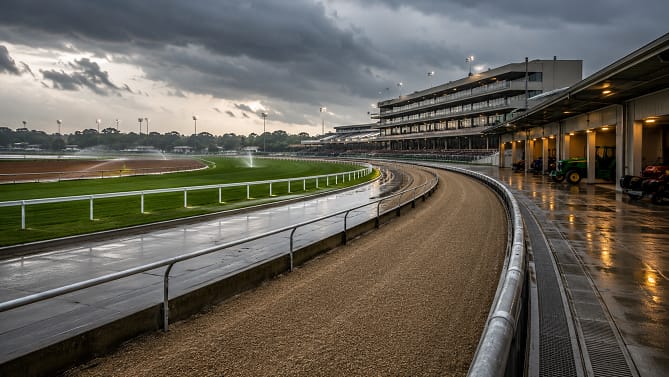
Racing is unusually sensitive to surface conditions. Heavy rain can force races off turf. Cold can complicate maintenance. Heat affects horses, workers, and fans. Drainage, irrigation, footing, and backup surfaces all influence whether a meet can operate smoothly.
Belmont’s redevelopment recognizes that reality.
The Tapeta track gives NYRA another option when turf races are moved because of inclement weather. The two turf courses have also been renovated and expanded to create additional running lanes, with a state-of-the-art irrigation system served by an on-site pump station drawing from a new infield irrigation pond. The main dirt track has been rebuilt with a limestone base and clay pad below the racing surface, matching a structure that NYRA says has worked effectively at Saratoga across varied weather conditions.
Those details show a venue being designed as a surface ecosystem.
A modern racetrack cannot rely on one kind of footing and hope the calendar cooperates. It needs a mix of surfaces, drainage systems, irrigation, maintenance protocols, and training options that work together. Belmont’s four-surface model is a response to that new reality.
Climate adaptation in racing may not always look like solar panels or cooling centers. Sometimes it looks like a synthetic oval, an irrigation pond, a new base layer, and a better plan for races moved off turf.
Why The Breeders’ Cup Raises The Stakes
Belmont Park’s new surface system also has to be understood in the context of the 2027 Breeders’ Cup World Championships.
Breeders’ Cup Limited and NYRA have confirmed that the 2027 World Championships will be held at Belmont Park on October 29–30, 2027. It will mark the event’s first return to New York since 2005 and its first edition at the new Belmont Park. NYRA has described the redevelopment as a $455 million capital construction project designed to create a world-class racing and entertainment destination on Long Island.
That makes every infrastructure detail more important.
The Breeders’ Cup is not a normal race weekend. It brings international horses, owners, trainers, jockeys, media, fans, broadcast partners, hospitality guests, regulators, and global attention. The venue must support elite competition, training, shipping, horse safety, fan circulation, paddock visibility, broadcast production, hospitality, security, and operations over a high-pressure two-day festival.
A new Tapeta track helps in that larger readiness story even if the Breeders’ Cup’s marquee races are not defined by it alone. It supports training flexibility. It strengthens weather contingency planning. It shows that the redeveloped venue is being built for more than one racing surface or one famous day.
Major events expose weaknesses in infrastructure. Belmont’s redevelopment is trying to reduce those weaknesses before the world arrives.
How Belmont’s Fan And Community Design Adds Another Layer
The Tapeta track is the most specific new infrastructure story, but it sits inside a larger redevelopment.
The reimagined Belmont Park is centered around a modern grandstand with new fan amenities and hospitality offerings. NYRA has also said the project will unlock the infield and provide fans and the surrounding community with more generally accessible green space than before. That is significant because racetrack modernization is not only about what happens on the track.
Racing venues have to compete with other sports and entertainment destinations. Fans now expect better sightlines, easier movement, hospitality choices, cleaner public spaces, digital access, and more comfortable event-day experiences. At the same time, communities increasingly expect major venues to provide broader public value.
Belmont’s challenge is to connect elite racing with modern public-space expectations.
The new surfaces support the racing side. The grandstand, paddock, infield access, and green space support the fan and community side. Together, they suggest that the racetrack is being rebuilt as a year-round venue rather than a collection of race days.
That is the direction major sports infrastructure is moving. Venues must now justify themselves across more uses, more seasons, and more audiences.
Why Aqueduct’s Closure Makes Belmont’s Role Bigger
Belmont’s infrastructure story also reflects the end of another New York racing era.
Aqueduct Racetrack in Queens closed after 132 years, marking the end of a long chapter in New York City racing. That closure shifts more attention and responsibility toward Belmont Park as the central downstate racing venue. It also makes Belmont’s redevelopment more than a modernization project. It is a consolidation project.
Consolidation increases pressure.
A venue that absorbs a larger share of regional racing needs must be more reliable. It must handle training, racing, stabling, fans, major events, and seasonal variation. It must serve horsemen who previously depended on multiple facilities. It must maintain continuity while creating a new identity.
The Tapeta track helps answer that pressure by adding capacity and flexibility. But it also raises expectations. If Belmont is going to become the long-term anchor for New York racing, its infrastructure must work in February as well as October, in rain as well as sun, for morning training as well as championship afternoons.
That is why the new surface is more than a technical upgrade. It is part of a regional racing reset.
How Racing Surfaces Became A Safety Conversation
Horse racing’s future depends partly on public trust, and surface safety is central to that trust.
Racing has faced heightened scrutiny around equine safety, track conditions, medication rules, and training practices. While no single surface can solve every issue, consistent footing is one of the infrastructure areas most directly tied to safety perception and operational confidence.
Michael Dickinson’s comments at Belmont’s Tapeta opening focused on safety and consistency. He noted that the surface may vary somewhat with weather, but not as much as turf or dirt, adding that trainers can know more clearly what they are getting. That kind of predictability matters.
For trainers, consistency supports planning. For horses, it can support safer daily routines. For racing operators, it can reduce weather-related uncertainty. For the public, it signals that venue modernization is paying attention to the sport’s most sensitive issue.
A modern racetrack cannot ask fans and participants to trust tradition alone. It has to show investment in safer, more consistent infrastructure.
Belmont’s Tapeta track is part of that argument.
Why The Surface System Matters More Than Any Single Track
The most important part of Belmont’s redevelopment may be the combination of surfaces.
A dirt track, two turf courses, a Tapeta oval, a dirt training track, a covered jogging barn with synthetic surface, and a Tapeta pony track create a layered system. That system gives horsemen options and gives racing officials more ways to manage weather, training, and race placement.
That is a more sophisticated model than treating each track as an isolated asset.
The dirt track serves racing tradition and major dirt events. The turf courses support grass racing and international-style competition. The Tapeta supports winter racing, weather contingencies, and year-round training. The training surfaces and jogging options help horses prepare in different ways. Together, they create resilience.
That is what modern sports infrastructure increasingly requires: redundancy, flexibility, and specialized spaces that support the whole operation.
Belmont’s Tapeta track matters because it strengthens the system. It is not replacing the identity of Belmont Park. It is helping the venue operate with more tools.
What Other Racing Venues Can Learn From Belmont
Belmont Park’s redevelopment offers several lessons for other racing venues.
First, surface planning should be connected to the calendar. A track’s racing schedule, training needs, climate, and major-event ambitions should shape what surfaces it builds and how it maintains them.
Second, weather resilience should be treated as infrastructure, not inconvenience. Heavy rain, cold, turf preservation, and winter racing all require planning before they become problems.
Third, horsemen’s daily routines should be part of facility design. Training options, surface variety, and predictable morning access affect the quality of the racing product.
Fourth, fan spaces and racing surfaces should be modernized together. A world-class grandstand without reliable racing infrastructure is incomplete. Reliable racing surfaces without a modern fan experience are also incomplete.
Fifth, major-event hosting should be used as a planning deadline. The 2027 Breeders’ Cup gives Belmont a visible target, but the infrastructure must work long before and long after that weekend.
Those lessons apply beyond New York. Any racing venue trying to remain relevant must think in full-season terms.
Why Year-Round Planning Is The Future Of Horse Racing Infrastructure
Belmont Park’s Tapeta track shows that the future of racing infrastructure is not only about bigger buildings or more premium hospitality. It is about operating resilience.

A racetrack has to train horses in the morning, host fans in the afternoon, manage weather across seasons, protect turf, support dirt racing, handle major events, provide safer surfaces, serve horsemen, and maintain community relevance. Those demands do not fit into an old model built around a few signature dates.
The new Belmont Park is being designed for a broader calendar. The Tapeta track is one of the clearest signs of that shift.
It gives the venue a winter racing surface. It gives horsemen a year-round training option. It gives racing officials a weather contingency. It strengthens the facility before the Belmont Stakes returns to Long Island in 2027 and before the Breeders’ Cup arrives that October.
That is why the Tapeta opening matters. It shows that horse racing infrastructure is becoming more adaptive, more technical, and more calendar-driven.
Belmont Park’s history still matters. But its future will depend on whether the new facility can operate safely and effectively across the full year. The Tapeta track is a major step toward that future.