The 2026 Toyota National Championships in Irvine show why aquatics infrastructure still matters on the road to the Olympics, even in a sports media landscape where fans can jump from national swimming results to a bettor’s review of Evergame in the same digital session. What makes this meet important is not only the names in the pool. It is the facility system behind them.
From July 28 to August 1, 2026, USA Swimming’s national championship meet brought elite long-course racing to the William Woollett Jr. Aquatics Center in Irvine, California. The event featured Olympic champions and national-team-level contenders, including Caeleb Dressel, Kate Douglass, and Gretchen Walsh, competing in a meet that functions as both a national showcase and a pathway checkpoint.
That matters because swimming’s Olympic pipeline depends on more than talent. It depends on pools, timing systems, warmup lanes, locker rooms, deck space, seating, officiating, athlete services, media operations, coach access, local organizing capacity, and the ability to host high-pressure racing under international-style conditions.
For aplevante.org’s Infrastructure category, Irvine is the story behind the results. The 2026 Toyota National Championships show that aquatics venues remain critical pieces of Olympic development, especially with Los Angeles 2028 approaching.
This also connects to the broader rise of sports facility openings and community recreation infrastructure, where pools, recreation centers, and multi-sport venues are becoming part of a larger national conversation about athlete pathways and public access.
Why Irvine Remains A Serious Aquatics Stage
The William Woollett Jr. Aquatics Center has long been one of Southern California’s most important swimming venues. Its value is not only historical. It is functional.

A national championship meet requires a facility that can support repeated high-level sessions across five days. Athletes need reliable water conditions. Coaches need space to monitor warmups and races. Officials need deck control. Timing partners need accurate systems. Fans need sightlines. Broadcast and digital result providers need technical consistency. Teams need logistics that do not distract from performance.
Irvine gives USA Swimming a proven environment.
The meet information identifies the event as a long-course meters competition, which matters because Olympic swimming is contested in a 50-meter pool. That makes the facility directly relevant to international preparation. A short-course or improvised venue can support racing, but it cannot fully replicate the Olympic format.
That is why major long-course pools remain essential infrastructure. They are not just places where meets happen. They are places where athletes test themselves in conditions that resemble the global standard.
How National Championships Serve The Olympic Pipeline
The Toyota National Championships sit in a critical place within the American swimming calendar.
They are not the Olympic Trials. They are not the Olympic Games. But they are part of the development system that keeps elite swimmers sharp, visible, and accountable between major international selection moments.
A meet like this gives established stars a chance to race under pressure. It gives rising swimmers a chance to compare themselves against Olympic-level competition. It gives coaches real data. It gives USA Swimming a national snapshot of depth across strokes and distances. It gives younger athletes a target.
That pipeline depends on a venue that can make the competition feel serious.
When athletes such as Caeleb Dressel, Kate Douglass, and Gretchen Walsh appear on a national championship stage, the setting matters. It must feel close enough to international standards that results carry weight. It must also be accessible enough for domestic athletes, teams, and families to participate in the broader national system.
Irvine provides that balance. It is a known aquatics market, a strong Southern California sports location, and a facility with the capacity to host national-level events without needing temporary Olympic-scale construction.
Why Aquatics Infrastructure Is Different From Stadium Infrastructure
Aquatics venues face a different infrastructure challenge than stadiums.
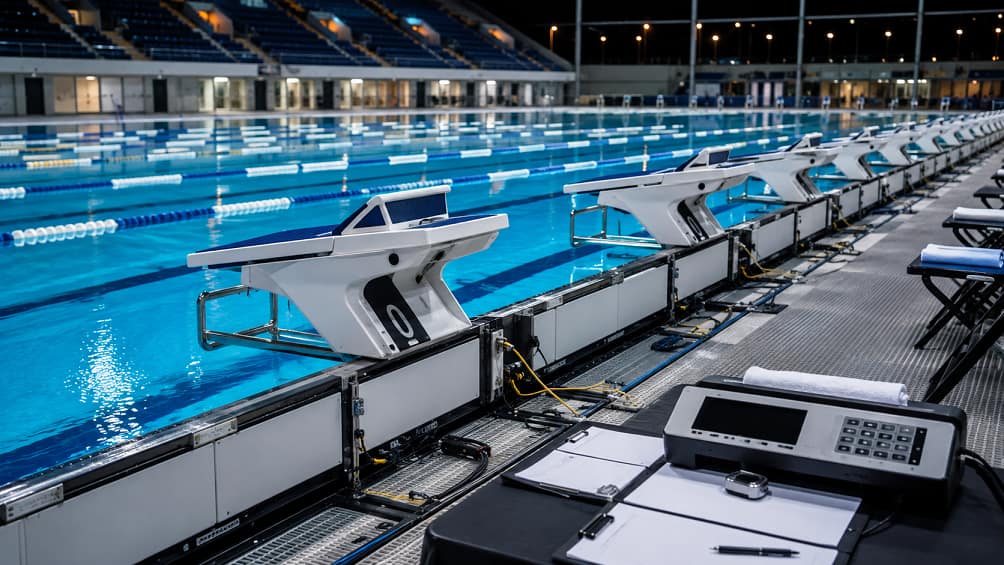
A stadium can be judged partly by seating, scoreboards, concourses, premium spaces, and crowd atmosphere. A swimming venue has a more technical foundation. Pool depth, lane width, water temperature, timing pads, starting blocks, warmup access, ventilation or outdoor conditions, athlete circulation, deck management, and officials’ positioning all affect the competition environment.
The William Woollett Jr. Aquatics Center’s outdoor setup also matters in Southern California. Weather, sun, shade, wind, spectator comfort, and athlete recovery all become planning factors. A high-performance pool must serve athletes first, but it also has to support multi-day event operations.
That is why aquatics infrastructure is often less visible to casual fans. A viewer may notice the race result, but the athlete experiences the venue through every detail: warmup timing, ready-room flow, deck crowding, lane availability, recovery access, and whether the event runs on schedule.
The best aquatics venues make those systems feel invisible.
How OMEGA Timing Turns Results Into Infrastructure
Official timing is another part of the infrastructure story.
OMEGA’s live results and meet data provided a centralized results system for the 2026 Toyota National Championships. That may sound like a technical detail, but elite swimming depends on precision. Hundredths of a second can separate finalists, national rankings, qualifying standards, and future opportunities.
Accurate timing is not just recordkeeping. It is competitive credibility.
Athletes, coaches, media, national-team staff, and fans all rely on official results. A meet without reliable timing loses authority. A meet with transparent, fast, and trusted timing becomes easier to follow and evaluate.
This is especially important in Olympic-pathway sports. Swimmers are not only racing opponents in the pool. They are racing standards, rankings, international benchmarks, and career timelines. The timing system connects one event to the larger sport.
That makes technology part of aquatics infrastructure.
Why Southern California Matters Before LA28
Irvine’s role becomes even more important because LA28 is approaching.
The 2028 Olympic and Paralympic Games will put Southern California back at the center of global sport. Even when Olympic swimming itself is tied to a specific Games venue plan, the broader region’s aquatics ecosystem still matters. Training sites, national meets, club programs, college pipelines, coaching networks, and athlete familiarity with Southern California conditions all contribute to the build-up.
A national championship in Irvine helps keep that ecosystem active.
It also reminds planners that Olympic legacy is not created only by the main Olympic venues. It is created by the regional network around them. Pools that host national meets, junior nationals, club championships, and developmental events all help sustain the sport.
That is especially true in swimming, where athletes often emerge through local clubs, regional meets, national age-group events, college programs, and senior national competitions before reaching an Olympic Trials or Olympic stage.
LA28 will be a global event. But the pathway toward LA28 is built through facilities like Irvine’s.
How One Venue Can Serve Elite And Developmental Swimming
The strongest aquatics venues serve multiple levels of the sport.
William Woollett Jr. Aquatics Center is not only a stage for senior national racing. It also appears on the broader USA Swimming event calendar for junior-level national competition, including the 2026 Speedo Junior National Championships scheduled shortly after the Toyota National Championships.
That back-to-back use matters.
It shows how one facility can support both elite and developmental layers of the pathway. Senior national swimmers race one week. Junior swimmers arrive soon after. Coaches, officials, timing systems, volunteers, and venue operations can carry institutional knowledge across events.
That is efficient infrastructure.
A pool that only hosts one elite meet every few years may still be valuable, but a pool that can support repeated high-level events becomes part of the sport’s operating system. It helps athletes understand what the next level looks like. It gives younger swimmers a direct connection to the senior pathway. It gives the host city recurring sports value.
That is how aquatics infrastructure drives development.
Why Public Aquatics Facilities Still Matter
Swimming is unusual because elite pathways often depend on public or semi-public aquatic facilities.
A football team may build a private training facility. A professional basketball franchise may control its practice center. But swimming’s development base is spread across municipal pools, club pools, school facilities, university pools, and public recreation centers.
That makes community aquatics infrastructure especially important.
A national championship meet at a public-facing facility like William Woollett Jr. Aquatics Center sends a useful message: Olympic pathways can be connected to community assets. The same type of infrastructure that supports elite racing can also support swim lessons, age-group meets, water safety, local clubs, high school teams, masters swimming, and public recreation.
That connection matters because aquatics investment is not only about medals.
Pools are also public-health and safety infrastructure. They teach children how to swim. They support lifeguard development. They provide low-impact fitness. They serve families, seniors, schools, and community programs. When a city maintains a serious aquatics venue, it supports both elite sport and public life.
That dual role gives aquatics facilities a stronger civic case than many people realize.
What The 2026 Meet Shows About Venue Readiness
A five-day national meet tests more than the racing pool.

It tests session timing, athlete check-in, scratch deadlines, distance-event procedures, warmup management, awards flow, officials’ coordination, medical readiness, parking, spectator movement, heat and sun planning, and post-race recovery. It also tests the city’s ability to host teams, families, coaches, and event staff over several days.
That is why venue readiness is so important.
If the facility runs smoothly, the meet becomes about performance. If the facility struggles, operational problems distract from the athletes. In Olympic-pathway sports, that distinction matters. Athletes need a competition environment that rewards preparation instead of punishing logistics.
The Toyota National Championships also show how national governing bodies rely on a network of trusted host sites. USA Swimming cannot build an elite calendar from scratch every year. It needs cities and venues that know how to deliver.
Irvine remains valuable because it can serve that role.
Why Aquatics Infrastructure Needs Long-Term Investment
Aquatics facilities are expensive to build and maintain.
Pools require water treatment, heating, filtration, deck maintenance, locker rooms, lighting, staffing, lifeguards, timing systems, accessibility upgrades, and constant safety oversight. Outdoor venues also face weather, sun exposure, seating comfort, shade needs, and long-term surface wear.
That cost can make aquatics infrastructure politically difficult. A field can sometimes be upgraded incrementally. A pool often requires larger capital investment and ongoing operational support.
But the 2026 Toyota National Championships show why that investment matters.
Without high-quality pools, the Olympic pathway narrows. Without strong community aquatics, fewer children enter the sport. Without national-meet venues, elite swimmers lose competitive stages. Without timing systems and facility maintenance, results lose credibility.
Aquatics infrastructure must be treated as a long-term sports and public-service asset, not only as a budget line.
What Other Cities Can Learn From Irvine
Irvine offers several lessons for cities that want to build or maintain serious sports infrastructure.
First, a venue does not need to be brand new to remain nationally relevant. Strategic renovation, maintenance, and consistent event hosting can keep a facility valuable for decades.
Second, aquatics venues work best when they support multiple levels of use. Senior nationals, junior nationals, club meets, swim lessons, and community programming can all strengthen the case for investment.
Third, Olympic pathways depend on domestic competition sites. A country cannot develop swimmers only through one Olympic Trials venue every four years.
Fourth, technical infrastructure matters. Timing systems, pool standards, warmup access, and meet operations are as important as spectator seating.
Fifth, public aquatics facilities can carry both elite and community value. That makes them especially important in sports infrastructure planning.
These lessons apply beyond swimming. They apply to gymnastics, track and field, cycling, rowing, volleyball, and other Olympic sports that need specialized but reusable facilities.
Why Aquatics Still Drives Olympic Pathways
The 2026 Toyota National Championships show that aquatics infrastructure remains one of the quiet engines of Olympic development.
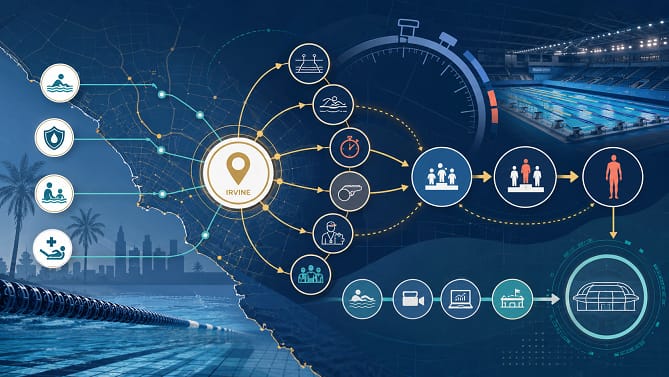
Fans may focus on Dressel, Douglass, Walsh, race times, finals, and national titles. Those stories matter. But behind them is the system that makes the racing possible: a long-course pool, a trusted host city, timing technology, trained officials, event operations, coach access, athlete services, and a venue capable of handling national pressure.
That system is infrastructure.
As LA28 approaches, the United States will spend more time talking about Olympic stars. It should also talk about the facilities that help produce and test them. Irvine’s William Woollett Jr. Aquatics Center is a reminder that Olympic pathways are built in places that host the hard, repeated work of competition.
A swimmer’s road to the Games does not begin under Olympic lights. It moves through national meets, junior events, club systems, public pools, and facilities that are ready before the world is watching.
The 2026 Toyota National Championships make that clear. Aquatics infrastructure still drives the pathway.