
The Sports Facilities Companies’ late-2026 venue slate shows how youth sports infrastructure is moving beyond fields, courts, and tournament weekends. It is becoming a full community systems story.
On July 28, 2026, SFC announced plans to support 10 venue openings, grand reopenings, and new community partnerships across eight states during the second half of the year. The list stretches across California, Oklahoma, New Mexico, Pennsylvania, Alabama, Kentucky, New Jersey, and Illinois. It includes sports parks, aquatics centers, recreation facilities, municipal golf, community fields, and mixed-use sports destinations.
That range is the real news.
Youth sports infrastructure is often discussed as if the core problem is simple field supply. A community needs more soccer fields, baseball diamonds, basketball courts, or tournament complexes, so it builds them. But the SFC slate shows a broader industry shift. Communities are not just building places to play. They are trying to build operating systems around recreation, sports tourism, health, wellness, programming, public access, and local economic development.
For aplevante.org’s Infrastructure category, this is exactly where the conversation is headed. The future of youth sports infrastructure is not only about who has the biggest complex. It is about which communities can turn a facility into a sustainable public asset.
That connects directly to the broader idea of multi-sport community hubs, where venues are designed to blur the line between athletic facility, civic space, recreation center, tourism engine, and neighborhood anchor.
Why The SFC Slate Signals A Bigger Infrastructure Shift
SFC’s announcement is notable because it does not describe one type of project.
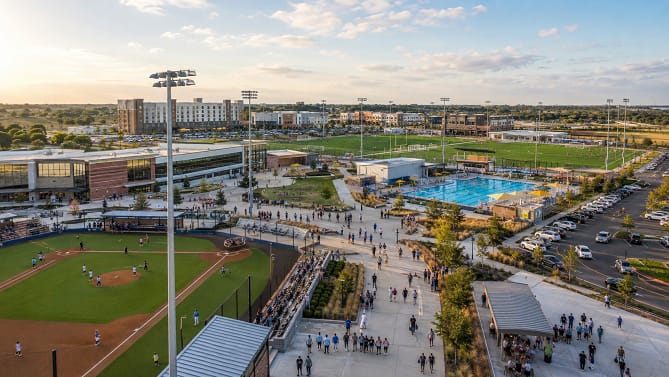
Ontario Sports Empire in Ontario, California, is expected to open in late October as a 200-acre mixed-use sports complex with 20 multipurpose fields, 14 youth diamond fields, eight full-size baseball diamonds, four football and rugby fields, and two championship diamond fields. That is the large-scale tournament model.
Wintrust Sports Complex at Bedford Park, outside Chicago, is targeting a late-fall Phase 2 grand opening tied to its five-year anniversary. Its $38 million expansion includes a Chicago Sky practice facility and connects to a broader mixed-use development with hotel and retail components. That is the professional, youth, and mixed-use model.
U.S. Steel Community Field in Pittsburgh’s Hazelwood Green development is expected to hold its grand opening in late summer. The year-round multipurpose venue is designed with a full-size athletic field, seating for about 3,000 spectators, a press box, concessions, and a renovated support building for athletic and community use. That is the urban redevelopment and community-field model.
Paducah Sports Park by CFSB in Paducah, Kentucky, is scheduled to open on September 10 as a diamond and long-field complex designed to support local leagues while expanding western Kentucky’s capacity for regional and national tournaments. That is the local-to-regional sports tourism model.
The same announcement also includes NEXUS Stadium in Middlesex County, New Jersey; Shafter Aquatics Center in California; Pelican Bay Aquatic Center in Edmond, Oklahoma; Artesia Recreation Center in New Mexico; Hartselle Parks and Recreation in Alabama; and Overlook Golf Course in Manheim Township, Pennsylvania.
Together, the projects show that youth sports infrastructure is no longer one category. It is a portfolio.
How Youth Sports Facilities Became Community Platforms
A modern youth sports venue is expected to do more than host games.
It must serve local leagues, traveling teams, schools, families, spectators, coaches, officials, trainers, community groups, and sometimes professional or semi-professional partners. It must support weekdays and weekends. It must generate revenue without pricing out local residents. It must be attractive enough for tournaments but useful enough for daily programming.
That combination turns a facility into a platform.
A field complex can become a local league hub. An aquatics center can support swim lessons, water-safety education, senior fitness, youth recreation, and family programming. A recreation center can combine courts, fitness spaces, walking tracks, children’s areas, and community rooms. A municipal golf property can support instruction, leagues, outings, food service, and public recreation. A stadium can support sports, concerts, community events, graduations, and civic gatherings.
That is why SFC’s list matters. It reflects a model where communities are trying to connect sports participation with wellness, tourism, economic development, and public life.
This does not mean every project will automatically succeed. Facilities can become expensive burdens if they are poorly planned, under-programmed, or disconnected from residents. But the direction is clear: communities are asking more from sports infrastructure than they did a generation ago.
Why Ontario Sports Empire Represents The Scale Question
Ontario Sports Empire may be the clearest example of the scale side of the trend.
A 200-acre sports destination with dozens of fields and diamonds is not a neighborhood park upgrade. It is a regional sports tourism engine. Its field mix suggests a facility designed to host simultaneous events across soccer, baseball, softball, football, rugby, and other field sports.
That scale creates opportunities. A complex of that size can attract weekend tournaments, club events, showcases, camps, and regional competitions. It can support hotels, restaurants, retail, transportation planning, and local spending. It can also give local athletes access to better fields and more organized programming.
But scale also raises questions.
Large complexes require strong operations, maintenance budgets, scheduling systems, parking plans, staff training, security, concessions, field rotation, tournament management, and community-access policies. Without those systems, a large venue can become difficult to sustain.
This is where youth sports infrastructure becomes more like city planning. A major sports complex is not just a collection of fields. It is a traffic generator, economic-development tool, land-use decision, family destination, and maintenance responsibility.
Ontario’s project shows how far the youth sports facility model has expanded. The infrastructure challenge is making sure big facilities still serve local families, not only out-of-town tournament traffic.
Why Wintrust Shows The Mixed-Use Direction
The Wintrust Sports Complex expansion points to another major trend: sports facilities are becoming anchors inside larger mixed-use developments.
The Bedford Park project’s Phase 2 plan includes a Chicago Sky practice facility and supports hotel and retail components. That combination reflects a more sophisticated model of sports infrastructure. Instead of placing a facility on isolated land and expecting visitors to drive in and out, communities and developers are increasingly connecting sports venues to lodging, food, shopping, entertainment, and professional team uses.
That can make sense. Tournament families need hotels. Spectators need restaurants. Athletes need recovery and training spaces. Professional teams need practice facilities. Local governments want tax activity. Developers want traffic-driving anchors.
But the mixed-use model also requires careful balance.
A youth sports facility should not become only a commercial real estate engine. It still needs local access, affordable programming, safe design, and community benefit. The question is not whether hotels and retail belong near sports complexes. In many cases, they do. The question is whether the facility’s public purpose remains clear.
Wintrust’s expansion shows how youth, professional, and commercial sports infrastructure can overlap. That overlap is likely to become more common.
Why Aquatics Belong In The Same Infrastructure Conversation
The SFC slate also includes Shafter Aquatics Center in California and Pelican Bay Aquatic Center in Edmond, Oklahoma. That is important because youth sports infrastructure is often dominated by field and court conversations.
Aquatics infrastructure deserves equal attention.
Swimming access is not only a competitive-sports issue. It is a public-safety issue, a recreation issue, a wellness issue, and a family-access issue. Community pools and aquatic centers can support swim lessons, lifeguard development, water-safety education, recreational swimming, senior fitness, therapy, school partnerships, and summer programming.
Pelican Bay Aquatic Center reopened on July 18 after renovations. SFC described the 17-acre complex as a place for water-safety education, community recreation, and family entertainment for Edmond and surrounding residents. Shafter Aquatics Center is targeting a late-summer grand reopening after significant improvements that began in 2024.
Those projects show why community systems matter. A pool is not only a place to swim laps. It can be part of a city’s health, safety, and youth development strategy.
For communities evaluating future sports investments, aquatics should not be treated as secondary to tournament fields. In many places, a well-run aquatics center may have a wider daily public impact than a showcase sports complex.
How Recreation Centers Expand The Definition Of Youth Sports
Artesia Recreation Center in New Mexico adds another layer to the story.
The two-story facility is scheduled to hold its grand opening ceremony on August 14 and is located near the Artesia Aquatic Center. SFC describes it as an all-in-one recreation hub with courts, fitness spaces, a running track, and children’s areas.

That kind of facility expands the meaning of youth sports infrastructure.
Not every child enters sports through a travel team. Some enter through after-school programs, open gym, youth fitness classes, family recreation, birthday events, camps, or casual play. Recreation centers can lower the barrier to entry because they do not always require club membership, tournament travel, or expensive equipment.
They also serve multiple age groups. A parent can use a fitness space while a child participates in programming. Older adults can walk indoors. Teens can play pickup basketball. Younger children can use supervised activity areas. Schools and nonprofits can partner on events.
That makes recreation centers critical to the “full community system” model. They help sports infrastructure serve residents who may never appear in tournament participation data but still benefit from active public spaces.
If communities only build elite sports complexes, they may miss the broader recreation need. Facilities like Artesia help fill that gap.
Why Community Fields Are Still The Foundation
Even as large complexes and mixed-use destinations grow, community fields remain central.
U.S. Steel Community Field in Pittsburgh is expected to provide a year-round multipurpose athletic field with spectator seating, concessions, a press box, and a renovated support building inside the Hazelwood Green development. That kind of project can serve youth sports, local schools, community programs, and civic events without requiring the scale of a 200-acre destination.
Community fields matter because they are close to residents. They are easier for families to access. They can serve neighborhood programs. They can become everyday assets rather than only tournament venues.
The same is true of Paducah Sports Park, which is designed to support local leagues while expanding the region’s tournament capacity. That phrase is important. A strong sports park should do both. It should serve local athletes during the week and support regional events when appropriate.
The healthiest youth sports systems have layers: neighborhood fields, school facilities, recreation centers, aquatics centers, tournament complexes, and regional sports campuses. Each plays a different role.
SFC’s 10-project slate shows that infrastructure growth is not only happening at the top of the pyramid. It is happening across the system.
Why Operations Matter More Than Ribbon Cuttings
The least glamorous part of the SFC announcement may be the most important: operations.
SFC frames its work around helping venues move from planning and development to sustainable day-to-day operations. That phrase should be taken seriously. Many sports infrastructure projects fail not because they are poorly imagined, but because they are poorly operated after opening.
A facility needs programming, staffing, maintenance, scheduling, marketing, safety policies, customer service, financial controls, partnerships, field rotation, tournament support, concessions, custodial systems, and community outreach. It also needs a clear identity. Is it primarily for local residents? Sports tourism? Wellness? Schools? Club teams? Family recreation? Professional tenants? Some combination?
If those questions are not answered, even impressive facilities can struggle.
This is especially true for youth sports venues. Families judge them by everyday experience: parking, restrooms, shade, seating, field conditions, safety, communication, affordability, and whether the schedule actually works. Tournament organizers judge them by reliability. Local governments judge them by use, cost, revenue, and community benefit.
Operations determine whether a venue becomes a system or just a building.
How Economic Development And Public Access Must Stay Connected
Sports venues are increasingly sold as economic-development projects. That is not wrong, but it is incomplete.
Tournament complexes can generate hotel nights, restaurant spending, fuel purchases, retail traffic, event jobs, and regional visibility. Mixed-use sports developments can support private investment. Recreation assets can improve quality of life and help cities compete for residents and employers.
But public access must remain central.
A venue that brings in visiting teams but prices out local families weakens its community case. A facility that looks impressive but lacks affordable programming may not improve youth participation. A sports park that becomes unavailable to local leagues because tournament rentals dominate the calendar can create resentment.
This is the balance communities must manage.
The best sports infrastructure creates both economic activity and public value. It hosts visitors while serving residents. It attracts tournaments while protecting local league access. It supports wellness, not only weekend spending.
SFC’s range of projects shows the potential for that balance. The challenge is maintaining it after the ribbon cutting.
Why Municipal Golf And Parks Belong In The Youth Sports Ecosystem
The inclusion of Overlook Golf Course in Manheim Township, Pennsylvania, and Hartselle Parks and Recreation in Alabama also broadens the conversation.
Municipal golf is often treated separately from youth sports infrastructure, but it can be part of a wider recreation ecosystem. Public golf courses can support instruction, junior golf, leagues, outings, dining, and community events. If they are operated well, they can serve both sport and public recreation.
Hartselle Parks and Recreation adds another municipal layer. SFC described the system as including civic, aquatic, athletic, trail, and recreation assets. That is exactly how many families experience sports infrastructure: not as one facility, but as a network of parks, trails, courts, fields, pools, and programs.
The future of youth sports planning should recognize that network.
A child may play soccer at one park, swim at an aquatics center, walk a trail with family, attend a camp at a recreation center, and later join a high school team. These experiences are connected. Communities that plan them together can build healthier participation systems.
That is why SFC’s 10-project slate is not just about venue openings. It is about how different types of assets fit together.
What Community Leaders Should Watch Next
The late-2026 openings will create several questions for community leaders.
Can large tournament complexes maintain local access? Can aquatics centers keep water-safety education affordable? Can recreation centers support teens, families, and older adults at the same time? Can mixed-use sports projects avoid becoming too commercial? Can municipal golf properties attract new users without losing public value? Can community fields stay maintained after the opening year?

These are practical questions, not abstract ones.
Communities should track participation, facility utilization, operating costs, maintenance backlogs, resident satisfaction, tournament impact, local league access, program affordability, and staff capacity. They should also track whether venues are serving the populations they were built to serve.
A sports facility can look successful during opening week and still fail to deliver long-term value. The real test comes after the first season, after the first tournament calendar, after the first maintenance cycle, and after the first budget review.
That is why infrastructure planning must extend into operations.
Why This Is The Next Phase Of Youth Sports Infrastructure
The SFC slate shows that youth sports infrastructure has entered a more complex phase.
Communities are no longer simply asking whether they have enough fields. They are asking whether sports facilities can support health, tourism, recreation, school partnerships, professional team needs, family entertainment, water safety, wellness, economic development, and everyday public life.
That is a much larger assignment.
It requires smarter planning, better operations, stronger public-private partnerships, more transparent financial models, and clearer community-access standards. It also requires humility. Not every town needs a massive tournament destination. Some need better neighborhood fields. Some need aquatics. Some need recreation centers. Some need trails, lighting, maintenance, or programming before they need new construction.
The best infrastructure strategy starts with local need, then builds the right system around it.
SFC’s 10 late-2026 venue openings show how quickly that system is changing. Youth sports infrastructure is no longer just about where games are played. It is about how communities organize active life.
Fields still matter. Courts still matter. Pools still matter. But the future belongs to communities that can connect those assets into durable, accessible, well-run systems.
That is the real lesson of SFC’s late-2026 slate: the next generation of youth sports infrastructure will be judged not only by what opens, but by how well it serves the community after opening day.