LA28’s ticket and volunteer rollout shows that Olympic planning is no longer only about venues, athletes, and ceremonies. It is also about fan infrastructure.
That may sound like a small shift, but it is central to how the 2028 Olympic and Paralympic Games will actually work. A fan does not experience the Games only through a stadium seat. A fan experiences the Games through registration systems, ticket draws, time slots, digital accounts, volunteer support, wayfinding, transportation, language help, venue entry, accessibility, security, hospitality, community events, and the confidence that the world’s largest sporting event can move millions of people through dozens of locations.
LA28’s current rollout makes that clear.
The official ticketing process has already moved through Visa Presale notifications, a July 29–31 Visa Presale window, Drop 2 notifications scheduled for August 6–7, and Drop 2 purchasing time slots running August 10–20, 2026. Meanwhile, LA28 opened Games-time volunteer applications on July 14, 2026, exactly two years before the Olympic Opening Ceremony. The volunteer crew is expected to include around 60,000 people, with roles supporting the Olympic and Paralympic Games across Greater Los Angeles and several other U.S. cities hosting events.
For aplevante.org’s Fan Planning category, this is the story. LA28 is not waiting until 2028 to test fan operations. It is already building the systems that will determine whether the Games feel organized, accessible, welcoming, and manageable.
That connects to the broader rise of flag football’s Olympic infrastructure test, where new Olympic sports are already forcing organizers to think about venues, athletes, fans, and pathways before the Games arrive.
Why Ticketing Is The First Fan Infrastructure Test
Ticketing is not just a sales process. For an Olympic Games, it is the first large-scale test of public access.
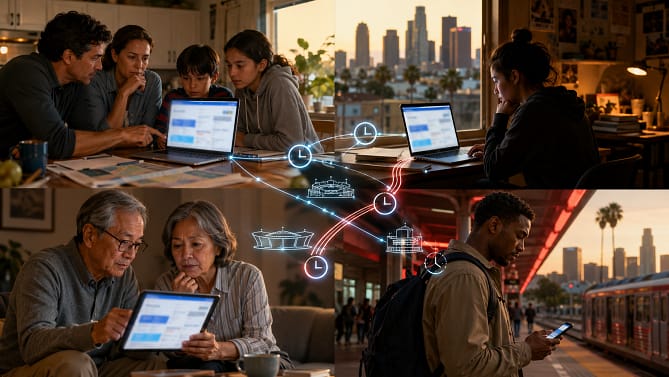
LA28’s ticket system uses registration, random draws, time slots, ticket drops, account profiles, eligibility rules, payment windows, and official communication channels. That structure is designed to manage massive demand before fans ever reach a venue.
The demand is already visible. LA28 announced that ticket registration had climbed to more than 12 million by late July 2026, up sharply from earlier registration numbers. That kind of demand changes the ticketing system from a back-office tool into a major piece of public infrastructure.
A normal sports team sells tickets across a predictable season. The Olympics sell access to hundreds of sessions, dozens of sports, ceremonies, high-demand finals, preliminary events, niche competitions, and multiple host-city zones. Fans may want gymnastics one day, swimming the next, soccer in another region, and athletics later in the week. The ticketing platform has to support that complexity.
That is why the rollout matters. If the draw process feels confusing, slow, expensive, or inaccessible, the Games begin with frustration. If it feels clear, fair, and well-communicated, fans are more likely to trust the larger event plan.
LA28’s first infrastructure test is digital, but it affects every physical venue.
How Time Slots Turn Demand Into Operations
The LA28 time-slot model is a way of turning overwhelming interest into staged demand.
The Visa Presale ran from July 29–31, 2026, for selected qualifying Visa cardholders. Fans who did not receive a Visa Presale time slot were automatically entered into the Drop 2 draw, with results scheduled for August 6–7 and purchase windows running August 10–20. That sequence spreads demand over time rather than forcing everyone into one chaotic sale.
That is important because Olympic access is not only about who buys a ticket. It is about how the organizing committee manages pressure on the digital system, customer support, inventory, payment processing, session availability, and fan expectations.
A time-slot system can reduce overload. It can also create anxiety if fans do not understand what happens next. That makes communication part of infrastructure. Clear deadlines, eligibility rules, account requirements, ticket limits, and future sale windows all shape fan confidence.
For LA28, the challenge is scale. A ticket buyer may be local, domestic, international, casual, obsessive, first-time Olympic fan, family planner, premium hospitality customer, or Paralympic supporter waiting for 2027 ticket availability. The system must speak to all of them.
This is why ticketing belongs in a fan planning article. It is not only a transaction. It is the first operating layer of the Games.
Why Volunteers Are The Human Side Of Olympic Infrastructure
If ticketing is the digital front door, volunteers are the human operating system.
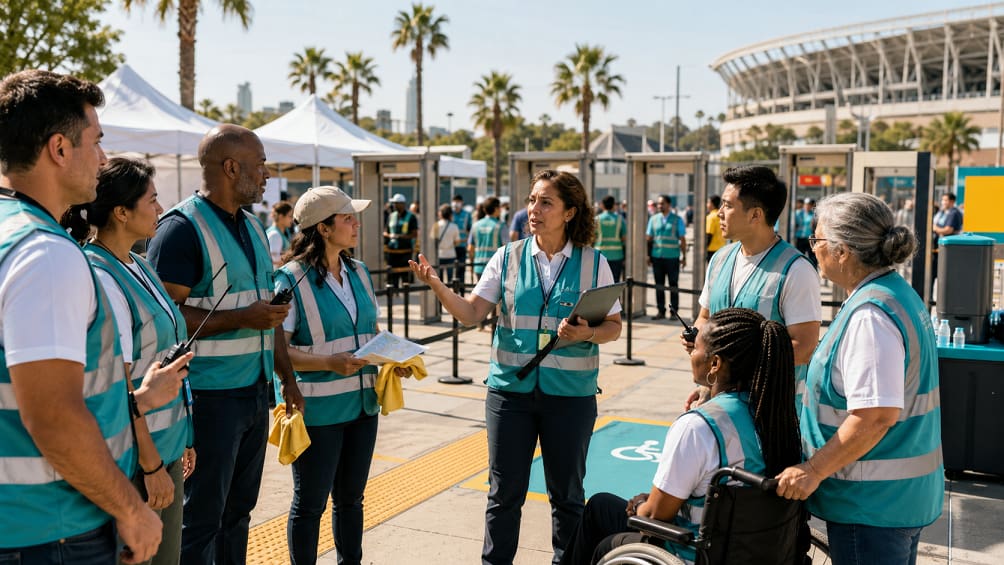
LA28 opened Games-time volunteer applications on July 14, 2026, and plans to build a crew of around 60,000 volunteers. LA28 says volunteers will support responsibilities ranging from welcoming and guiding spectators and athletes to specialized roles such as medical or language translation assistance. Volunteers will commit to at least 10 shifts within one volunteer period.
That is a massive workforce plan.
The Olympics cannot function only through paid staff, contractors, police, transit workers, and venue employees. Volunteers are often the people fans remember: the person who gives directions, solves confusion, points a family toward the correct entrance, helps an international visitor, supports accessible movement, or keeps a venue experience from feeling overwhelming.
That is why volunteer recruitment is infrastructure.
The LA28 Volunteer Program also includes community volunteering before the Games. That matters because the Games-time crew cannot be built overnight. Volunteer culture has to be cultivated. People need time to apply, be screened, trained, assigned, scheduled, and integrated into venue operations.
A volunteer is not simply a friendly face. At Olympic scale, a volunteer is part of crowd management, fan service, accessibility, translation, hospitality, and regional identity.
How Multi-City Events Make Fan Planning Harder
LA28 is not a one-city Olympic Games in the simplest sense.
The core identity is Los Angeles, but events extend beyond the city and even beyond California. LA28’s volunteer announcement says volunteers will be needed for Olympic events in several U.S. cities, including Oklahoma City, New York, Columbus, Nashville, St. Louis, San José, and San Diego. That makes the fan planning challenge more complex.
A fan traveling to one Olympic session in Los Angeles has one kind of planning problem. A fan trying to follow a team or sport across multiple host cities has another. Volunteers, ticketing systems, transportation guidance, venue communications, security rules, and local hospitality need to feel connected even when geography is spread out.
This is especially important for sports that use existing venues across the country. LA28 has promoted itself as the first Games since 1948 to require no new permanent infrastructure. That is a major planning philosophy, but it also means the organizing committee has to knit together many existing assets into one coherent Olympic experience.
Existing venues reduce construction burden. They do not automatically reduce fan complexity.
The fan still needs to know where to go, when to arrive, how to enter, what is allowed, what transit or parking options exist, and who can help when something goes wrong.
That is infrastructure.
Why No New Permanent Infrastructure Still Requires Massive Planning
LA28’s no-new-permanent-infrastructure model is one of its defining claims.
It reflects a modern Olympic strategy: reuse existing venues, avoid unnecessary permanent construction, and reduce the risk of expensive white elephants. But a no-new-build approach does not mean a low-complexity Games. It means the infrastructure burden shifts from construction to operations.
That shift is important.
Instead of building a new Olympic park from scratch, LA28 has to coordinate existing stadiums, arenas, convention spaces, temporary overlays, training sites, athlete movement, media operations, security perimeters, sponsor requirements, fan routes, volunteer deployment, and accessible service across a huge region.
Fan infrastructure becomes the connective tissue.
A stadium may already exist, but the Olympic fan experience around it still has to be built. Temporary signage, ticket scanning, shuttle operations, volunteer stations, multilingual support, restroom capacity, food service, security screening, broadcast compounds, accessibility routes, and weather planning all matter.
The ticket and volunteer rollout is an early sign of that operational reality. LA28 is building the user system before most fans are thinking about the venue system.
Why Pricing And Access Are Part Of Fan Infrastructure
Ticket demand also raises an access issue.
High-demand Olympic sessions can become expensive quickly, and recent fan reaction to ticket fees and pricing has shown that affordability will remain part of the public conversation. LA28 has promoted a wide range of price points, but public trust depends on whether fans feel that regular people can realistically attend.
That makes pricing part of fan infrastructure too.
An accessible Games is not only one with ramps, signs, and volunteers. It is also one where families can understand the buying process, plan ahead, identify affordable sessions, avoid unofficial resellers, and know when future opportunities are coming. Confusion favors insiders. Clarity favors broader participation.
LA28 will need to keep explaining ticket drops, future inventory, official resale channels, hospitality differences, Paralympic ticket timing, and community access programs. That communication is not a marketing extra. It is a public-service function.
The Olympics are at their strongest when fans feel included in the event, not merely targeted as consumers.
How Volunteers Connect The Games To Local Communities
The volunteer program also matters because it creates a bridge between LA28 and the communities hosting the Games.

LA28’s community volunteering work began before the Games-time application window, with service opportunities connected to sustainability, restoration, wellbeing, and local nonprofit partners. That matters because Olympic volunteerism should not only appear when tourists arrive. It should build civic connection before the event.
A volunteer program can create local ownership. Residents who may not buy premium tickets or attend major finals can still participate in the Games through service. Local organizations can connect Olympic attention to community needs. Volunteers can become ambassadors for their neighborhoods, transit systems, venues, and public spaces.
That is especially important in Los Angeles, where the Games will touch many communities rather than one compact downtown core.
The best volunteer systems do not simply fill staffing gaps. They build trust between the organizing committee and the public.
LA28’s challenge is to make the volunteer rollout feel meaningful rather than transactional. If 60,000 volunteers are treated as part of the civic fabric of the Games, the experience can strengthen the host region. If they are treated only as unpaid labor, the program can lose public goodwill.
Why Paralympic Planning Should Stay Visible
LA28’s ticketing timeline says Paralympic tickets will be available for purchase starting in 2027. That detail should not be treated as secondary.
The Paralympic Games are part of the same fan infrastructure challenge. Ticketing, volunteers, accessibility, transportation, venue entry, wayfinding, medical support, seating, broadcast access, and public communication all need to serve Paralympic fans and athletes with equal seriousness.
Because Paralympic tickets come later, LA28 will need to keep the Paralympic planning message visible. Otherwise, the Olympic ticket rollout can dominate public attention and make the Paralympic experience feel like an afterthought.
That would be a mistake.
The strongest Games planning treats Olympic and Paralympic operations as connected, not separate. Volunteers will support both. Venues will need to adapt for both. Fan systems will need to serve both. Accessibility lessons from Olympic planning should feed directly into Paralympic readiness.
A fan infrastructure story is incomplete without the Paralympic side of the Games.
Why Fan Planning Starts Two Years Early
The timing of LA28’s rollout matters.
Opening Games-time volunteer applications on July 14, 2026, exactly two years before the Olympic Opening Ceremony, sends a clear message: the event is already in its operational buildout phase. Ticket drops, volunteer recruitment, account creation, communications, community volunteering, and venue planning are all happening now.
This is how major events become real.
Fans often think of the Olympics as a two-week spectacle. Organizers experience it as a years-long systems project. Every ticket account, volunteer application, training module, venue plan, transport map, staffing schedule, and support desk matters before the first medal is awarded.
That is why fan planning has to start early. The Games cannot wait until summer 2028 to teach fans how ticketing works or train volunteers to support spectators. The infrastructure has to be built gradually.
LA28’s current rollout is therefore less about hype and more about readiness. It is the beginning of the public-facing operating system.
What Other Sports Events Can Learn From LA28
LA28’s ticket and volunteer rollout offers lessons beyond the Olympics.
First, fan access has to be planned early. Any major event with high demand should treat ticketing as a trust-building process, not only a revenue mechanism.
Second, volunteer programs should be connected to community purpose. A trained volunteer workforce can improve fan experience, but it can also strengthen civic identity when designed well.
Third, multi-venue events need one coherent communication system. Fans should not feel like each venue, sport, or city is operating in isolation.
Fourth, accessibility and affordability should be part of infrastructure planning from the beginning. They cannot be fixed at the last minute.
Fifth, existing venues still require major fan overlays. Reusing stadiums and arenas reduces construction, but it does not eliminate operational complexity.
These lessons apply to World Cups, college championships, NFL international games, youth tournaments, citywide festivals, and emerging-sports showcases. The biggest events increasingly depend on the quality of invisible systems.
LA28 is now showing those systems in public.
Why This Is A Fan Infrastructure Story
LA28’s ticket and volunteer rollout turns Olympic planning into a fan infrastructure story because it reveals what actually makes a Games work.

Venues matter. Athletes matter. Broadcasts matter. But the fan experience is built through systems: who can get tickets, how they are selected, what they understand, where they go, who helps them, how volunteers are trained, how cities are connected, how access is explained, and how the Olympic and Paralympic experience feels before and after a person enters a venue.
The 2028 Games are still two years away, but the fan infrastructure is already being tested.
The ticket draw measures demand. The presale and Drop 2 windows test digital access. The volunteer portal starts building the human workforce. Community volunteering begins shaping civic connection. Multi-city planning stretches the operating model. Paralympic ticket timing creates the next access challenge.
That is the real meaning of the rollout.
LA28 is not only selling tickets and recruiting volunteers. It is building the public-facing system that will determine whether the Games feel like a massive event people can actually navigate. In modern Olympic planning, that system is infrastructure.