
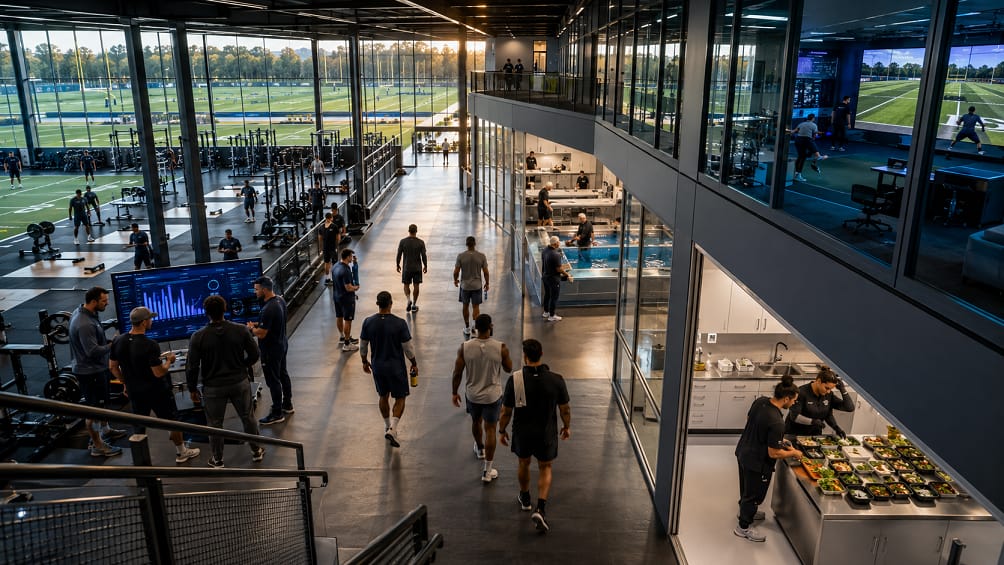
The New England Patriots’ new 160,000-square-foot training center in Foxborough makes an important point about the future of NFL infrastructure: the modern practice facility is becoming much more than a locker room attached to football fields.
The Patriots formally unveiled the New Balance Athletics Center on August 12, 2026, next to Gillette Stadium. The football-only building brings strength and conditioning, nutrition, rehabilitation, hydrotherapy, virtual reality, medical support, player meetings, equipment operations and football administration into one connected environment.
Its scale is substantial. The facility includes a 15,000-square-foot weight room, an 11,000-square-foot dining hall and kitchen, a 10,500-square-foot virtual-reality room, 3,700 square feet dedicated to hydrotherapy and a 7,000-square-foot locker room containing 92 player lockers. A 160-seat team meeting room adds another layer to a building designed around the daily requirements of an NFL roster.
Those numbers are impressive, but they are not the main story.
The more important development is how those spaces relate to one another.
Patriots planners described the design process around what they called the “player journey.” The building was organized around the sequence players actually follow through a workday: food and hydration, locker room, treatment, strength training, equipment, meetings and practice.
That turns architecture into a performance tool.
For aplevante.org’s Infrastructure category, the facility represents another stage in the evolution already visible around projects such as Cleveland’s District 46 sports development. NFL facilities are no longer being evaluated only by how many offices or practice fields they contain. They are becoming integrated campuses built around performance science, recovery, nutrition, technology and organizational efficiency.
Why 160,000 Square Feet Is About Integration, Not Just Size
NFL teams have always required large football operations.
Players need locker rooms. Coaches need meeting areas. Strength staffs need weight rooms. Athletic trainers need treatment facilities. Equipment departments need storage. Football executives need offices.
The difference in Foxborough is how those functions have been brought together.
When construction began in December 2024, the Patriots described the new center as a stand-alone football building that would more than double the square footage of their previous footprint inside Gillette Stadium.
That expansion created room to rethink workflow rather than merely build larger versions of existing rooms.
A bigger weight room alone does not create a sports science campus. Neither does an expensive hydrotherapy area or advanced video room.
The value comes from connecting them.
An athlete can move from nutrition to treatment, strength work, equipment and practice without crossing disconnected parts of a stadium complex. Coaches and performance personnel can operate closer to players. Medical and strength staffs can coordinate more easily.
Physical distance becomes an operational variable.
In a league where teams try to recover minutes everywhere they can, facility design increasingly becomes part of competitive preparation.
How The Player Journey Became An Architectural Plan
One of the most revealing details in the Patriots’ description of the facility is how closely designers studied a normal player day.
The team found that food and hydration often represented both the beginning and end of that daily cycle.
That helped determine where the nutrition center should sit.
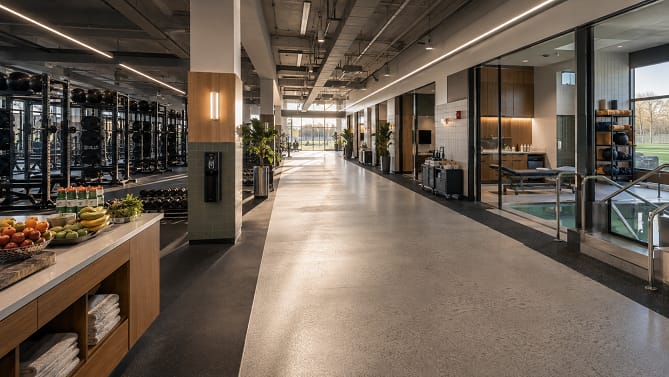
After players enter from the covered parking garage and reach the main level, food and hydration are positioned immediately along their path. From there, the building follows the practical progression toward the locker room, training spaces, weight room, equipment areas and practice fields.
That sounds simple.
It is actually a significant change from older sports facilities that evolved gradually as departments were added over decades.
When rooms are built independently, athletes may move back and forth through inefficient corridors. Medical, nutrition and strength departments may operate in separate zones. Coaches may have to travel farther between meetings and practices.
A purpose-built campus can organize those activities around behavior instead of legacy architecture.
That makes player movement part of sports infrastructure planning.
Why Nutrition Is Now A Core Football Space
The Patriots devoted approximately 11,000 square feet to the dining hall and kitchen.
That alone illustrates how much professional football’s approach to nutrition has changed.
Food was once treated largely as support service. Modern teams increasingly consider nutrition part of the performance program.
The Patriots’ new nutrition center includes made-to-order meal preparation, hot and cold service lines, salad and fruit areas and multiple action stations intended to give players more individualized options.
The design also places the space where athletes encounter it naturally.
That matters because successful performance systems are not only about having expertise available. They are about making good decisions easier to repeat.
If hydration, recovery food and customized meals are built directly into a player’s route through the facility, nutrition becomes integrated into the workday rather than something athletes have to seek out separately.
That is the campus model.
Performance does not belong to one department.
It becomes an environment.
Why The 15,000-Square-Foot Weight Room Is Designed As A Hub
The new weight room is another example.
At 15,000 square feet, it is large enough to support the demands of an NFL roster while creating room for different training groups and equipment configurations.
But its relationship with the rest of the building matters even more.
The locker room connects directly to the strength area, and large windows bring natural light into the space while connecting it visually with the practice fields. A cardio mezzanine provides views both toward the outdoor football fields and down into the strength floor.
The effect is to make strength and conditioning a central part of the facility rather than a room hidden deep inside it.
That reflects how NFL performance departments have evolved.
Strength staffs work alongside athletic trainers, sports scientists, dietitians and position coaches. Workload decisions affect practice plans. Rehabilitation plans affect lifting schedules. Nutrition affects recovery.
Putting those disciplines closer together supports faster communication.
The building becomes a platform for collaboration.
How Hydrotherapy Shows Recovery Is Becoming Infrastructure
The Patriots allocated 3,700 square feet to hydrotherapy.
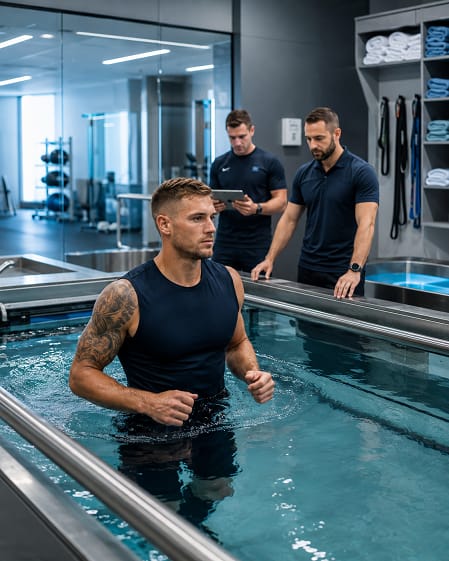
Plans for the facility included hot tubs, cold plunge tubs, a pool and an underwater treadmill.
These are not cosmetic amenities.
An NFL roster goes through enormous physical stress across training camp, 17 regular-season games, practices and potentially the postseason. Recovery is therefore a daily operational problem.
Hydrotherapy gives medical and performance staffs another tool for managing players returning from injury, reducing load during rehabilitation and supporting recovery between sessions.
An underwater treadmill is particularly useful because water can reduce impact while still allowing controlled movement.
The broader infrastructure point is that recovery no longer happens in whatever spare room remains beside the athletic training office.
Teams are building dedicated recovery environments into the center of football operations.
That is a significant shift in how facilities define performance.
Why Virtual Reality Needs 10,500 Square Feet
Perhaps the most striking number inside the New Balance Athletics Center is the 10,500 square feet associated with virtual-reality space.
NFL teams have used video study for generations, but simulation technologies allow teams to expand how players process information away from full-speed field repetitions.
A quarterback can work through reads.
A defender can study formation recognition.
Players can experience spatial relationships without requiring an entire 11-on-11 practice period.
The technology cannot replace physical football, but it can supplement the limited amount of practice time teams have available.
That becomes particularly relevant under modern workload management.
Teams want players to receive mental repetitions without always adding physical collisions or running volume.
Virtual reality therefore fits naturally inside a sports science campus.
It connects cognitive preparation to physical preparation.
The facility is not simply training bodies.
It is building environments for decision-making.
How The Practice Fields Complete The Campus
A football performance center ultimately has to connect to football.
The Patriots’ facility opens directly toward three redesigned practice fields beside Gillette Stadium.
That connection is important.
Players can move from preparation inside the building to practice outside without treating the field as a separate destination. Strength coaches, trainers and equipment staff remain physically close to the action.
The outdoor practice fields also remain part of the team’s relationship with fans.
For 2026 training camp, the Patriots scheduled public practices on the upper grass fields behind Gillette Stadium, while practices moved into the indoor field house because of weather would remain closed.
That creates two overlapping infrastructures in Foxborough.
The New Balance Athletics Center is optimized for football performance.
The public training-camp fields support fan access.
Together with Gillette Stadium and Patriot Place, the site now works more like a sports campus than a collection of independent buildings.
Why Covered Parking Can Be A Performance Detail
Even the parking design tells part of the story.
Players enter through a covered garage at the ground level.
In New England, that has practical value.
Rain, snow and winter temperatures are part of the operating environment. A covered arrival area reduces exposure and helps keep the transition into the building predictable.
That detail may sound minor compared with VR rooms or hydrotherapy pools, but good facilities are often defined by small reductions in daily friction.
Athletes repeat the same routes hundreds of times during a season.
An efficient doorway matters.
A well-positioned meal station matters.
A short path to treatment matters.
A direct connection to the weight room matters.
Sports science facilities are ultimately systems of repeated behaviors.
Architecture can either support those behaviors or complicate them.
How The New Draft Room Expands The Meaning Of Performance
The building is not limited to player services.
It also houses football administration, personnel offices and meeting rooms, including an upgraded draft operation.
Patriots football operations moved into the facility before the full ceremonial opening, and executives used its new draft room during the 2026 offseason.
That shows why the term “sports science campus” should not be interpreted too narrowly.
NFL performance also depends on scouting, roster construction, coaching communication, video analysis and organizational decision-making.
A modern football center therefore has to connect player performance with football intelligence.
The same campus that supports rehabilitation also supports draft preparation.
The same building that houses nutrition staff also houses personnel executives.
That concentration can improve communication across an organization.
Why Player Recruitment Is Now Part Of Facility Strategy
Training centers also increasingly matter in recruiting.
NFL free agency is primarily driven by contracts, playing opportunity, coaching and competitive outlook. A facility cannot overcome those factors.
But working conditions still matter.
Veterans spend enormous amounts of time at team headquarters. They see locker rooms, treatment areas, food quality, weight rooms, meeting spaces and recovery infrastructure every day.
A state-of-the-art building sends a message about organizational investment.
Patriots officials have already discussed the facility as a tool for attracting and retaining talent.
That creates another infrastructure arms race.
Once one organization significantly improves player working conditions, others face pressure to keep pace.
A franchise may not need the largest building in the league.
It increasingly needs a facility that shows athletes their daily development has been taken seriously.
Why Community Access Still Matters Around Private Performance Centers
There is one important distinction.
The New Balance Athletics Center itself is football-exclusive infrastructure.
It exists primarily to help Patriots players, coaches and staff.
But the larger Foxborough campus has public-facing layers.
The Patriots Foundation has already brought community groups into the new environment, including elementary-school students participating in a 2026 Community Day designed around experiencing aspects of a Patriots player’s day.
Training camp remains free and open to the public on designated outdoor practice dates.
That creates an interesting model.
The most specialized performance spaces can remain controlled while the surrounding campus creates selected opportunities for public connection.
Not every piece of sports infrastructure needs unrestricted public access.
But professional teams can still use private investments to strengthen community programming, education and youth engagement.
What Youth And College Facilities Can Learn From The Patriots
Most schools and community programs will never build anything close to a 160,000-square-foot NFL training center.
They should not try.
The useful lesson is not scale.
It is integration.
A high school does not need a 10,500-square-foot VR room to think carefully about how athletes move between changing areas, athletic training, hydration and practice.
A college program does not need NFL-level hydrotherapy to understand that recovery, nutrition and strength work should communicate with one another.
A community sports complex can still design routes that reduce congestion and improve medical access.
The Patriots’ project demonstrates a planning principle that works at smaller scales: build around the athlete journey.
That idea can matter at almost any level of sport.
Why NFL Training Centers Are Becoming Sports Science Campuses
The New Balance Athletics Center shows how the definition of an NFL practice facility has changed.
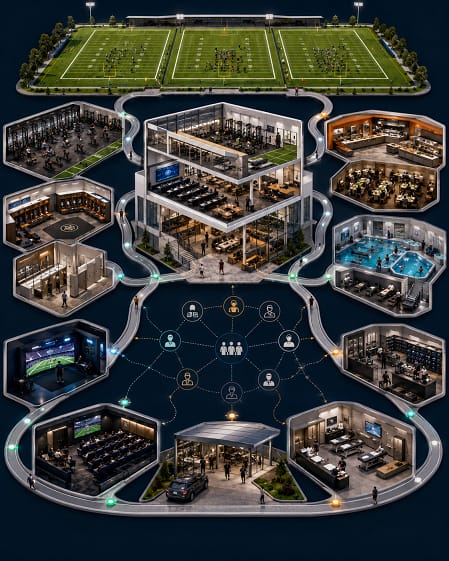
The old model could be summarized as offices, locker rooms and fields.
The new model looks much more interconnected.
Nutrition becomes performance infrastructure.
Hydrotherapy becomes recovery infrastructure.
Virtual reality becomes cognitive infrastructure.
Strength spaces become collaboration hubs.
Practice fields connect directly to medical, equipment and coaching operations.
Even parking, circulation and locker design are considered parts of the athlete’s workday.
That is why the Patriots’ 160,000-square-foot facility matters beyond Foxborough.
Its significance is not that NFL teams are building larger buildings.
It is that those buildings are being designed as systems.
The future NFL training center is increasingly a place where architecture, medicine, nutrition, technology, recovery, coaching and football operations intersect.
Calling it a practice facility is starting to undersell what it does.
It is becoming a sports science campus.