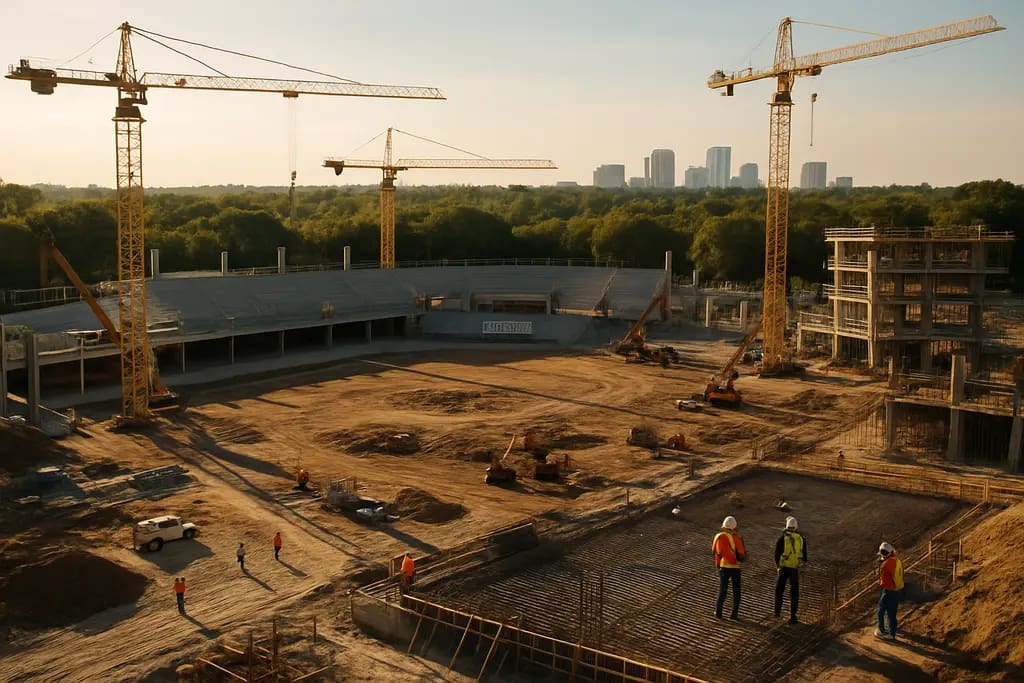
The Orlando Dreamers Ballpark proposal is not only a baseball story. It is a public finance test for Orange County, a tourism strategy claim, and a community sports question rolled into one $2 billion plan. As of August 27, 2026, the proposal centered on a domed, 45,000-seat stadium on a 35.5-acre site off International Drive near State Road 528, with the Dreamers saying they had secured more than $2 billion in private funding for team acquisition and stadium financing WFTV reported.
The central policy question is narrower than the renderings: should Orange County commit tourist development tax dollars to a proposed Major League Baseball facility, and under what conditions? The Dreamers asked for about $975 million in Tourist Development Tax revenue, a request that was presented to local tourism tax decision-makers before August 27, 2026 Spectrum News 13 reported. That scale deserves a cautious, sports-first read.
Orlando Dreamers Ballpark Funding Claims
Stadium finance proposals often sound clean at the podium: private money for one piece, public money for another, and long-term growth for the region. The Orlando Dreamers Ballpark pitch follows that familiar structure. The group has framed its private financing claim as large enough to support the combined burden of team acquisition and stadium financing, while the public request targets the stadium portion through Orange County’s Tourist Development Tax.
The distinction matters. Private funding reduces some risk for taxpayers only if the commitments are binding, timed correctly, and not dependent on later public action. A county evaluating the proposal would need to know whether private capital is equity, debt, letters of intent, committed investment, or contingent pledges. Those categories carry different risks. A pledged dollar that disappears if MLB expansion timing changes is not the same as capital placed in escrow.
Orlando Dreamers Ballpark And The TDT Ask
The $975 million TDT request is the pressure point. Tourist Development Tax revenue is generated from visitor-related lodging activity, not from a general property tax in the ordinary sense. Still, it is public money. If the county commits a large share to a ballpark, those dollars cannot be used for other eligible tourism-related priorities during the same period.
Local concerns about return on investment are not abstract. The research notes cite questions from officials and advisory board members about whether roughly $32 million in average annual added TDT revenue would justify a $975 million public investment unless wider economic spillovers materialize. That is a fair question. A simple payback comparison is not the whole analysis, but it is a useful first screen. If the public case depends on hotel demand, restaurant spending, media attention, event programming, and baseball attendance all arriving together, then the county should test each assumption separately.
What A Safer Funding Structure Would Require
A safer structure would connect public payments to verified milestones. That means proof of MLB franchise status before major public funds are released, audited private financing before county borrowing or allocation, clear cost-overrun responsibility, and public access commitments tied to community fields or youth programming. Those conditions do not answer every policy question, but they reduce the chance that public partners pay early while private benefits arrive first.
Tourism Economics And Public Risk
The Dreamers’ economic argument is built around Orlando’s tourism base. The research notes state that Orlando drew nearly 80 million tourists in 2025 and that TDT collections set records over a 14-month stretch leading into mid-2026. That context makes the proposal plausible in one sense: Orange County already has a large visitor economy. But a strong tourism base does not automatically prove that a new MLB stadium creates new spending rather than shifting existing visitor dollars from one entertainment option to another.
For sports-business analysis, substitution is the key risk. If a family that would have spent money at another attraction instead spends it at a baseball game, the county may see activity near the stadium, but not a full net gain. If a convention visitor extends a stay for a game, or if out-of-market fans travel specifically for a series, the case improves. The difference between those two outcomes should drive the public review.
Separating Gross Impact From Net Gain
The research notes reference an independent economic analysis projecting $72 billion or more in economic impact over 30 years for Orange County. That figure is large enough to attract attention, but county decision-makers should ask what counts inside it. Gross output, visitor spending, wages, tax receipts, and induced activity are not interchangeable. Public budgets are paid with actual revenue, not with headline economic activity.
A useful review would break the claim into measurable buckets: new hotel nights, new TDT receipts, new full-time equivalent jobs, construction payroll, public infrastructure cost, annual operating obligations, and maintenance responsibilities. The county should also ask for downside cases. A base case is helpful; a stress case is more revealing.
Jobs, Wages, And Community Health
The research notes include job estimates of more than 38,000 construction jobs during the build phase and more than 52,000 permanent jobs after opening. Those numbers should be treated as estimates until the underlying job definitions are public. Are they job-years, headcount, full-time equivalent positions, direct jobs, or indirect jobs? The answer changes the community impact.
From a wellness and community sports perspective, job quality matters as much as job quantity. A stadium district can support local workers if hiring targets, transit access, heat-safety planning, and living-wage expectations are built into agreements. It can also deepen inequality if service work expands without stable hours or safe mobility. The sports venue should be judged not only by attendance, but by whether nearby residents gain access to work, recreation, and public space.
Community Sports And Sustainability Tests

The proposal includes more than an MLB stadium in the research notes: hotels, retail, restaurants, office space, parking garages, and lighted youth baseball and softball fields county-wide. The youth-field element is the bridge between a professional sports project and community sports development. It should not be treated as decoration. If public tax revenue is involved, the county can require a delivery schedule, field maintenance funding, equitable geographic distribution, and affordable access policies.
Sustainability also needs concrete measurement. A domed stadium in Central Florida can offer weather protection for fans and athletes, but the public review should ask about energy demand, stormwater handling, heat mitigation around parking areas, and transit connections near International Drive and State Road 528. A venue that depends heavily on car trips can create congestion and emissions burdens unless mobility planning is part of the deal.
A Practical Checklist For County Review
Before approving any large TDT commitment, county leaders and residents could use a short test that keeps the debate focused on evidence rather than team enthusiasm.
- Require audited documentation of private funding commitments and state which funds are conditional.
- Define exactly when public TDT dollars would be released and what milestones must be met first.
- Publish net fiscal projections, not only gross economic impact figures.
- Assign cost-overrun risk before construction begins.
- Set enforceable youth-field, hiring, access, and maintenance obligations.
- Review transport, heat, water, and energy impacts before final public approval.
This is where comparisons across venues can help. Charlotte’s Bank of America Stadium renovation has been discussed as a multi-sport planning test, and the same discipline applies in Orlando: public benefits should be written into the deal, not assumed after opening. A related analysis of multi-sport venue planning shows why year-round use matters in public facility debates.
For those interested in broader sports logistics and venue accessibility, related insights can be found over at Triple T Powersports, covering topics such as venue access and event-day logistics within the sports economy sphere.
Orlando Dreamers Ballpark Decision Points
The Orlando Dreamers Ballpark proposal has enough scale to merit serious review and enough public exposure to demand caution. The strongest version of the case would prove that private financing is firm, public TDT spending is capped, and community benefits are enforceable. The weakest version would rely on optimistic impact totals while leaving the county with unclear cost overruns, uncertain franchise timing, and soft promises around youth sports access.
For Orange County, the practical path is neither reflexive rejection nor blind approval. It is a staged process: verify the money, publish the assumptions, protect the public side, and require measurable community returns. Baseball can be a meaningful civic asset, but only if the financial structure respects the public resources being asked to support it.