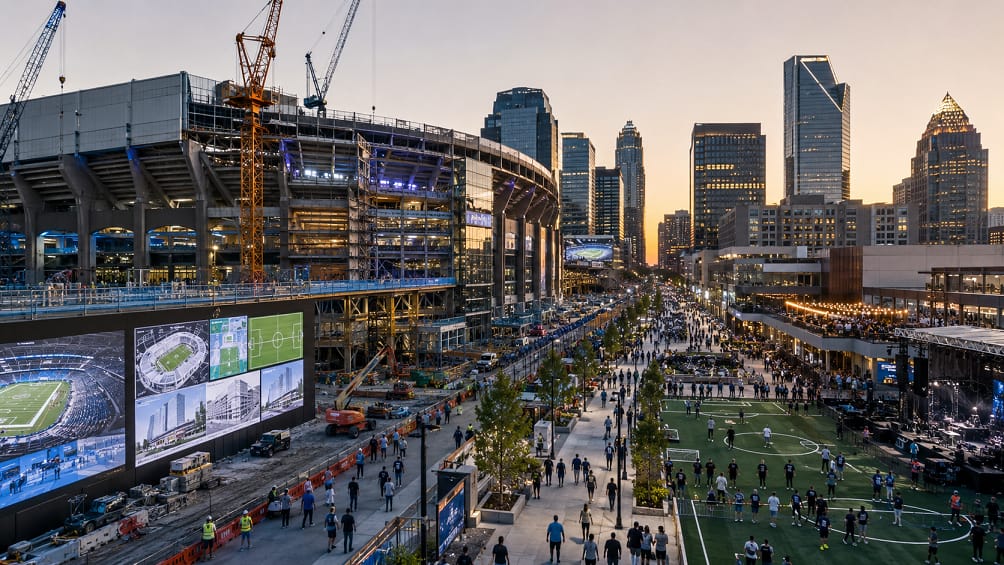
Bank of America Stadium’s $1.3 billion renovation is not only a Carolina Panthers story. It is a test of how a modern American stadium can serve football, soccer, concerts, civic events, fan districts, and year-round urban activity without losing its core sports identity.
That matters because the venue is no longer just an NFL home field. Bank of America Stadium sits in Uptown Charlotte, hosts the Panthers, serves as the home of Charlotte FC, stages major concerts and events, and functions as one of the city’s most important downtown traffic generators. When Tepper Sports & Entertainment and Bank of America announced a long-term naming-rights extension in July 2026, the bigger news was the scale and ambition of the renovation vision.
Tepper Sports & Entertainment said it would increase private investment to move forward with all optional projects previously presented to the City of Charlotte, bringing the total project to more than $1.3 billion. TSE also said it would fund potential overages and ongoing maintenance obligations under the agreement. The new renderings describe a broader plan: modernized fan areas, design elements inspired by the Carolinas, new social spaces, an immersive sales experience, and a year-round weekend destination anchored by the stadium.
For aplevante.org’s Infrastructure category, the important question is not whether the building gets better concourses or premium seating. The question is whether Charlotte can turn an aging 1996 stadium into a true multi-sport civic platform.
That connects directly to the broader trend of minor league stadiums reshaping community development, where venues are increasingly judged by their ability to serve cities beyond the event calendar.
Why This Renovation Is Bigger Than An NFL Upgrade
NFL stadium renovations are often explained through the language of gameday comfort: bigger video boards, improved concessions, premium clubs, better bathrooms, faster entry, more social spaces, and stronger technology. Those upgrades matter, but they do not fully explain Bank of America Stadium’s project.

Charlotte’s stadium has a more complicated role.
It must host NFL games for the Panthers. It must support Major League Soccer crowds for Charlotte FC. It must handle concerts, international soccer events, community uses, and civic gatherings. It also sits in a dense Uptown environment where event traffic, hospitality spending, parking, transit, restaurants, hotels, office workers, residents, and visiting fans all overlap.
That makes the renovation a multi-use planning test rather than a single-team construction project.
A stadium that works for an NFL Sunday may not automatically work for a midweek soccer match, a summer concert, a family-oriented fan festival, or a global tournament event. Each use has different crowd patterns, arrival times, concession needs, security demands, broadcast requirements, field requirements, and fan expectations.
The renovation’s success will depend on whether the stadium becomes more flexible, not merely more expensive.
How Charlotte FC Changed The Stadium Equation
Charlotte FC is central to the stadium’s future.
When Bank of America Stadium opened in 1996, it was built around the Panthers and the NFL. Today, the building also has to support one of Major League Soccer’s most visible expansion markets. Charlotte FC has shown that soccer can draw major crowds in the Carolinas, turning the stadium into a dual-anchor venue rather than a football-only facility.
That changes planning.
Soccer crowds move differently than NFL crowds. Supporter culture, chants, pregame marches, different kickoff times, international friendlies, club events, and lower-bowl configurations create different operational needs. Soccer also puts more pressure on sightlines, field layout, supporter sections, concourse flow, and fan engagement outside the NFL template.
The Panthers and Charlotte FC share ownership under Tepper Sports & Entertainment, which gives Charlotte a more integrated planning opportunity. Instead of treating soccer as a tenant event, the renovation can build around both franchises.
That is why the project should be seen as a multi-sport venue strategy. If the renovation only improves the NFL experience, it will underserve the building’s actual future. If it strengthens both football and soccer operations, Bank of America Stadium can become a stronger regional sports platform.
Why The $1.3 Billion Scale Raises The Stakes
The jump to more than $1.3 billion changes how the project should be judged.
A smaller renovation can be evaluated as maintenance and modernization. A billion-dollar-plus renovation becomes a civic investment question. Charlotte has to ask what the stadium will deliver over the next 20 years, not only what it will look like when construction is complete.
The public side of the agreement was already significant. Charlotte’s earlier stadium plan included $650 million in city funding from hospitality and tourism tax resources, with a non-relocation agreement keeping the Panthers and Charlotte FC tied to the city for decades. The new July 2026 announcement adds a larger private commitment from TSE to move forward with optional projects and cover overages.
That balance matters because stadium projects often create debate over public value. Fans may focus on renderings. City leaders have to focus on long-term use.
If the renovation helps Bank of America Stadium host more events, improve Uptown activity, serve both major teams, create better fan access, and strengthen Charlotte’s event competitiveness, the public case becomes stronger. If it functions mainly as a premium-seat upgrade, the civic case becomes weaker.
The project’s scale demands proof that this is infrastructure, not just decoration.
How Uptown Activity Makes The Stadium A City Planning Asset
Bank of America Stadium is one of Charlotte’s most powerful event engines.
The Panthers’ renovation materials say that in 2023, 9 of the 10 busiest days for Uptown occurred when Bank of America Stadium hosted events, and all stadium events generated more than $1.1 billion in economic impact for Charlotte that year. Those figures help explain why the city sees the venue as more than a sports building.
A stadium in Uptown affects restaurants, hotels, bars, parking decks, rideshare zones, light rail use, sidewalks, public safety, police staffing, street closures, hospitality workers, and nearby businesses. Every event is also an urban operations exercise.
That is why a renovation should improve the stadium’s relationship with the city around it.
Better entry points, plazas, concourses, wayfinding, and pregame gathering spaces can reduce pressure on surrounding streets. Better fan amenities can keep visitors in the district longer. Improved event operations can help Charlotte host more than Panthers games. A more flexible stadium can support concerts, soccer, college games, international events, watch parties, and community gatherings.
The building’s success will be measured by more than seats filled. It will be measured by how well it works with Uptown.
Why A Year-Round Weekend Destination Is The Real Planning Goal
The Panthers’ announcement described a broader vision for a year-round weekend destination anchored by Bank of America Stadium. That phrase is important.

Modern stadiums are increasingly expected to generate activity outside their core game schedule. Teams and cities want venues that support food and beverage, entertainment, retail, hospitality, public events, corporate gatherings, watch parties, youth sports activations, and tourism. The stadium becomes the anchor, but the district becomes the product.
Charlotte is moving in that direction.
The Bank of America Stadium Experience Center at 720 South Church Street adds another layer to that strategy. It is a 15,700-square-foot immersive sales and storytelling space designed to show fans the future of the renovation, including premium areas, seating, parking, and stadium history. It is also a sign that major stadium projects are now sold through year-round engagement, not only construction updates.
That does not mean every stadium should become a commercial district. But it does mean Charlotte is planning for a venue that must work across more days and more audience types.
The challenge is protecting public value. A year-round destination should not only serve premium buyers. It should improve access, movement, atmosphere, and utility for regular fans and the wider city.
How Renovating In Place Tests Operational Discipline
One of the most difficult parts of the Bank of America Stadium plan is that the building has to remain functional while work moves forward.
The Panthers and Charlotte FC cannot simply disappear from the city for multiple seasons. Construction has to be phased around NFL games, MLS matches, concerts, and other event windows. That creates a serious operations challenge.
A stadium renovation in place requires careful scheduling, temporary circulation plans, safety zones, construction logistics, fan communication, contractor coordination, broadcast adjustments, premium-seat transitions, and emergency planning. It also requires patience from fans who may experience temporary disruption before long-term benefits arrive.
This is where venue planning becomes more complex than architecture.
A rendering can show a finished building. The actual project has to manage several years of partial construction while the stadium keeps hosting high-demand events. That is especially important in a multi-sport building, where the NFL and MLS calendars create different rhythms.
Charlotte’s test is not only designing the future stadium. It is operating the present stadium while building that future.
Why The Renovation Has To Serve Different Fan Groups
The stadium’s future audience is not one audience.
Panthers fans, Charlotte FC supporters, concertgoers, corporate guests, families, visiting fans, supporters’ groups, international soccer fans, local residents, and premium buyers all use the building differently. A strong renovation has to understand those differences.
NFL fans may prioritize tailgating, weather protection, concessions, video boards, seating comfort, and tradition. Soccer supporters may prioritize atmosphere, safe standing, supporter-section identity, march routes, chants, and continuous match energy. Concertgoers may prioritize entry flow, acoustics, floor access, sightlines, and late-night transportation. Families may prioritize bathrooms, shade, security, price points, and easier movement.
That diversity is what makes multi-sport venue planning difficult.
If the renovation leans too heavily toward one audience, it can weaken the building’s flexibility. If it recognizes the venue’s different uses, it can become more resilient.
The best stadiums do not treat every event as if it were the same. They create systems that can adapt.
Why Charlotte’s Stadium Could Matter For Future Soccer Events
Charlotte’s stadium also has a larger soccer future to consider.
Charlotte FC has already made the venue a major MLS platform. The stadium has also hosted international soccer and could continue to matter as the United States moves from World Cup 2026 toward future events, including LA28 and the 2031 FIFA Women’s World Cup. Even when a venue is not the centerpiece of a tournament, its readiness can shape regional soccer relevance.
A renovated Bank of America Stadium could strengthen Charlotte’s case for future friendlies, club exhibitions, women’s soccer events, college football and soccer crossovers, and other large-scale sports uses.
That means the renovation should think beyond Panthers and Charlotte FC calendars. It should account for grass conversion, locker rooms, broadcast infrastructure, media operations, security, international-team needs, and fan access patterns that differ from weekly league events.
Multi-sport infrastructure works best when it anticipates future demand rather than reacting to it later.
Charlotte has a chance to position the stadium as a flexible Southeastern event asset.
How Public Funding Changes The Accountability Standard
Because public funding is involved, the project has to be judged by more than team satisfaction.
Charlotte residents and city leaders should be able to ask clear questions. How many events will the renovated venue support? How will local businesses benefit? How will transportation and pedestrian flow improve? How will the stadium remain accessible to non-premium fans? How will community use be preserved? How will the city evaluate long-term economic impact? How will maintenance obligations reduce future public exposure?
Those questions are not anti-stadium. They are necessary for a project of this size.
Public-private stadium agreements work best when the public side receives durable value. That value can include team retention, event activity, economic impact, tourism, downtown vitality, community events, and civic identity. But it has to be measured carefully.
The July 2026 commitment by TSE to fund optional projects, overages, and ongoing maintenance obligations strengthens the private-investment side of the equation. Still, the public should expect transparency as the project moves forward.
A $1.3 billion renovation is a major civic decision. It deserves a long-term scoreboard.
What Other Cities Can Learn From Charlotte
Charlotte’s renovation offers lessons for other cities with aging but strategically located stadiums.

First, location matters. Bank of America Stadium’s Uptown setting gives the renovation broader value because it connects directly to hotels, restaurants, offices, transit, and civic life.
Second, multi-sport use should be planned from the beginning. NFL and MLS needs overlap, but they are not identical.
Third, public funding should be tied to public outcomes. Stadiums need to justify themselves through more than team retention.
Fourth, renovations in place require serious operational planning. Keeping a venue active during construction is its own infrastructure challenge.
Fifth, stadium districts are becoming part of the venue product. Fans increasingly experience the building, the surrounding streets, the pregame environment, and the postgame district as one connected event.
Those lessons apply far beyond Charlotte.
Across the United States, cities are trying to decide whether to build new stadiums, renovate old ones, or create mixed-use districts around existing venues. Charlotte’s choice is to modernize a central stadium and make it work harder for more uses.
That is a practical test many cities will face.
Why This Is A Multi-Sport Venue Planning Test
Bank of America Stadium’s renovation will be judged by how it handles complexity.
Can it serve Panthers fans without treating Charlotte FC as secondary? Can it improve soccer atmosphere without weakening NFL tradition? Can it support concerts and civic events without turning every upgrade into premium inventory? Can it strengthen Uptown activity without creating new access problems? Can it justify public investment through long-term use rather than short-term excitement?
Those are the questions that make this project important.
The $1.3 billion price tag will draw attention, but the planning test is bigger than cost. Bank of America Stadium has to become a more flexible, more durable, more useful venue for a city whose sports identity is expanding.
Charlotte is no longer planning for a football stadium alone. It is planning for an urban sports platform.
If the renovation succeeds, it will show how an older NFL stadium can evolve into a multi-sport, year-round civic anchor. If it falls short, it will show the limits of expensive modernization without a clear public-use strategy.
The next phase of American stadium infrastructure will belong to venues that can serve more sports, more event types, more fan groups, and more city needs. Bank of America Stadium is now one of the clearest tests of that future.