Forget everything you’ve heard about fitness trackers and workout trends. This isn’t about counting steps or burning calories. It’s about something far more fundamental.
Think of physical literacy as your body’s operating system. It’s the foundational code that lets you move through life with competence and confidence. It’s what separates those who can move from those who want to move.
The Aspen Institute defines it perfectly: “the ability, confidence, and desire to be physically active for life.” It’s not about creating Olympic athletes. It’s about creating humans who won’t throw out their backs reaching for the top shelf.
This is the real-world version of Neo’s “I know kung fu” moment. Except instead of martial arts, you’re downloading competence in fundamental movement patterns. These make life more enjoyable and less injury-prone.
Physically literate individuals aren’t just better at sports. They’re better at life.
Core Program Components
Forget the quick fixes that promise six-pack abs in six weeks. Physical literacy is about building a strong foundation for lifelong activity. It’s like building a cathedral, not assembling furniture.
The framework has four key parts that work together:
- Motivation and Confidence (The “Why”): That inner drive to move
- Knowledge and Understanding (The “How”): Knowing why proper form is important
- Physical Competence (The “Can-Do”): Being able to do movements without falling
- Engagement (The “Will-Do”): Committing to keep showing up

The Long Term Development framework maps these components across human development. It’s like a master architect’s plan. You can’t teach calculus to kindergarteners, and you shouldn’t force competitive training on first-graders.
Most programs fail because they don’t respect human development. They either treat everyone like Olympians or give generic workouts. The LTD framework respects human growth:
- Awareness and First Involvement: Creating movement enthusiasts with positive first impressions
- Active Start & FUNdamentals (Ages 0-12): Making movement a game, not punishment
- Learn to Train & Train to Train (Ages 8-16): Developing skills without burnout
- Train to Compete & Train to Win (Ages 15+): For those who want to specialize
- Active for Life: The ultimate goal of sustainable lifelong activity
The “FUNdamentals” stage is not just cute branding. It’s scientifically important. If movement isn’t fun before puberty, it’s like building a skyscraper on quicksand. I’ve seen many programs make movement feel like dental work, killing natural motivation.
This framework sees developing physical literacy as building a great relationship. You start with positive early experiences, build fundamental compatibility, then deepen the connection through specialized practice. The result is not just better athletes but humans who enjoy moving for decades.
Integrating Movement Skills
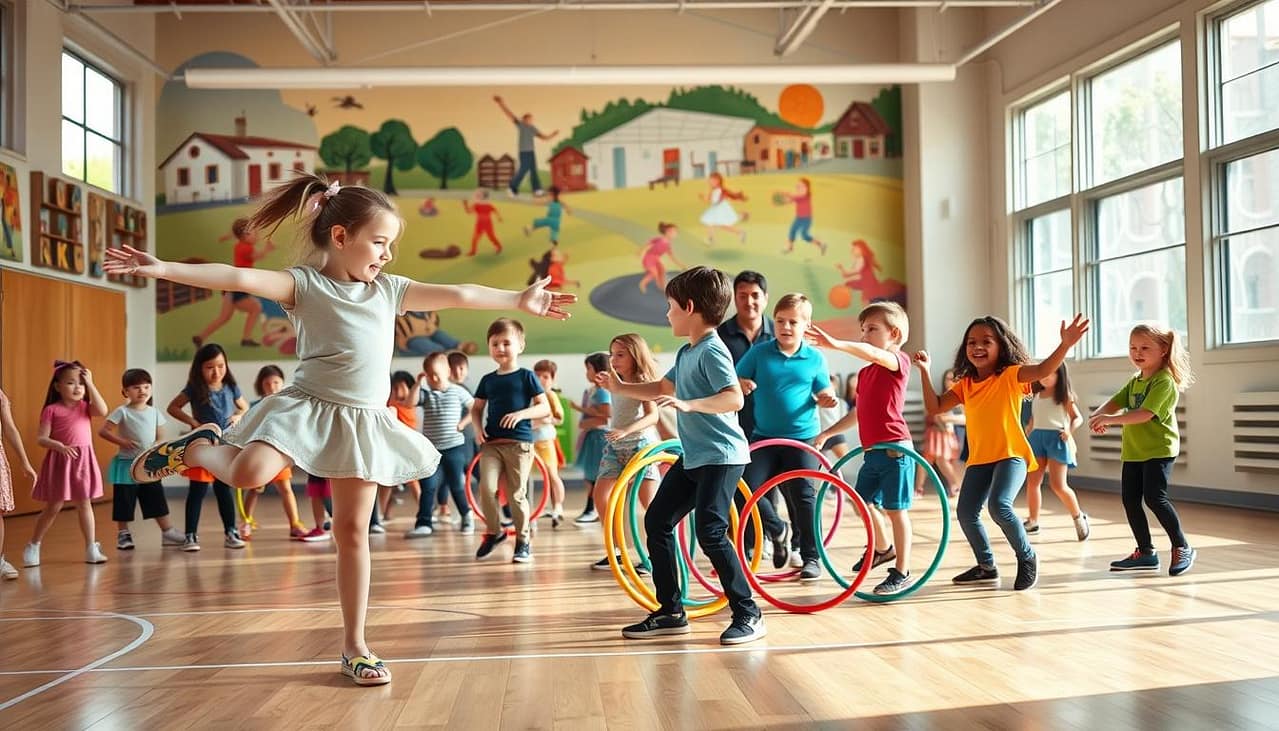
Watching a child master movement skills is like witnessing evolution in fast-forward. From clumsy hominid to graceful human in just a few years. Early motor skills are not just about playground dominance; they’re the foundation of lifelong physical literacy.
Think of fundamental movement skills as the alphabet of physical activity. Running, balancing, hopping, throwing – these are not random exercises. They are the basic vocabulary that makes movement comprehensible and enjoyable. Without this vocabulary, physical activity becomes a foreign language that many adults never learn to speak fluently.

The chart reveals something fascinating: we have specific developmental windows for each skill. Kicking matures by age 6-7, running by 5-6, jumping by 6-7. Miss these windows, and you’re creating movement accents that persist into adulthood. It’s the physical equivalent of learning grammar before writing poetry.
What separates effective physical literacy programs from mere exercise drills? Context. We’re not training little soldiers – we’re creating movement laboratories where natural exploration happens. The playground becomes a research facility, and every game is an experiment in gravity, momentum, and coordination.
The skills progression reads like humanity’s greatest hits album. Running – our evolutionary birthright. Throwing – what separated us from other primates. And skipping – the movement world’s jazz improvisation. Each skill builds confidence and opens new possibilities for engagement.
Here’s the brutal truth I’ve observed: awkward adult movers weren’t born that way. They missed their developmental windows. Their physical literacy development got stuck somewhere between crawling and competent movement. The good news? It’s never too late to learn, but childhood is the ideal time.
Effective integration means recognizing that movement skills aren’t isolated exercises. They’re interconnected patterns that build upon each other. A child who masters balancing can progress to hopping. Solid hopping leads to confident skipping. It’s a movement domino effect.
The real magic happens when physical literacy becomes invisible – when skills integrate so seamlessly that children forget they’re “practicing” and simply play. That’s when movement transitions from chore to joy, from exercise to expression.
We’re not just teaching kids to throw balls. We’re helping them develop movement confidence that will influence their relationship with physical activity for decades. It’s about creating movers who don’t just perform skills but understand them – the difference between memorizing phrases and speaking a language fluently.
The data shows intervention points, but the real intervention is cultural. We need to shift from seeing movement as something we schedule to something we live. From plastic prison yards to dynamic environments that invite exploration. That’s where true physical literacy flourishes.
Community Partnerships
Community partnerships are like the ensemble cast in a Broadway show. They make the show worth watching. Without them, it’s just a solo act.
The Aspen Institute knows this. They’ve found ten key sectors to make physical literacy real. These include:
- Community recreation organizations designing spaces that invite movement
- Education systems integrating physical activity into learning
- Fitness professionals who understand development over six-pack abs
- Healthcare providers screening for movement competence like vital signs
- Media showing competent movement (looking at you, Hollywood’s awkward running scenes)
viaSport shows what happens when sectors work together. They’ve formed a team effort, not just individual stars.
Parents and guardians are the most overlooked partners. They should show kids that lifelong activity is for everyone, not just kids.
These partnerships make movement a part of everyday life. Healthcare spots movement issues early. Schools add activity to lessons. Recreation areas encourage people to move.
This leads to a culture where physical literacy is as basic as reading. Lifelong activity becomes a natural part of life. Communities support movement skills from young to old.
This team effort changes physical literacy into a cultural shift. It’s like teaching someone to fish and creating a fishing industry that lasts for generations.
Evaluating Program Outcomes
Let’s get real about the wellness industry. It loves to show off enthusiasm without real evidence. Physical literacy programs are more than just counting push-ups or tracking times.
We don’t have decades of studies yet. But we have something even better – a story of movement patterns.
Research shows a cool chain reaction. Kids with good motor skills in preschool stay active in elementary school. Then, those active kids become active teens. It’s like compound interest in movement skills.
The real challenge isn’t just about fitness. It’s about measuring confidence, competence, and motivation at different ages.
We’re not just making better athletes. We’re making people who enjoy moving because they can, not because they have to.
The ultimate goal? Seeing if someone enjoys moving without anyone watching or keeping score. That’s true physical literacy success.
Current methods focus on:
- Movement skills in different places
- How confident someone is in trying new things
- How much they want to do it for themselves, not for rewards
- How well they connect with others through activity
This isn’t just about collecting data. It’s about understanding how people behave. Research shows that motor skills in childhood predict activity later in life. It’s like finding childhood clues in adult choices.
The best proof of physical literacy programs might be what happens after the program ends. Do people keep moving? Do they look for new challenges? That’s where the real test starts.
We’re looking at something more valuable than just fitness scores. We’re tracking people who enjoy moving for life. That’s an outcome worth measuring.
Promoting Lifelong Wellness habits
Physical literacy’s true value isn’t in winning or fitness scores. It’s in the quiet confidence of choosing to move because it feels good. It’s about understanding our bodies as instruments of joy, not problems.
I’ve seen how retirement communities show the power of movement literacy. Those who stay active garden, dance, and play with grandkids. The others mostly sit in chairs. Research backs up what we see: those who move well stay engaged longer.
The “Active for Life” phase is about taking control of our physical literacy. It’s about hiking because it’s an adventure, not a challenge. It’s dancing because it connects us to music and memories. This makes movement a personal choice, not just a routine.
Physical literacy asks a big question: do you want to live longer or live better? The answer shows in how we move. We move with confidence, competence, and joy, making activity a lifelong choice.