
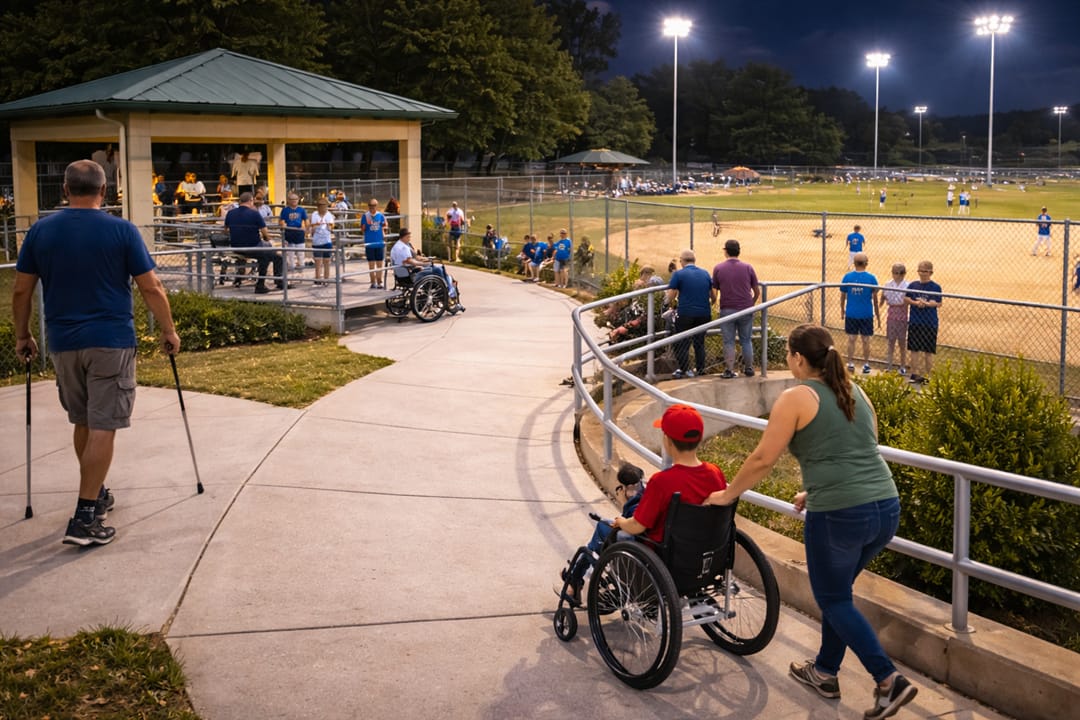
Inclusion does not begin with a registration form.
It begins with pavement width. With ramp grade. With restroom access. With whether a wheelchair can reach the sideline without crossing gravel or mud.
Youth sports often celebrate diversity in mission statements. But infrastructure reveals truth. A field complex either invites participation from athletes of all abilities, or it quietly filters them out.
If community athletics are meant to serve everyone, infrastructure must reflect that promise. Adaptive sports design is not an add-on. It is foundational planning. As discussed in the analysis of heat-resilient facility planning, infrastructure decisions shape who can safely participate.
Accessibility Is Not Optional Infrastructure
The Americans with Disabilities Act (ADA) establishes baseline requirements for public facilities. But compliance is the floor, not the ceiling.
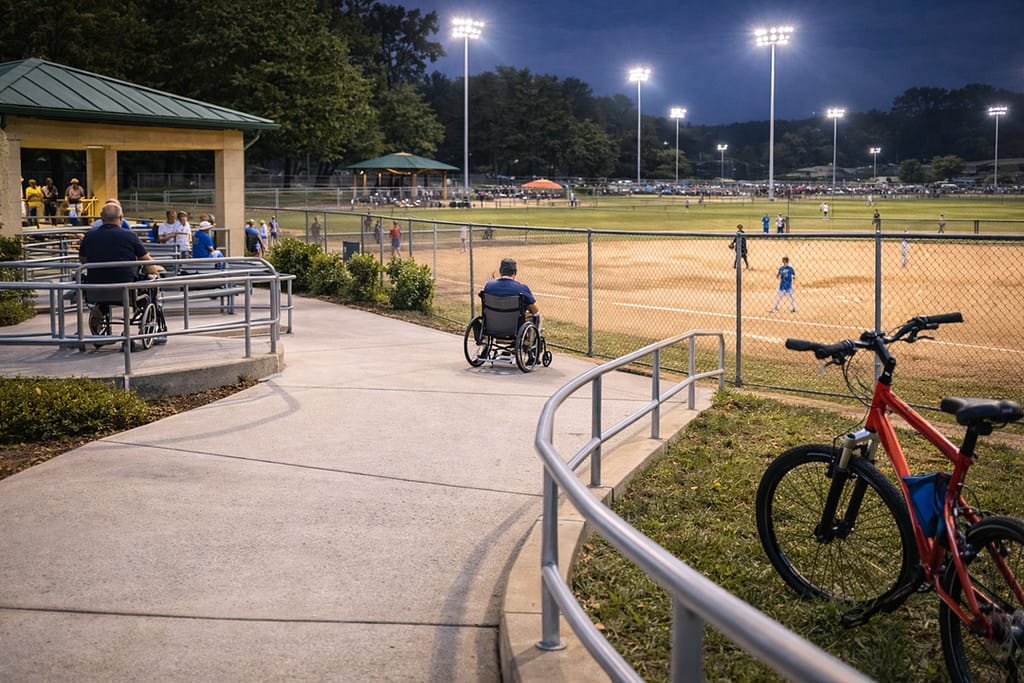
True inclusive design moves beyond minimum code. It anticipates diverse needs rather than reacting to complaints.
Core accessibility components in sports complexes include:
| Infrastructure Element | Minimum Compliance Std. | Inclusive Upgrade |
|---|---|---|
| Pathways | 36-inch clear width | Wider dual-direction pedestrian lanes |
| Ramps | 1:12 slope ratio | Integrated ramp systems with rest platforms |
| Seating Areas | Designated wheelchair spaces | Integrated seating without segregation |
| Restrooms | ADA-accessible stall | Family-access and adult changing stations |
| Dugouts & Benches | Level entry required | Adjustable seating and shade coverage |
Compliance ensures legal protection. Inclusive design ensures belonging.
Facilities built only to meet code often remain technically accessible but practically inconvenient. True planning considers the athlete, the parent, the volunteer, and the sibling—all with varied mobility needs.
Universal Design as Competitive Advantage
Universal design principles assume that environments should work for as many people as possible without adaptation.
In sports infrastructure, that means thinking about:
- Surface transitions between turf and pavement
- Shade access for athletes with heat sensitivity
- Clear signage with high contrast and simple language
- Audible and visual scoreboards for varied sensory needs
When facilities are designed universally, participation expands organically. Registration barriers decrease. Community perception improves.
Consider how infrastructure choices affect participation:
| Design Feature | Impact on Participation | Long-Term Benefit |
|---|---|---|
| Rubberized Pathways | Improved wheelchair mobility | Reduced erosion and maintenance |
| Sensory-Quiet Zones | Supports neurodivergent athletes | Expands family engagement |
| Multi-Height Water Fountains | Accessible hydration | Lower injury risk |
| Adjustable Practice Equipment | Adaptive training support | Broader programming options |
Inclusive infrastructure does not dilute competition. It strengthens community trust.
Field Surfaces and Adaptive Play
Surface selection is often framed as durability versus cost. Inclusion adds another dimension.
Natural grass fields can present uneven terrain, especially in high-use zones. Artificial turf offers consistency but introduces heat retention and long-term replacement costs.

Adaptive athletes—particularly those using mobility devices—benefit from stable, predictable surfaces.
Field planning should consider:
- Transition edges between turf and track
- Drainage systems that prevent pooling
- Bench and sideline spacing for adaptive equipment
- Clear emergency access routes
Surface selection becomes not just a maintenance decision, but an access decision.
Programming Requires Physical Space
Inclusion is not only about built environment. It is about whether facilities allocate space for adaptive programming.
Does the complex include:
- Storage for adaptive equipment?
- Flexible scheduling windows for inclusive leagues?
- Quiet warm-up areas?
- Training space for unified teams?
Infrastructure determines programming capacity. If facilities lack space for adaptation, inclusive intentions collapse under logistical strain.
Inclusive planning should be embedded at the master plan stage—not retrofitted after construction.
Budgeting for Inclusion
A common objection to adaptive infrastructure is cost. Yet retrofitting later is almost always more expensive.
Proactive design distributes cost across the full capital lifecycle. Additionally, inclusive planning strengthens eligibility for grants tied to equity, disability access, and public health.
| Investment Category | Upfront Cost Impact | Long-Term Value |
|---|---|---|
| ADA-Plus Design | Moderate increase | Reduced liability exposure |
| Adaptive Equipment Storage | Minimal | Expanded program offerings |
| Accessible Seating Integration | Low | Improved spectator diversity |
| Inclusive Signage & Wayfinding | Low | Reduced operational confusion |
Inclusion is not a luxury expense. It is risk mitigation and community development combined.
Leadership and Inclusive Infrastructure
Facilities reflect leadership priorities. When boards and administrators treat accessibility as secondary, it shows.
Leadership decisions determine:
- Whether inclusive audits are conducted
- Whether architects are selected for universal design experience
- Whether community members with disabilities are consulted in planning
Inclusive field planning should involve stakeholder engagement early. Listening sessions, accessibility walkthroughs, and community surveys reveal barriers that blueprints may miss.
Infrastructure speaks louder than slogans.
Beyond Compliance Toward Belonging
Designing for all is not about accommodating a minority. It is about recognizing that ability exists on a spectrum.
Athletes age. Volunteers sustain injuries. Grandparents attend games. Families navigate temporary or permanent mobility challenges. Inclusive facilities serve everyone at some point.
When complexes are built with adaptive infrastructure, they send a message: participation is expected from all members of the community.
The field is a gathering place. Its design either expands that circle—or narrows it.
Inclusive planning widens it.