
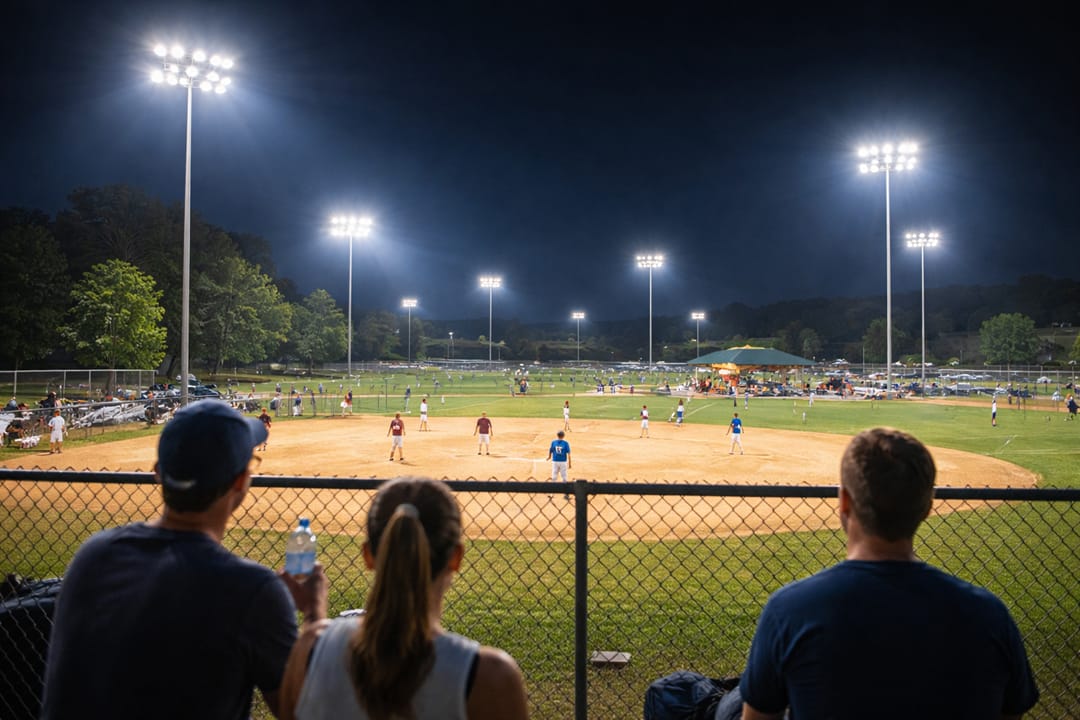
The game starts at 7:00 p.m.
By then, the sun has dropped below the treeline. Stadium lights flicker on. Parking lot poles hum. Scoreboards glow. Concession stands buzz back to life for a second shift.
Evening games feel efficient. They avoid heat, accommodate work schedules, and extend field availability. But night play carries a cost that rarely appears on a registration form: energy consumption.
If youth sports are serious about sustainability, we cannot stop at water use or transportation emissions. We must look up—at the lights.
The Energy Reality of Evening Competition
Outdoor field lighting is energy intensive by design. Competitive standards require high lux levels for safety, visibility, and officiating accuracy. A single baseball or soccer field may rely on four to eight high-mast poles, each equipped with multiple high-output fixtures.
Older systems often use metal halide or high-pressure sodium fixtures. These lamps consume large amounts of electricity and lose efficiency over time. They also require warm-up periods and frequent maintenance.
Here is a general comparison of lighting technologies commonly used in youth sports complexes:
| Lighting Type | Average Wattage | Lifespan (Hours) | Maintenance | Efficiency |
|---|---|---|---|---|
| Metal Halide | 1,000–1,500W | 6K–15K | High | Low |
| High-Pressure Sodium | 400–1,000W | 15K–24K | Moderate | Moderate |
| LED Sports Lighting | 300–800W | 50K–100K | Low | High |
The difference compounds quickly. Multiply fixture wattage by 20–40 fixtures across a complex, and by multiple fields running simultaneously. Add practice sessions and tournament weekends. The monthly utility bill tells a story few administrators track closely.
Evening games are not just about light. They are about sustained load.
Demand Charges and the Hidden Utility Multiplier
Most facility managers focus on kilowatt-hour consumption. But commercial utility bills often include demand charges. These are fees based on the highest 15-minute spike in power usage during a billing cycle.
When stadium lights, concession equipment, HVAC systems, and parking lot lighting activate simultaneously, the facility’s peak demand can surge. That spike sets the demand charge for the entire month.
This means a few high-intensity evenings can influence total operating costs disproportionately.
A simplified breakdown looks like this:
| Cost Component | What It Measures | Why It Matters |
|---|---|---|
| Energy Consumption (kWh) | Total electricity used | Influences variable monthly cost |
| Demand Charge (kW Peak) | Highest short-term load | Multiplies cost even if usage is brief |
| Maintenance | Bulb replacement, lift rentals | Adds long-term operational expense |
| Fixture Degradation | Light output decline over time | Reduces efficiency without visible warning |
The true cost of evening games is not just runtime. It is peak intensity.
LED Retrofits: Efficiency or Expense?
LED sports lighting has transformed commercial stadiums. The question is whether the economics work for community facilities.
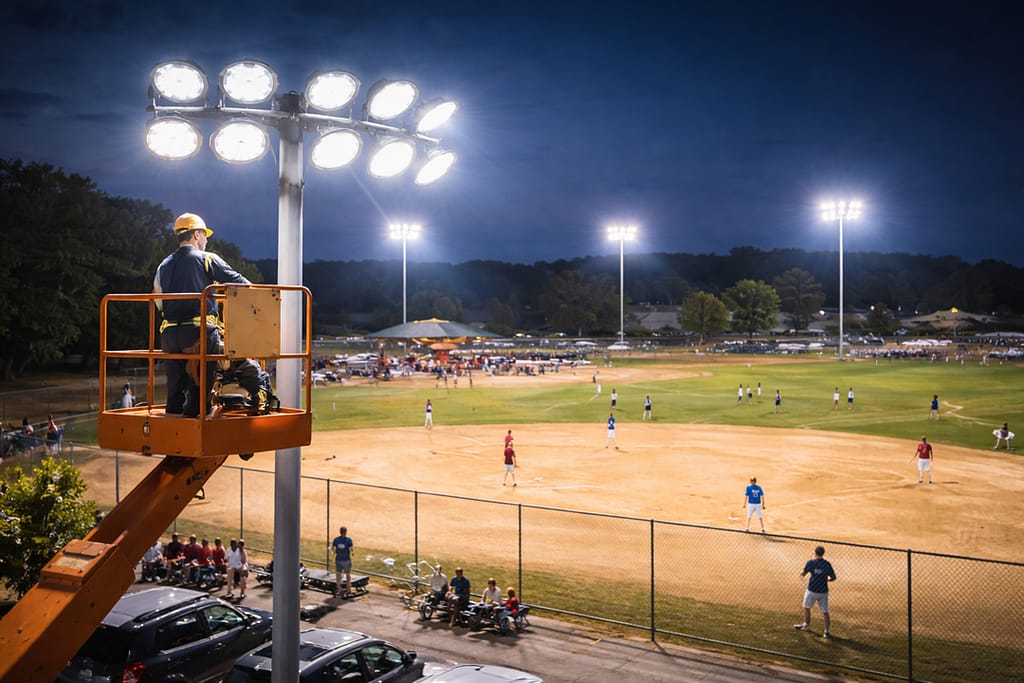
LED systems reduce wattage, eliminate warm-up time, and provide instant on/off control. They also allow zoning—lighting only part of a field for practice. This flexibility can reduce unnecessary consumption.
However, retrofit costs are significant. Installation often includes new drivers, rewiring, pole evaluation, and photometric planning to meet safety standards.
A high school-sized field retrofit may range from tens of thousands to well into six figures depending on scope.
But long-term savings alter the equation:
| Factor | Metal Halide System | LED Retrofit |
|---|---|---|
| Energy Consumption | High | 40–70% lower |
| Bulb Replacement Cycle | Frequent | Minimal |
| Warm-Up Time | 10–20 minutes | Instant |
| Light Spill | Higher | More controllable |
| Annual Maintenance Cost | Elevated | Reduced |
LED retrofits are not just about savings. They improve light uniformity, reduce glare, and minimize light spill into surrounding neighborhoods. That last factor matters more than many realize.
Light Pollution and Community Impact
Evening play does not exist in isolation. Fields are embedded in neighborhoods. Bright stadium lighting can extend far beyond the sidelines.
Light spill affects nearby residents, wildlife patterns, and night sky visibility. Poorly aimed fixtures contribute to glare and visual discomfort. In some municipalities, field lighting has become a zoning conflict.
Modern LED systems can reduce spill through precision optics and directional control. But operational policy matters as much as hardware.
Ending games on time. Avoiding unnecessary late-night practices. Shutting lights off immediately after play concludes. These decisions are governance, not technology.
Scheduling as an Energy Policy
Evening scheduling is often treated as convenience logistics. It should also be viewed as energy policy.
Heat mitigation drives many leagues toward nighttime competition. But if climate adaptation pushes more activity into the evening, energy demand rises in parallel.

Administrators can evaluate:
- Whether some divisions can remain daytime-based
- Whether tournaments can stagger start times to reduce simultaneous lighting loads
- Whether off-season practices require full-field illumination
- Whether curfew policies align with energy and community goals
Small scheduling shifts can meaningfully lower total load without reducing participation.
Financing Smarter Lighting
LED retrofits can be financially daunting for smaller programs. Yet funding pathways increasingly recognize energy efficiency as infrastructure improvement.
Common financing models include:
| Funding Pathway | Description | Advantage |
|---|---|---|
| Utility Rebates | Incentives for energy-efficient upgrades | Reduces upfront cost |
| Energy Performance Contracts | Savings repay retrofit investment | Limits capital risk |
| Municipal Grants | Sustainability or infrastructure funding | Aligns with city climate targets |
| Corporate Sponsorship | Naming rights tied to green upgrades | Enhances brand visibility |
When lighting upgrades are framed as safety, cost control, and environmental responsibility combined, funding conversations change.
The Full Cost of Playing After Dark
Evening games are not inherently unsustainable. In many climates, they protect athletes from heat stress and expand participation access.
But lighting is infrastructure. Infrastructure carries lifecycle cost, maintenance burden, energy demand, and community impact.
The real question is not whether to play at night.
It is whether facilities understand the operational footprint of doing so.
If youth sports teach discipline and long-term thinking, then facilities should model the same mindset. Measure load. Evaluate peak demand. Assess maintenance cycles. Revisit scheduling norms.
The lights make the game possible.
Understanding their cost makes the program responsible.