

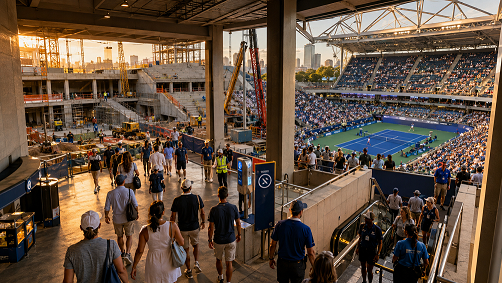
Arthur Ashe Stadium is undergoing the largest single investment in US Open history, but the most important part of the $800 million transformation may not be the new courtside seats, luxury suites or expanded concourses. It is the construction schedule. The USTA is rebuilding major portions of the centerpiece of the Billie Jean King National Tennis Center while continuing to stage one of the world’s biggest annual sporting events, turning Queens into a live test of how sports venues can modernize without shutting down their primary event.
That challenge has become particularly visible during the 2026 US Open cycle. Fans increasingly interact with sports across ticketing platforms, streaming services, travel tools and information sites where they may even compare football lines, but the physical venue still has to move thousands of people safely through entrances, concourses, seating sections and hospitality spaces while construction progresses around an immovable tournament calendar.
For aplevante.org, that makes Arthur Ashe Stadium a sports-infrastructure story rather than simply a tennis renovation story. It connects directly to the larger question of how organizations can create sports infrastructure that lasts while continuing to serve athletes and spectators during the transition.
Why The US Open Cannot Simply Close For Renovations
Closing Arthur Ashe Stadium for an extended construction period would solve many logistical problems.
Contractors could control larger sections of the site. Work could continue without accommodating spectators. Temporary spaces would be less important. Construction schedules would have more flexibility.
The US Open does not have that luxury.
The tournament is an annual global event with established television windows, hospitality commitments, ticket holders, commercial partners, international players and a massive New York tourism footprint. The USTA says the US Open produces more than $1.2 billion in annual economic impact during its three-week event period.
That creates a hard deadline every year.
Construction teams can work around the tournament, but the tournament cannot move around construction.
The USTA therefore divided the transformation into three phases spanning the periods around the 2025, 2026 and 2027 US Opens. The objective is unusually demanding: fundamentally modernize Arthur Ashe Stadium while preserving scheduled play and fan access.
That makes the project an exercise in event continuity as much as architecture.
How Phase One Prepared The Building For Bigger Changes
The first phase took place before the 2025 US Open and was intentionally difficult for spectators to notice.
Structural work reinforced Arthur Ashe Stadium’s columns so the building could support later construction. Work also began on the lower two stories of the four-story building that will eventually contain the new Player Performance Center.
Those lower levels provide parking.
That kind of behind-the-scenes work illustrates an important principle in phased venue construction. The most visible upgrades often depend on structural interventions completed much earlier.
Fans arriving for a tournament may see little change while engineers are preparing the building for major alterations above and around them.
In infrastructure terms, that is preparation for operational resilience.
A live-event renovation cannot simply demolish everything at once. Each construction phase has to create the conditions for the next while leaving enough of the venue operational for the upcoming event.
Why The 2026 US Open Is The Critical Middle Test
Phase Two is where the transformation became much harder to hide.
Between the 2025 and 2026 tournaments, the existing courtside and suite levels were removed and replaced with an expanded courtside bowl and two dedicated luxury suite levels.
For the 2026 event, the courtside level gained 2,000 seats, increasing capacity in that area from 3,000 to 5,000.
The promenade-level concourse also gained approximately 40% more space.
Those are substantial physical changes to the stadium spectators are actively using.
Yet the 2026 environment is deliberately transitional. The USTA has acknowledged that some areas fans encounter this year are temporary because the final design will not be complete until 2027.
That is what makes this phase particularly instructive.
Venue operators have to create a high-quality temporary condition inside a permanent construction program.
Fans still expect clear circulation, functioning concessions, reliable restrooms, safe seating, visible wayfinding and normal tournament operations. They do not experience the US Open as an architectural construction phase. They experience it as the event they paid to attend.
The construction team therefore has to disappear operationally even when its work is physically obvious.
How A 40% Larger Concourse Becomes A Crowd-Flow Experiment
The promenade expansion is more important than it may appear in a rendering.
Concourses are transportation infrastructure inside stadiums.
They carry people between seats, bathrooms, concessions, merchandise, exits and vertical circulation. During session changes and rain delays, pressure can build quickly.
Increasing promenade-level space by 40% gives the USTA more room to manage those movements.
But the 2026 season is effectively testing the change before the complete final environment opens.
Operators can observe where fans gather, how lines form, whether new circulation patterns reduce congestion and which temporary configurations perform well.
Those observations can influence how the final 2027 environment operates.
That is one advantage of phased construction during active events: the building generates real-world information.
Instead of relying only on computer simulations, planners can see tens of thousands of actual spectators move through the modified stadium.
Why Escalators And Elevators Matter More Than Premium Lounges
Luxury spaces attract attention because they are visually impressive and commercially important.
From an infrastructure perspective, some of the less glamorous upgrades may have a wider effect.
The completed Arthur Ashe Stadium plan includes additional escalators and elevators, particularly around the South entrance, along with expanded restroom access and redesigned concourses.
Those improvements affect how different groups move through the building.
Parents with children, older spectators, people with mobility limitations and fans sitting at higher levels all depend on vertical circulation.
A stadium may have excellent seats and attractive restaurants, but if spectators spend too much time waiting for elevators or navigating crowded stairways, the event experience suffers.
That is why circulation capacity is core live-event infrastructure.
Arthur Ashe Stadium is testing the balance between adding desirable destinations inside the building and making sure people can reach them efficiently.
How The Player Performance Center Adds Another Construction Layer
The transformation is not limited to spectators.
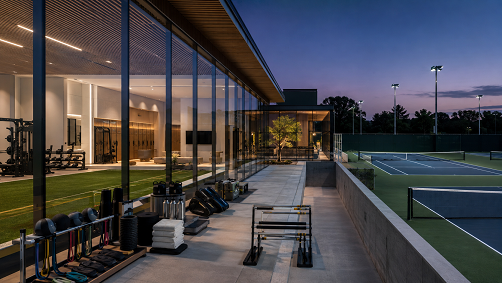
A new $250 million Player Performance Center is being constructed west of Arthur Ashe Stadium beside the practice courts.
The two-story player facility will occupy the upper floors of a four-story structure and is expected to open for the 2027 US Open.
Plans call for expanded indoor and outdoor fitness and warm-up areas, including turf, track and US Open court surfaces. Players will also receive redesigned locker rooms, lounges, larger dining areas, an outdoor courtyard, a private café and a dedicated entrance.
The USTA says close to 2,800 players and team members converge on the tournament each year.
That creates another operational challenge.
Athlete infrastructure has to improve while the existing player system continues functioning during the construction period.
The organization cannot sacrifice athlete preparation in order to build better athlete preparation facilities.
That makes sequencing critical.
Why Temporary Infrastructure Is Part Of The Real Project
Temporary spaces are sometimes viewed as construction compromises.
At a live sporting event, they are infrastructure.
Temporary hospitality areas, circulation routes, barriers, service spaces and operational zones all have to meet real event requirements even if they will disappear months later.
That creates additional cost and planning complexity.
A normal construction project tries to avoid building something twice. Live-event construction sometimes requires exactly that.
The temporary solution may exist for only one tournament, but it still has to safely support fans, staff, vendors, broadcasters and partners.
Arthur Ashe Stadium shows why renovation budgets cannot be understood only through the permanent finished product.
Keeping a major event alive during construction requires an entire transitional layer.
How The US Open Calendar Changes Construction Management
The tournament calendar creates an unusual construction rhythm.
When the US Open ends, the clock immediately begins ticking toward the next one.
Demolition and structural work have to proceed quickly. Long-lead materials must arrive on schedule. Contractors need tightly coordinated work zones. Testing and commissioning must happen early enough for event operations teams to take control before fans return.
Then construction activity has to yield to tournament operations.
That is very different from a project where the contractor controls the building until completion.
At the National Tennis Center, construction and event teams effectively exchange control of the site.
That requires detailed communication.
An unfinished building cannot become an excuse for an unfinished event.
Why The 2027 Deadline Is More Than A Completion Date
Phase Three will take place between the 2026 and 2027 US Opens.
It includes the final Grand Entrance designed with architect Daniel Libeskind, completed loge and promenade levels, upgraded retail and food-and-beverage spaces, expanded restrooms, additional escalators and elevators and new hospitality areas.
The Player Performance Center interior will also be completed during this phase.
That makes the 2027 tournament the point when temporary solutions give way to the full operating model.
The important question will not only be whether the construction looks finished.
It will be whether several years of phased work produce better movement, athlete preparation and event operations under real tournament pressure.
The final test occurs with people inside the building.
Why The USTA’s Funding Model Changes The Project Debate
Another notable detail is how the project is financed.
The USTA says the $800 million transformation is entirely self-funded without taxpayer or government construction funding.
Combined with the previous modernization completed in 2018, the organization says it has invested nearly $2 billion into the US Open and its home facility.
That does not eliminate questions about priorities.
Premium seating and hospitality are major components of the transformation, and increasing courtside inventory has obvious revenue value.
But private funding changes the public-policy framework compared with stadium projects requiring substantial municipal contributions.
The infrastructure question becomes less about taxpayer exposure and more about whether the investment improves the tournament sufficiently to sustain its global position and economic impact.
Why Arthur Ashe Is A Different Kind Of Stadium Renovation
Most stadium renovation projects have longer operating windows.
An NFL team plays a limited number of home dates each season. Baseball facilities face many games but can sometimes concentrate major construction in winter. Arenas may schedule around renovations.
The US Open has one annual window that defines the facility internationally.
Missing that window would be extremely costly.
That makes Arthur Ashe Stadium unusually dependent on precise scheduling.
Construction can take months.
Failure can be measured in days.
A delayed concourse, incomplete seating section or unavailable operational zone can affect an event with international broadcasting, athletes from around the world and hundreds of thousands of spectators.
The margin for error is small.
What Other Sports Facilities Can Learn From Queens
Arthur Ashe Stadium offers a useful model for venues that cannot afford a long closure.
The first lesson is to build the phasing strategy before construction starts.
The second is to distinguish between work fans need to see and work that can remain behind the scenes.
The third is to treat temporary infrastructure as seriously as permanent infrastructure.
The fourth is to use live events as operational feedback opportunities.
The fifth is to protect athlete and spectator functions separately. Both groups have different needs, and construction cannot compromise either.
Those lessons extend well beyond tennis.
Football stadiums, baseball parks, arenas, race tracks and multi-sport complexes increasingly face the same challenge: older buildings need major investment, but closing them can disrupt revenue, teams, communities and event calendars.
Why This Is Really A Live-Event Construction Test
Arthur Ashe Stadium’s $800 million transformation matters because the USTA is trying to rebuild one of tennis’ most important venues without stopping the event that gives the building its purpose.
The new seats matter.
The expanded concourses matter.
The Player Performance Center matters.
But the most difficult achievement is continuity.
Fans are entering a stadium that is simultaneously operating and evolving. Players are competing while their future performance center takes shape beside them. Contractors are sequencing years of work around a tournament that cannot simply be postponed.
That turns Queens into a laboratory for sports infrastructure.
By the 2027 US Open, the final result should look permanent.
The more important measure of success will be whether the USTA managed to make the complicated years before completion feel temporary to the people who came to watch tennis.
That is the standard live-event construction ultimately has to meet.