
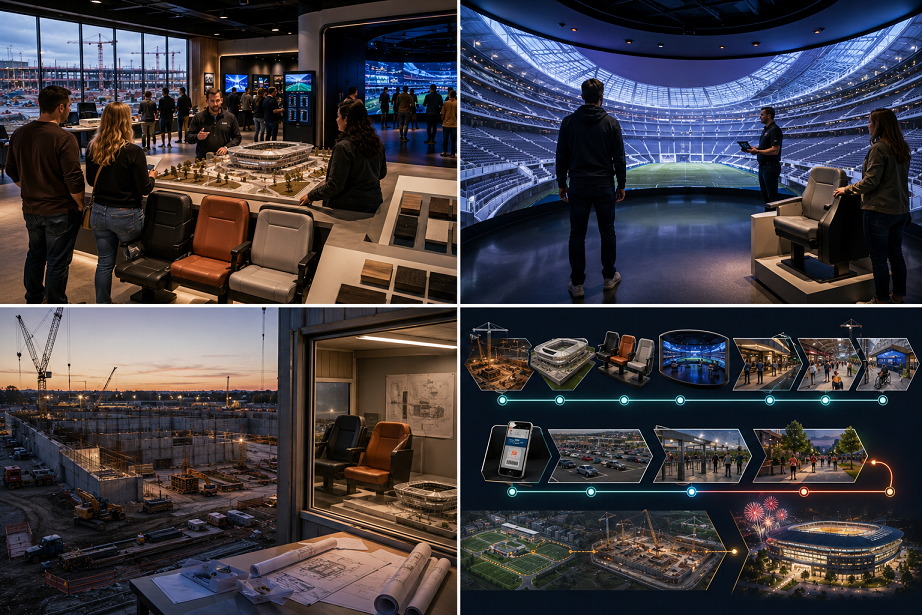
The Cleveland Browns are building their next stadium in Brook Park, but one of the most revealing pieces of the project has opened miles away in Berea. On August 17, 2026, the organization and Haslam Sports Group opened the Browns Experience Center, a space designed to let fans experience parts of the future Huntington Bank Field years before the building itself is scheduled to open.
That changes the traditional stadium-development timeline.
Fans usually encounter a new venue through renderings, construction photographs, seat maps and eventually a ticket invoice. Cleveland is inserting another stage between blueprint and opening day. Visitors can examine a large-scale stadium model, sit in examples of future seats, explore a team-history environment and enter a 270-degree immersive digital installation intended to simulate pieces of the future experience.
The center therefore is not merely a showroom. It is evidence that stadium construction is becoming a fan-planning product.
For aplevante.org, that makes the project a natural continuation of the recent look at District 46 and the Browns’ broader sports development strategy. Berea is becoming the place where the organization introduces fans to its next generation of infrastructure, while Brook Park is where the larger stadium and mixed-use destination are physically taking shape.
Why The Experience Center Changes The Construction Timeline
The new Huntington Bank Field is scheduled to open for the 2029 season.
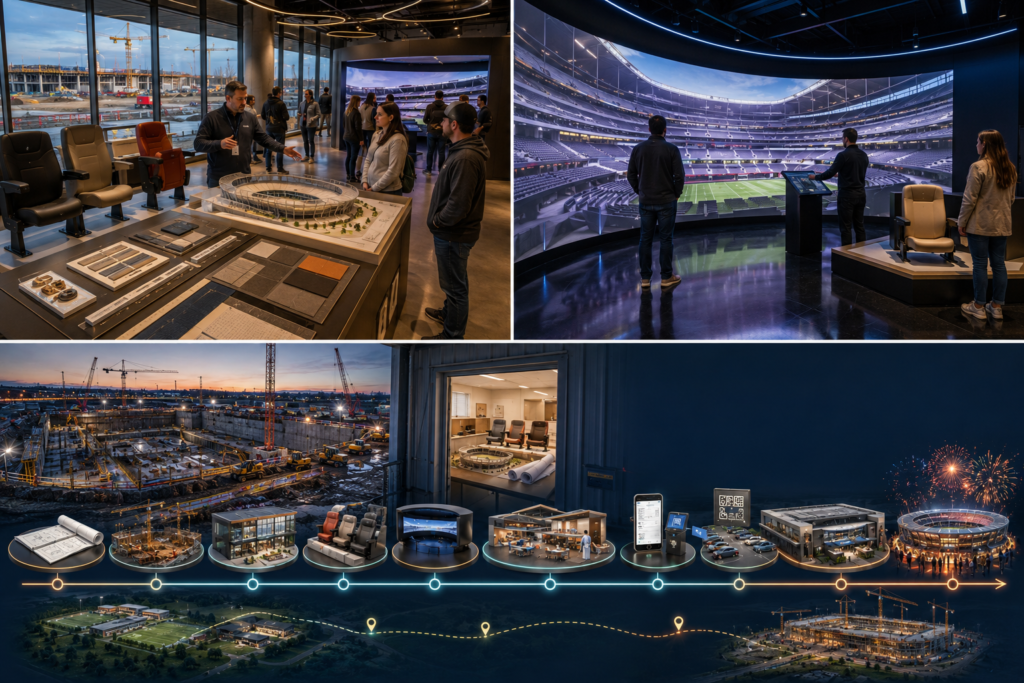
That leaves several years between the April 30, 2026 groundbreaking and the first regular-season game inside the building. Traditionally, that period would belong mainly to construction teams, architects, public officials, engineers and project managers.
The Browns are bringing fans into the process much earlier.
Located at the CrossCountry Mortgage Campus in Berea, the Experience Center gives visitors something more tangible than a rendering. A person considering future seats can physically test them. A fan trying to understand the seating bowl can examine a detailed model. Someone curious about the atmosphere can enter an immersive environment rather than trying to interpret a flat architectural image.
That turns construction into an ongoing communication process.
Instead of asking supporters to disappear from the project until 2029, the team can keep them engaged while excavation, foundations and structural work continue in Brook Park.
That matters because modern stadium construction is not only a technical project. It is also a long transition between an existing fan routine and a new one.
How The 270-Degree Cube Makes A Future Stadium Feel Real
The most distinctive feature inside the Experience Center may be The Immersive Cube.
Created by Advent, the wrap-around digital installation spans 270 degrees and is described by the Browns as the widest installation of its kind in the United States. Its value is not simply technological spectacle.
Its real function is translation.
Architects and venue planners understand sections, elevations, renderings and sightline studies. Most fans do not. They understand what it feels like to enter a stadium, walk toward a seat, look toward the field and absorb the surrounding environment.
Immersive visualization helps close that gap.
A future venue becomes easier to understand when fans can experience scale rather than read dimensions. The technology can help communicate the relationship between seating, concourses, premium areas, entry sequences and the overall stadium environment before those spaces physically exist.
That makes digital simulation part of venue infrastructure.
The construction site builds the building. The Experience Center builds familiarity with it.
Why Actual Seats Matter More Than Another Rendering
Displaying future stadium seats may sound like a small detail, but it reflects a larger change in fan planning.
Seats are one of the few stadium features every ticket holder physically interacts with for hours. Width, comfort, spacing, angle and location all affect how a fan evaluates a venue.
Putting actual seating inside the Experience Center gives prospective ticket members a direct reference point before making long-term decisions.
That is particularly relevant because the new Huntington Bank Field construction plan is built heavily around sightlines and proximity.
The Browns say approximately 70% of seating will sit below ground level. The planned football configuration includes 67,500 seats plus 2,500 standing-room positions, and the team says the seating bowl will feature the closest front and back rows in the NFL.
Those claims are easier to communicate through physical experience than marketing language.
A seat model and immersive view allow supporters to evaluate what “closer” could actually mean.
Why Fan Planning Now Starts Before A Stadium Exists
Stadium operations once focused overwhelmingly on opening day and everything after it.
Modern fan planning begins much earlier.
Before a new building opens, teams now have to decide how existing season-ticket holders migrate into new inventory, how premium areas are presented, how different seating categories are explained, how accessible seating is communicated and how traditions move from one facility to another.
Cleveland’s transition is especially significant because the Brook Park project represents a fundamentally different venue model.
The current Browns stadium sits on Cleveland’s lakefront. The new stadium is being developed within a 176-acre Brook Park site envisioned as a live-work-play destination.
Fans will not simply receive different seats.
They will encounter different roads, parking patterns, gathering areas, entrances, surrounding businesses and pregame routines.
The Experience Center gives the organization a place to start explaining that change now.
How Brook Park’s Scale Makes Early Communication More Important
The new stadium is not being built as a single-purpose football bowl.
At groundbreaking, the Browns described the project as an enclosed venue capable of hosting Browns games, NCAA Final Fours, international soccer and concerts. Its planned flexible configuration can range from approximately 6,000 people for smaller events to as many as 75,000 for major productions.
The roof is intended to allow year-round activation.
That scale means the venue has to be understood as more than the replacement for an existing NFL stadium.
The Browns are effectively introducing a new regional sports and entertainment system.
Fans have to understand what an enclosed Browns game feels like. Concert promoters need to understand event configurations. Corporate partners need to see hospitality inventory. Future visitors need to understand how the development surrounding the venue will function.
The Experience Center becomes an interpretive layer between construction drawings and those different audiences.
That is increasingly valuable as stadium projects become more complicated.
Why Premium Sales And Fan Planning Now Overlap
There is an obvious commercial side to the Experience Center.
Legends Global is managing sponsorships, premium seating and suite sales for the future Huntington Bank Field. Elevate designed and delivered the center, and the Browns noted that the company has developed 10 experience centers for teams, leagues and venues in three years.
That suggests this is not an isolated Cleveland experiment.
Experience centers are becoming part of the business architecture surrounding large venue projects.
But commercial value and fan planning are not necessarily opposing goals.
A well-designed preview environment can help a supporter make a more informed seating decision. It can show the actual difference between inventory categories instead of relying on abstract diagrams. It can establish expectations about views, amenities and circulation years before opening.
The risk comes when the preview experience focuses only on expensive premium inventory.
A stadium is ultimately used by tens of thousands of people with very different ticket budgets. The strongest fan-planning model will eventually explain general seating, standing-room areas, accessibility, family considerations, entry systems and public spaces with the same clarity used for suites and clubs.
Why Browns History Is Part Of The Infrastructure
The Experience Center also includes a Browns Tunnel centered on team history and supporters.
That may appear to be a branding element rather than infrastructure, but it solves a real stadium-development problem: continuity.
Moving into a new venue can disrupt routines that fans have built over decades. Particular gates, parking locations, tailgate groups, seating sections and stadium landmarks become part of supporter culture.
A completely new building risks feeling detached from that history.
The Browns are trying to connect the future stadium to the franchise’s existing identity before construction is complete.
That matters because successful venue transitions are partly emotional infrastructure projects.
Fans need to understand not only what is changing but what is being carried forward.
The modernized Dawg Pound is another example. The Brook Park stadium may be technologically and architecturally different from the current venue, but the organization is signaling that one of Cleveland football’s most recognizable supporter traditions remains central to the design.
How The Experience Center Connects Berea And Brook Park
There is also an interesting geographic dimension.
The stadium is being constructed in Brook Park. The Experience Center opened in Berea at the CrossCountry Mortgage Campus, where the Browns train and where the District 46 development is expanding the organization’s footprint.
Berea Mayor Cyril Kleem described the Experience Center as the first building in the CrossCountry Mortgage Campus expansion to come online.
That gives the Browns two simultaneous development stories.
Brook Park is becoming the future event destination.
Berea is becoming a year-round football, community, sports medicine, hospitality and mixed-use campus.
The Experience Center creates a bridge between them. Fans visiting the team’s longtime football headquarters can encounter the next stadium without traveling through an active construction site.
That is efficient fan planning.
The construction zone remains focused on construction. The fan-facing preview happens in a controlled environment built specifically for communication.
Why A Construction Site Cannot Do This Job
Large stadium construction sites are inherently poor fan-experience spaces.
They are noisy, restricted, hazardous and constantly changing. Access has to be limited. Sightlines are incomplete. Most visitors would struggle to understand what a foundation or structural element will eventually become.
The Browns’ July construction update showed how technical the work currently is.
Crews were carrying out mass excavation, digging roughly 80 feet to create the stadium foundation. Approximately 70% of the future seating will ultimately sit beneath ground level.
That is fascinating engineering, but it is difficult to translate into a future Sunday afternoon.
An Experience Center solves that communication problem.
The stadium can remain a controlled job site while fans experience a polished representation elsewhere.
That separation may become increasingly common as large venue projects compete for public attention over three-, four- or five-year construction periods.
How Experience Centers Can Reduce Opening-Day Confusion
There is another operational benefit that becomes more important closer to 2029.
Every new stadium creates unfamiliarity.
Fans have to learn parking systems, mobile ticket procedures, gates, sections, concessions, restrooms, premium entrances, pedestrian routes and accessibility options.
Much of that learning usually happens during the first several events, which can generate frustration and congestion.
A permanent preview center creates an opportunity to begin fan education earlier.
As Brook Park construction progresses, the Browns could use the space to explain more than seats. Digital simulations could eventually demonstrate parking approaches, gate locations, concourse routes and district connections.
The closer the simulation becomes to actual event operations, the more useful it can become.
That is where an Experience Center moves fully from sales space to fan infrastructure.
Why Multi-Event Stadiums Need More Explanation
The Brook Park stadium will also serve audiences who are not Browns season-ticket holders.
The enclosed venue is designed for concerts, international soccer, major college events and other entertainment. The planned “Super Theater” configuration is intended to allow the building to scale dramatically depending on the event.
That flexibility complicates the fan experience.
A football configuration may use the stadium one way. A concert could alter seating, entrances and floor access. A basketball event could create another configuration. International soccer may place different demands on supporter movement and field presentation.
Flexible venues therefore need flexible communication.
Digital visualization could become particularly valuable in helping visitors understand how the same building changes from one event to another.
That is another reason experience centers may become more common as sports venues evolve into year-round event platforms.
What Other Teams Can Learn From Cleveland
The Cleveland model offers several lessons for teams planning new venues.
First, fan engagement should begin while construction is still in its early phases.
Second, physical samples can communicate more effectively than renderings alone.
Third, immersive technology has practical value when it helps people understand scale, sightlines and circulation.
Fourth, stadium history should be integrated into the transition rather than added after opening.
Fifth, an experience center can keep fans away from a dangerous construction site without disconnecting them from the project.
The larger lesson is that stadium planning increasingly requires a front door before the stadium itself has one.
Teams are asking supporters to make decisions about buildings that do not yet exist. Giving those supporters a better way to understand the product can improve both commercial performance and fan confidence.
Why The Experience Center Is Really A Fan-Planning Product
The Browns Experience Center matters because it makes the future stadium usable before it is physically usable.
Fans cannot sit inside Huntington Bank Field yet.
They cannot walk its concourses, enter the new Dawg Pound, attend a concert beneath its translucent roof or navigate the surrounding Brook Park development.
But they can begin understanding those experiences.
That is a meaningful shift in sports infrastructure.
The traditional construction sequence was design, build, open and then teach fans how the building works.
Cleveland is moving toward design, build, preview, educate, sell, familiarize and then open.
That longer fan-planning cycle makes sense for a venue intended to serve football, concerts, international sports and year-round events for decades.
Construction is still happening 80 feet below ground in Brook Park. The fan transition has already started in Berea.
The Browns Experience Center shows why those two processes increasingly belong to the same stadium plan.