The Women’s Football Alliance’s 2026 National Championship Weekend in Canton shows that women’s football is no longer trying to prove that it can fill a single title game. It is building the kind of permanent event hub that serious sports infrastructure requires.
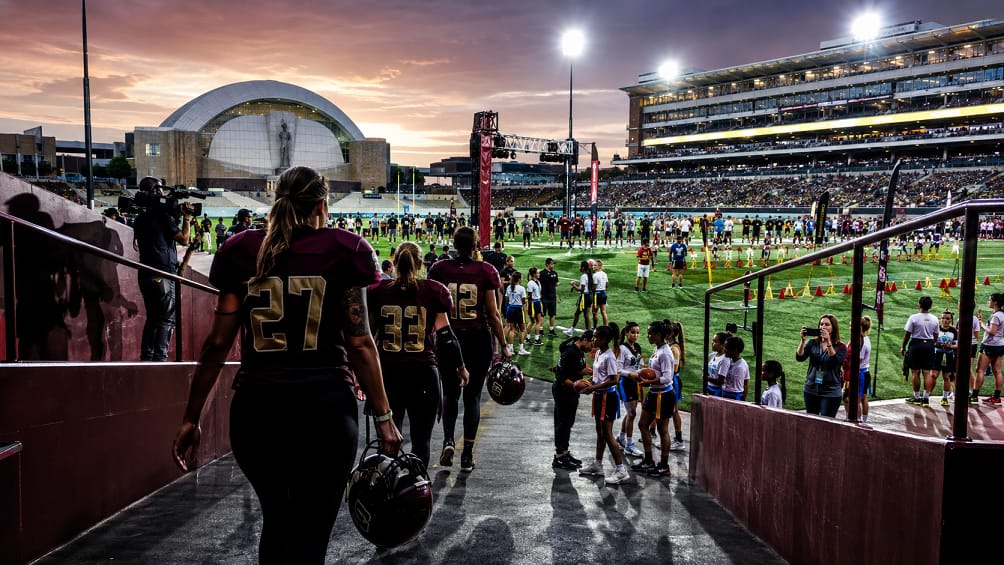
From July 24–26, 2026, the WFA staged its championship weekend at Tom Benson Hall of Fame Stadium in Canton, Ohio. The schedule was not limited to one final. It included WFA Flag National Championship rounds, the WFA Division 2 National Championship, a WFA D2 All-American Game, an awards presentation, the WFA Pro National Championship on ESPN2, the WFA World Bowl, a girls clinic at Hall of Fame Village, and a post-event championship celebration.
That range matters.
Women’s football has often been framed through scarcity: limited media windows, limited facility access, limited sponsorship, limited travel budgets, limited institutional support, and limited recognition. Canton changes the frame. By placing multiple championship events, development activities, flag football, tackle football, international competition, and media coverage inside one football destination, the WFA is showing what a more durable model can look like.
For aplevante.org’s Infrastructure category, this is the real story. Women’s football infrastructure is not only about creating more teams. It is about building repeatable event platforms, credible championship venues, broadcast-ready operations, youth pathways, and places where the sport can gather consistently.
That connects naturally to the broader rise of flag football infrastructure, where women’s and girls’ football pathways are becoming more visible across tackle, flag, youth, high school, international, and Olympic-adjacent systems.
Why Canton Gives Women’s Football A Symbolic And Practical Anchor
Canton is not a neutral location in American football.
Tom Benson Hall of Fame Stadium sits next to the Pro Football Hall of Fame, one of the sport’s most recognizable symbolic centers. The stadium hosts major football events and is part of a larger Hall of Fame Village ecosystem built around football history, tourism, and year-round event activity. For women’s football, that setting matters because it places the WFA inside a football institution rather than on the margins of one.
The symbolism is obvious. Women’s football belongs in the same conversation as the sport’s broader history.
But the practical value may be more important. A championship weekend needs more than a field. It needs locker rooms, broadcast support, ticketing systems, media spaces, hospitality options, hotels, fan movement, parking, security, field operations, and a venue staff familiar with large football events. Canton can provide that infrastructure more naturally than a one-off neutral site.
That is what makes it a hub.
A permanent or recurring championship destination helps a league build tradition. Fans know where to go. Teams know what they are chasing. Media partners understand the event. Sponsors can plan around it. Youth clinics and ancillary events can become part of the calendar. The venue becomes part of the league’s identity.
For a growing women’s football ecosystem, that consistency is valuable.
How The Weekend Format Builds More Than A Title Game
The WFA’s Canton schedule shows a smart event-design strategy.
A single championship game can create a peak moment, but it is hard to build a full sports ecosystem around one game. A weekend format creates layers. It allows different divisions, player groups, fans, media partners, youth participants, and international athletes to share the same stage.
The 2026 weekend began with WFA Flag National Championship rounds and the D2 National Championship on Friday. Saturday included the D2 All-American Game, league awards presentation, WFA Pro National Championship on ESPN2, and WFA World Bowl. Sunday returned to the WFA Flag National Championship quarterfinals, semifinals, and championship.
That structure turns the event into a festival of women’s football.
It gives Division 2 players a championship platform. It gives pro-level players a national broadcast slot. It gives flag football athletes a place inside the same weekend as tackle football. It gives elite players recognition through an All-American event. It gives younger girls a clinic connected to the championship environment. It gives fans a reason to stay for multiple days.
That is how emerging sports build gravity.
A permanent event hub works best when it creates more than one audience. Canton allows the WFA to gather players, families, alumni, coaches, youth participants, local fans, media, and international guests around the same football weekend.
Why The ESPN2 Window Matters For Infrastructure
The WFA Pro National Championship airing on ESPN2 is not just a media note. It is an infrastructure signal.
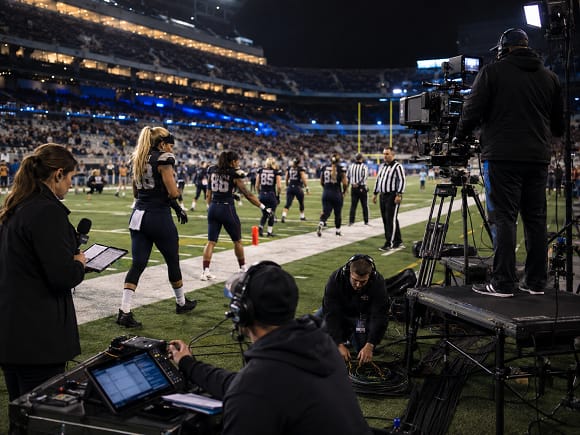
Broadcast coverage changes what a championship event needs to be. A game on national television requires timing discipline, production zones, camera positions, media coordination, reliable lighting, scoreboard operations, press access, replay workflows, sponsor inventory, and professional event presentation. It also changes how the league can sell itself to future athletes, partners, and fans.
For women’s football, that matters because visibility has historically been one of the sport’s biggest gaps.
A televised championship gives players a larger stage. It gives families and local communities a way to see the sport without traveling. It gives young athletes a visible example of what women’s football can become. It gives sponsors a clearer product. It gives the league a piece of content that can outlive the weekend.
The venue has to support all of that.
Tom Benson Hall of Fame Stadium is useful because it is not being asked to become a broadcast football venue for the first time. It already has football-event infrastructure. That allows the WFA to focus on building its product rather than inventing the operating model from scratch.
Media exposure and venue readiness now reinforce each other. The ESPN2 window makes the event more valuable, and the Canton venue makes that window more credible.
How The World Bowl Adds A Global Layer
The WFA World Bowl adds another important piece to the hub model.
The WFA announced the 2026 World Bowl as a matchup between the WFA All-Pro Team and Team World, with international players connected to Costa Rica, the Netherlands, Australia, Honduras, Brazil, Canada, Mexico, and Colombia. That detail pushes the Canton weekend beyond a domestic championship.
It gives women’s football a global showcase inside an American football landmark.
That is important because football’s global growth is often discussed through the NFL, flag football, and Olympic pathways. The WFA World Bowl shows that women’s tackle football also has an international development story. Players from different countries need a stage, a schedule, travel coordination, competitive structure, and media visibility. A recurring hub makes that easier to build.
International participation also helps the WFA create a larger identity. The league is not only crowning a national champion. It is positioning itself as a gathering point for elite women’s football beyond the United States.
That matters for long-term infrastructure. If women’s football is going to grow globally, it needs anchor events where athletes, coaches, and organizers can meet, compete, and create shared standards.
Canton gives that effort a recognizable home.
Why Flag Football Belongs Inside The Same Weekend
The inclusion of WFA Flag National Championship rounds is another sign of smart event planning.
Flag football and tackle football are different formats, but they increasingly share a development conversation. Flag football is expanding quickly through youth, high school, college, international, and Olympic channels. Tackle football remains the WFA’s core elite product. Putting both inside the same championship weekend allows the league to connect multiple participation pathways.
That is especially important for girls and women.
Some athletes may begin with flag football and later explore tackle. Others may stay in flag. Some may see tackle as the higher-contact competitive format. Others may prefer the speed, accessibility, and lower-equipment demands of flag. A strong women’s football ecosystem should not force every player into one model. It should build bridges between formats.
The Canton weekend does that by treating flag as part of the event rather than a side attraction.
This also makes the championship more relevant to the future of football infrastructure. Facilities, schools, leagues, and cities are already trying to understand how flag football’s growth fits alongside traditional football fields and tackle programs. The WFA’s weekend model shows that a single event hub can support both.
That makes Canton more than a championship site. It becomes a football pathway showcase.
Why The Girls Clinic Is More Than A Community Add-On
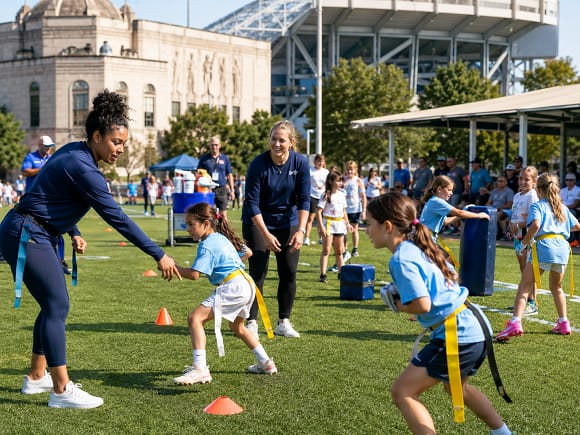
The All-American Girls Clinic at Hall of Fame Village is an important part of the weekend’s design.
Clinics can sometimes feel like public-relations extras. In this case, the clinic helps connect elite women’s football to the next generation. That matters because an event hub is stronger when it does not only celebrate current champions. It also builds future participants.
A young girl attending a football clinic during championship weekend is not simply doing drills. She is entering an environment where women are playing, coaching, competing, being broadcast, receiving awards, and occupying one of football’s historic spaces. That experience can change how she sees the sport.
Youth development depends on visibility and access. A league can inspire more players when girls can physically stand near the championship environment and see a pathway that includes them.
This is why the Canton model has long-term value. It links youth programming to elite competition. It shows that women’s football can be part of family travel, clinics, weekend events, and development experiences.
The strongest event hubs create both memories and entry points.
How The Minnesota Vixen Title Adds Competitive Credibility
The 2026 WFA Pro National Championship also delivered a strong competitive story.
The Minnesota Vixen defeated the Pittsburgh Passion in Canton, giving the Vixen their first WFA Pro Championship. Local coverage from Minnesota and Pittsburgh framed the game as a breakthrough for Minnesota and a missed opportunity for a Pittsburgh team trying to end a long title drought.
That kind of competitive history matters for a league trying to build a permanent event identity.
A hub is not just a venue. It is a place where stories accumulate. Teams win first titles. Rivalries develop. Players become recognizable. Fan bases travel. Defeats carry weight. Broadcast highlights become part of league memory.
Women’s football needs more of that continuity.
When championship games move through disconnected venues with limited media attention, the sport has to rebuild context every year. When a championship weekend repeatedly gathers at a meaningful location, the location starts to hold the league’s history.
Canton is useful because it already carries football memory. The WFA can add its own chapter to that memory.
Why Hall Of Fame Village Strengthens The Event Model
Tom Benson Hall of Fame Stadium is only one piece of the larger Canton environment.
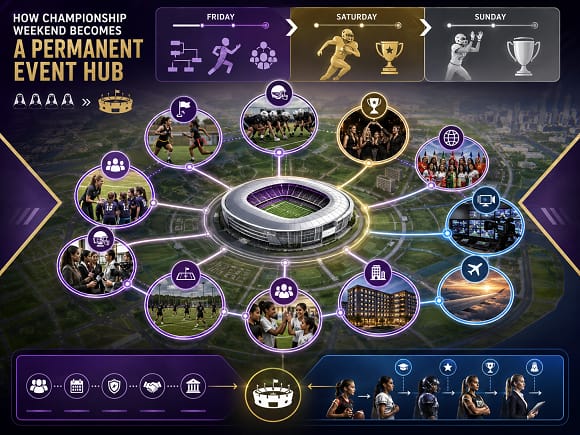
Hall of Fame Village gives the WFA a broader event setting, with football-themed facilities, hospitality potential, youth programming spaces, and a destination framework around the Pro Football Hall of Fame. That matters because championship weekends need more than a game venue. They need a place where people can spend time.
For traveling teams and families, the weekend experience includes lodging, meals, transportation, downtime, clinics, awards, and social events. For fans, it includes pregame and postgame activities. For media, it includes access and production needs. For sponsors, it includes activation space. For the league, it includes the ability to turn a championship into a recurring destination.
This is why many sports are moving toward event hubs rather than isolated game sites.
A hub creates operational efficiency. It lets organizers reuse knowledge. It helps sponsors understand the footprint. It lets local tourism partners plan. It gives fans a familiar destination. It gives the league a place to build rituals.
Women’s football benefits when its biggest weekend feels like an event, not an afterthought.
What Women’s Football Still Needs To Build
The Canton weekend is a sign of progress, but it should not hide the infrastructure gaps that remain.
Women’s football still needs stronger funding, better travel support, deeper media coverage, more full-time operational resources, expanded sponsorship, safer and more consistent facility access, and clearer youth-to-adult pathways. Many athletes across women’s football continue to carry major personal costs to play. Many teams depend heavily on volunteers. Many players train and compete without the institutional support that men’s football receives automatically.
A championship hub helps, but it does not solve everything.
The next step is using the visibility of Canton to build more durable systems. That means stronger league-wide commercial support, more regional development events, better local facilities, clearer player services, improved medical standards, and more partnerships with schools, municipalities, brands, and football organizations.
The WFA’s model shows what is possible. The challenge is making that model easier for teams and athletes to sustain.
A permanent event hub is a foundation. The full structure still has to be built.
Why Canton Could Become A Women’s Football Tradition
The strongest sports events become annual markers on the calendar.
Canton has the ingredients to become that for women’s football. It has football symbolism, a professional stadium, a village environment, media infrastructure, tourism context, youth programming potential, and enough room to host multiple divisions and formats. It also gives the WFA a clear identity: the league’s championship weekend belongs in a place built around football history.
That identity matters.
Women’s football should not have to borrow legitimacy from men’s football, but it can use football’s landmark spaces to make a powerful statement. Playing at Tom Benson Hall of Fame Stadium says that women’s football is not outside the game’s history. It is part of its future.
If the WFA continues building the weekend around tackle championships, flag championships, clinics, awards, international competition, and broadcast windows, Canton can become more than a venue. It can become the league’s annual gathering point.
That is how sports infrastructure becomes tradition.
Why This Is A Permanent Event Hub Story
The WFA’s Canton Championship Weekend shows that women’s football is building infrastructure at the event level.
The weekend combines elite tackle football, flag football, player recognition, youth development, international competition, broadcast exposure, and a football destination into one recurring model. That is exactly what emerging sports need when they move from survival to growth.
A permanent event hub gives women’s football a place to organize its biggest stories. It gives athletes a stage worthy of their work. It gives fans a destination. It gives young girls a visible pathway. It gives media partners a more coherent product. It gives the league a platform to build history.
The WFA still has major challenges ahead, but Canton shows a practical direction.
Women’s football does not need only more attention. It needs places, systems, schedules, partners, and traditions that can hold that attention year after year. The 2026 championship weekend at Tom Benson Hall of Fame Stadium shows how that kind of infrastructure can start to take shape.