
New York’s Lake Placid–New York City 2042 Olympic concept is not an official bid yet. That distinction matters. But the exploratory committee announced by Gov. Kathy Hochul on June 22, 2026, is already useful as a sports infrastructure case study because it points toward a different way of thinking about mega-events in the United States.
Instead of imagining one city carrying the full burden of a Winter Olympics, the concept links Lake Placid’s Olympic legacy and winter-sport venues with New York City’s global platform, transportation network, hospitality capacity, media reach, and major-event infrastructure. The result is a regional model that could test whether future Olympic planning should be less about building one massive host city and more about connecting existing assets across a state.
For aplevante.org’s infrastructure lens, the story is not only whether New York eventually bids for 2042. The deeper question is whether the Lake Placid–NYC concept can redefine how sports leaders think about venue reuse, regional coordination, transportation, tourism, athlete movement, community access, and long-term public value. That same question already sits inside the broader shift toward multi-sport community infrastructure, where the best facilities are expected to serve more than one event, one team, or one season.
Why The Exploratory Committee Matters Before A Bid Exists
The most important detail is that New York has not formally committed to an Olympic or Paralympic bid. The state’s announcement created an exploratory committee, not a campaign committee. That means the group is supposed to test feasibility before political momentum turns into an expensive promise.

That structure is important because Olympic planning has a long history of moving too quickly from ambition to obligation. Cities often discover late that projected costs, land use, housing pressure, security needs, transportation upgrades, and venue requirements are more complex than early bid language suggested. A one-year exploratory process gives New York a chance to ask harder questions before it asks the United States Olympic & Paralympic Committee, the International Olympic Committee, local governments, and residents to support anything formal.
The state’s official announcement of the Lake Placid–New York City exploratory committee framed the concept around existing venues, sustainability, fiscal responsibility, and community engagement. That language reflects the modern Olympic reality. Future hosts will be judged not only by spectacle, but by whether the event avoids unnecessary construction and leaves useful infrastructure behind.
The committee is chaired by Ashley Walden, president and CEO of the Olympic Regional Development Authority. Its leadership group includes state and local officials, economic development leaders, and public-service representatives. Subcommittees are set to focus on community engagement, finance, games operations, legal issues, and senior advisory work. That structure shows why the project belongs in an infrastructure discussion. The Games are not only a sports competition. They are a transportation, finance, legal, community, tourism, and operations problem at once.
How Lake Placid Gives The Concept Historical Depth
Lake Placid is not a symbolic add-on. It is one of the few places in the world with two Winter Olympic histories, having hosted in 1932 and 1980. The 1980 Games remain tied to the “Miracle on Ice,” but the region’s value is not only nostalgia. Lake Placid still has a functioning winter-sport ecosystem that includes competition venues, training environments, and institutional experience.
New York State has invested more than $750 million in modernizing Lake Placid’s Olympic venues, according to the governor’s office. That investment matters because a future Olympic concept built around existing infrastructure only works if the existing infrastructure is credible. Modernized venues reduce the pressure to build temporary or one-time facilities. They also strengthen the case that public money is supporting year-round sports use, athlete development, recreation, tourism, and international competitions before any Olympic decision is made.
Lake Placid’s facilities have already remained relevant beyond memory. The Olympic Regional Development Authority continues to position the region as an active winter-sports hub through its Lake Placid legacy venues, which include sites connected to sliding, skiing, skating, and multi-sport training. That ongoing use is central to the infrastructure argument: a third Olympic role would not start from zero. It would build on a venue network that already exists, has already received major upgrades, and already serves winter sports outside the Olympic cycle.
The state also noted that Lake Placid’s venues were designated as a contingency sliding venue for the Milan-Cortina 2026 Winter Games. That detail shows the region is still part of the international winter-sports conversation, not merely a historical reference point.
Why New York City Changes The Scale Of The Model
Lake Placid gives the concept winter-sport credibility. New York City gives it scale. That combination is why the idea is different from a traditional small-host Winter Games model.
New York City can offer hospitality capacity, airports, international media infrastructure, global sponsors, cultural venues, security experience, and event operations at a scale Lake Placid cannot match alone. A Winter Olympics demands more than slopes, rinks, and sliding tracks. It requires international arrivals, hotel inventory, media distribution, ceremony capacity, fan services, medical planning, and transportation connections across several weeks.
The region’s global access is also part of the case. New York City’s airport system, rail links, hotel inventory, and major-event experience could support the kind of operational load that a small mountain community would struggle to absorb alone. That is why the concept points toward a distributed model rather than a single-host model.
A regional model could allow Lake Placid to focus on what it does best while New York City supports what it already handles well: large crowds, global attention, major venues, and international logistics. That does not make the concept easy. It simply changes the planning question.
Instead of asking whether Lake Placid alone can absorb a modern Winter Olympics, the state can ask whether Lake Placid and New York City together can distribute the burden intelligently. Snow and sliding events could remain connected to the Adirondacks, while ice events, ceremonies, media activity, hospitality, sponsor activations, and global fan experiences could lean more heavily on the city.
The challenge is coordination. A regional Olympics can reduce overbuilding, but it can also create distance problems. Athlete travel, team logistics, event timing, fan movement, broadcaster planning, and volunteer coordination become more complex when the event is split between regions. New York’s concept would need a detailed answer for how the two areas function as one Games rather than two disconnected event clusters.
What The Milan-Cortina Model Means For New York
The Lake Placid–NYC concept is clearly influenced by the modern regional-hosting approach that has shaped recent Olympic thinking. Milan-Cortina 2026 showed how a Games could be spread across multiple places instead of forcing every venue into one compact host-city model.
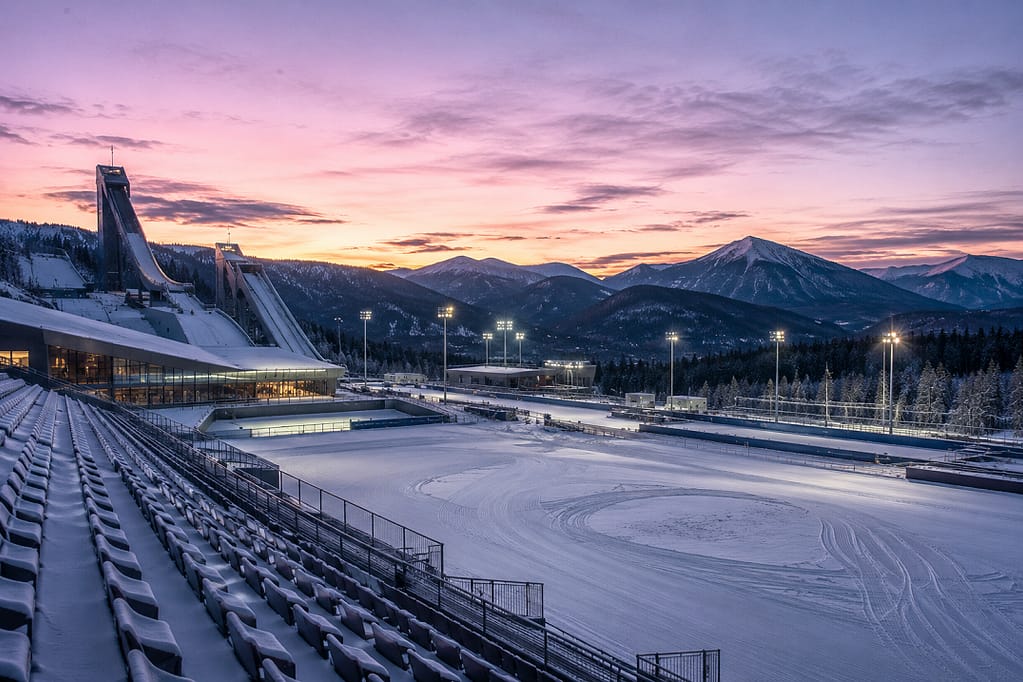
That approach can make financial and environmental sense. Existing venues can be reused. Tourism benefits can spread across regions. Construction pressure can fall. Smaller communities can keep their Olympic role without carrying the entire event alone.
The Milan Cortina 2026 venue model offers a useful comparison because it distributes events across clusters rather than placing every facility in one city. New York would not be copying that plan directly, but the principle is relevant: modern Olympic hosting is increasingly about using existing regional assets instead of building unnecessary new venues.
But the model also reveals tradeoffs. A distributed Games demands stronger transportation planning, clearer public messaging, and more precise operations. Fans need to understand where events are happening and how to move between them. Athletes need reliable village, training, and recovery systems. Broadcasters need predictable technical infrastructure. Local communities need confidence that Olympic attention will not overwhelm their daily life.
For New York, the Milan-Cortina comparison is useful but incomplete. Italy’s geography, winter-sport culture, rail systems, and host-region relationships are different. New York would need its own model that recognizes the distance between the Adirondacks and New York City, the realities of winter travel, the demands on highways and airports, and the climate risks that will shape all future Winter Games.
The lesson is not to copy Milan-Cortina. The lesson is to study whether a regional approach can be adapted responsibly to New York’s assets.
Why Climate And Existing Venues Are Now Central To Olympic Planning
Winter Olympic planning is increasingly tied to climate reality. Fewer regions can confidently host snow and ice events without major artificial support or environmental strain. That makes places with reliable winter conditions, existing venues, and recent modernization more valuable.
The International Olympic Committee has already pushed future Olympic planning toward venue reuse, sustainability, cost control, and flexibility through its Olympic Agenda reforms. That policy direction matters for New York because a Lake Placid–NYC model would likely be judged by how intelligently it uses what already exists.
Still, climate suitability is not the same as event readiness. A future Winter Games would need to evaluate snow reliability, energy use, transportation emissions, water demand, venue operations, and long-term environmental impact. A sustainable bid cannot rely only on the fact that Lake Placid has history. It has to prove that the region can host major events without undermining the landscape that makes winter sport possible.
Existing venues help with that argument. Building fewer new facilities can reduce risk, cost, and environmental disruption. But existing venues also require maintenance, modernization, accessibility upgrades, digital infrastructure, broadcast systems, and transportation connections. The $750 million already invested in Lake Placid is a foundation, not a finish line.
That is why the exploratory committee’s focus on sustainability and fiscal responsibility matters. If New York eventually pursues 2042, the bid will likely be judged by how well it uses what is already there.
How A Regional Olympic Concept Could Serve Local Communities
The strongest version of a Lake Placid–NYC concept would not treat local communities as backdrops. It would define legacy in practical terms: better year-round venue use, youth winter-sport access, athlete development, tourism stability, small-business support, transportation improvements, and public recreation.
Lake Placid’s challenge is different from New York City’s. Lake Placid needs to protect local quality of life while absorbing global event pressure. Housing, seasonal workforce capacity, traffic, tourism congestion, and environmental sensitivity all matter. A small mountain community cannot be evaluated the same way as a global city.
New York City’s challenge is different but equally real. If the city hosts ice events, ceremonies, media hubs, or fan zones, planners will need to coordinate with existing sports calendars, transit systems, security operations, neighborhood impacts, and high-cost venue environments. The city may have scale, but scale does not erase complexity.
A regional Games could work only if benefits flow in both directions. Lake Placid should not become only the scenic winter backdrop. New York City should not become only the media billboard. The concept has to connect elite sport, community use, tourism, and infrastructure investment in a way that remains useful after the Olympic flame leaves.
That is where the exploratory process becomes valuable. It gives planners a chance to define what “legacy” means before a formal bid creates pressure to sell the project.
What The Committee Should Measure Over The Next Year
The next year should not be about producing promotional slogans. It should be about stress-testing the concept.

The committee needs to measure venue readiness, cost exposure, transportation feasibility, hotel capacity, athlete village options, workforce demands, climate risk, accessibility, security planning, media requirements, community support, and long-term public benefit. It should also evaluate how existing venues would be used before and after 2042, because Olympic facilities that sit idle after the Games are the clearest sign of poor planning.
Transportation deserves special attention. A Lake Placid–NYC model only works if movement is credible for athletes, officials, media, and fans. That does not necessarily mean everyone moves between regions constantly. It may mean the event is structured so travel is minimized and each region has a clear role. But that structure has to be explicit.
Finance is another test. Olympic optimism often hides public risk. The committee’s finance subcommittee should examine who pays, who benefits, what upgrades are actually needed, and which costs are avoidable because infrastructure already exists.
Community engagement may be the most important test. A concept that looks elegant to planners can still fail if residents believe it will raise costs, strain housing, disrupt neighborhoods, or serve tourists more than locals. Public input should not be a formality. It should shape whether the idea moves forward.
Why The 2042 Concept Matters Even If New York Never Bids
Even if New York never submits a formal Olympic bid, the Lake Placid–NYC concept is still valuable because it reflects where sports infrastructure planning is headed.
The old mega-event model asked cities to prove ambition through construction. The newer model asks regions to prove intelligence through coordination. That shift is important for the United States, where many communities already have major stadiums, arenas, training centers, colleges, transit networks, and tourism assets but struggle to connect them into coherent regional sports strategies.
New York’s exploratory process can become a blueprint for evaluating large sports events before committing to them. It can show how to ask whether existing venues are enough, whether upgrades would help communities anyway, whether transportation can support the event, whether public dollars are justified, and whether local residents are part of the benefit structure.
That is why the 2042 concept should be watched closely. It is not only a potential Olympic story. It is a test of whether modern sports infrastructure can be planned regionally, sustainably, and transparently.
Lake Placid has the Olympic past. New York City has the global platform. The hard part is proving that the connection between them can create a future model that serves athletes, fans, residents, and public infrastructure long after the Games are over.