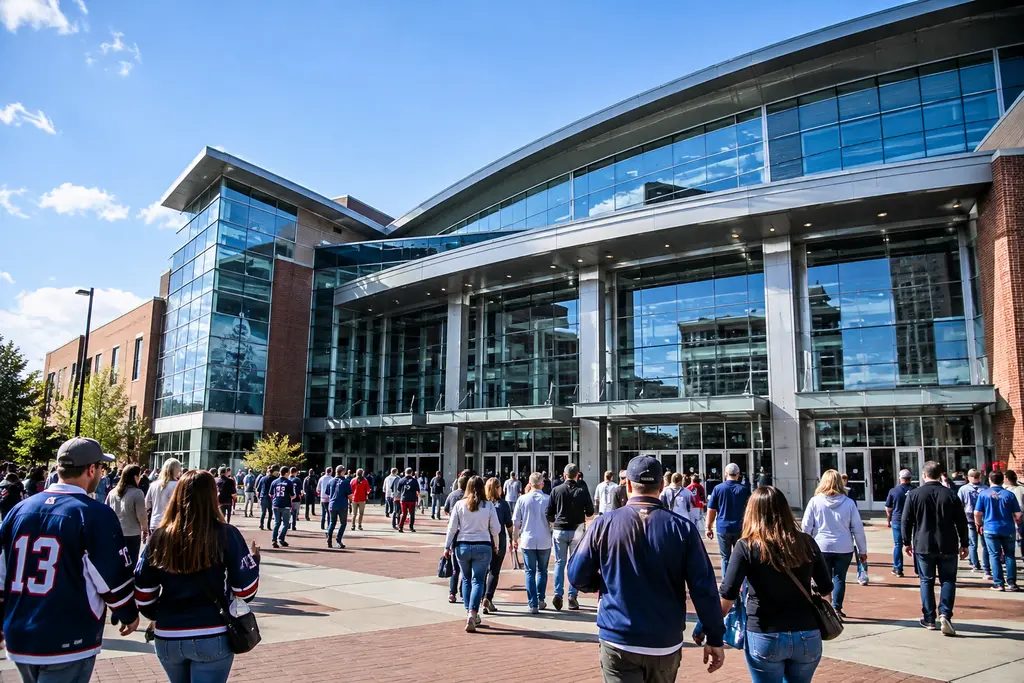
The Nationwide Arena Renovation has moved from broad concept into a more defined public planning phase, with the Franklin County Convention Facilities Authority planning a $400 million, multi-year modernization that would keep the building active for Columbus Blue Jackets games, concerts, and other events during phased work, according to the FCCFA update. That operating choice matters. A closed arena creates a clean construction site, but it also removes event activity from nearby workers, restaurants, hotels, and community groups. A phased project protects that activity, while placing more pressure on scheduling, wayfinding, temporary access, and public communication.
What The Nationwide Arena Renovation Changes
The project is best read as two linked efforts: core building renewal and guest-facing improvement. The official project materials identify critical system replacement, new elevators, replacement escalators, safety and accessibility improvements, and upgraded screening and security technology. They also list outdoor plaza improvements, a digital display for outdoor watch-party use, a pedestrian bridge connection to the McConnell Parking Garage, and enhanced social, event, and premium spaces on the arena modernization page.
Nationwide Arena Renovation Scope And Certainty
The Nationwide Arena Renovation is not a single amenity package. It reaches the less visible parts of the building that determine whether fans move safely, whether staff can operate efficiently, and whether the venue can serve event calendars without repeated service disruptions. Critical systems are not always noticed by spectators, but failure in those systems can shape the entire event day. For community sports advocates, that is the useful lesson: fan experience starts before a person reaches a seat.
The public sources cited here confirm the $400 million planning figure, the phased intent, and the broad categories of work. They do not, by themselves, settle final construction start dates, the exact order of each construction phase, or every design decision. That uncertainty should not be treated as a flaw; it is common at this stage. The practical task is to monitor whether future updates keep the stated priorities aligned with daily users, including fans with mobility needs, event staff, families, and visitors moving between parking, plazas, and entrances.
Why Phasing Shapes Fan Experience
Keeping the arena operational during construction can reduce the economic shock that would come from a long shutdown. It also creates direct fan-experience risks. Entrances may shift. Interior circulation may narrow. Certain routes from parking to seating could change between events. If temporary conditions are not explained clearly, the project can feel worse to regular attendees even when the long-term plan is sound.
A useful benchmark is whether each phase includes simple public-facing information: which doors are open, which elevators are available, which routes work best for accessible entry, and how much extra arrival time is reasonable. Those details sound ordinary, but they are often where trust is gained or lost. A large arena project should be judged not only by the final renderings, but by how well fans are treated while the work is under way.
Fan Access, Safety, And Daily Operations
Access is the part of an arena project that most clearly links infrastructure to community value. The planned elevator additions and escalator replacement point to a need for better vertical movement. In a multi-level venue, that affects older fans, children, people with disabilities, suite and club users, event staff, media crews, and anyone trying to leave after a close game or a sold-out concert.
Vertical Movement And Accessibility
Elevators and escalators are not premium extras. They are basic capacity tools. If they are undersized, poorly placed, or out of service too often, fans experience the building as crowded even when seating capacity has not changed. New elevators can improve accessible routes, but only if those routes are easy to find, staffed when needed, and tied to clear signage from the plaza and parking connections.
The planned pedestrian bridge to the McConnell Parking Garage is also important. Parking links can either reduce conflict points or push crowding into a new bottleneck. The evaluation should ask how the bridge connects to security screening, stairs, elevators, and post-event traffic flow. A bridge that shortens a route but deposits people into a tight checkpoint would solve one problem while creating another.
Screening, Security, And Trust
Security technology upgrades can improve entry speed and consistency, but they also require careful governance. Screening systems are part of public safety, yet fan trust depends on clear rules, trained staff, and accessible lanes for people who need assistance. The public materials identify upgraded screening and security technology as a planned element; future public updates should explain the fan-facing impact in plain terms.
For a community sports venue, the goal should be predictable entry rather than novelty. Families, visiting supporters, and occasional eventgoers do not benefit from a system that only regular fans understand. A good security plan reduces confusion without reducing dignity. It also gives staff the tools to manage large crowds without treating every event as if it has the same risk profile.
Public Value Tests For Community Sports

A $400 million arena modernization raises a fair public-interest question: what should Columbus expect beyond a better building for major events? The strongest answer is not abstract civic pride. It is measurable access, safer circulation, clearer connections to nearby streets and parking, and event spaces that can support varied uses. For readers comparing venue upgrades across cities, our Ball Arena renovation analysis shows why fan flow and access risks deserve as much attention as premium spaces.
What Local Venues Can Borrow
Smaller community facilities will not copy a $400 million arena project. They can copy the order of thinking. Start with systems and movement before cosmetics. Ask whether people can enter, move, rest, find services, and leave without avoidable stress. Then connect amenities to participation. A better plaza can support watch-party use, but it also needs safe pedestrian routes, weather planning, and clear staffing. Social and event spaces can widen use beyond game nights, but only if pricing and scheduling allow more than private functions.
This is where sports infrastructure connects to participation strategy. A family that has a manageable first arena visit is more likely to return. A youth team invited to a civic event benefits more if its members can move through the building easily. A venue that works for older fans and wheelchair users sends a stronger access signal than one that simply adds new hospitality spaces.
Risks To Track During Phased Work
The main risks are not hard to identify. The difficult part is tracking them in public and correcting them quickly. Community groups, fan councils, and local officials should ask for evidence during each phase, not only after the project is complete.
- Access continuity: Are accessible entrances, elevators, restrooms, and parking paths clearly marked during construction?
- Queue management: Do temporary screening areas keep lines from blocking sidewalks, plazas, or garage exits?
- Communication: Are event-day changes published early enough for families, older fans, and visitors to plan?
- Public space use: Do plaza and outdoor display plans support community activity, not only paid event traffic?
- Post-event movement: Do bridges, exits, and rideshare or pickup areas reduce crowding after major events?
Those tests are practical. They do not require a fan to read construction documents. They ask whether the project works for people who use the building under real conditions. For a broader look at how major sports facilities impact supporter experience and attract public interest, World Football Idol provides valuable insights from a related network site.
Nationwide Arena Renovation Scorecard For Columbus
The final assessment should be based on operations, not slogans. The project will be easier to defend if public updates show progress against clear measures: elevator availability, queue times, accessible route continuity, pedestrian safety, event-day complaint patterns, and use of social or outdoor spaces outside the biggest ticketed events. These measures do not need to expose sensitive security details. They can still show whether the building is becoming easier to use.
Measures That Should Be Public
For the Nationwide Arena Renovation, the most useful scorecard would combine schedule transparency with fan-impact reporting. A simple phase-by-phase dashboard could identify active work areas, temporary entry changes, accessible routes, and completed upgrades. That would help regular fans adjust and give community advocates a way to see whether the project is delivering value as it proceeds.
The cautious case for the project is clear: an aging major-event venue needs critical system renewal, safer movement, better accessibility, and updated public spaces if it is going to serve Columbus well. The caution is just as clear: a phased $400 million plan can disappoint if communication is weak or if premium improvements outrun access basics. The right standard is not whether the arena looks newer. It is whether more people can use it with less friction, from the sidewalk to the seat and back out again.