
The reported U.S.–FIFA talks over hosting the 2029 Club World Cup turn World Cup 2026 into something bigger than a tournament. They make it a leadership audition.
That distinction matters. The United States is not only trying to stage one successful summer of international soccer. It is trying to prove that its cities, stadiums, transportation systems, security planning, fan infrastructure, commercial market, media platforms, and civic leadership can support a longer run of global soccer events.
According to The Guardian’s 2029 Club World Cup report, the U.S. has expressed interest in hosting the next edition as FIFA looks to capitalize on the commercial and logistical success of World Cup 2026. The same report noted that 2026 ticket sales had reached 6.5 million, with projected revenues above $11 billion.
For aplevante.org’s Leadership category, the real story is not simply whether the U.S. gets another tournament. The deeper question is whether 2026 has shown enough operational maturity to make the country FIFA’s preferred platform for future global soccer. That connects directly to the infrastructure conversation already visible in World Cup 2026 digital fan infrastructure, where host cities are being judged not only by stadium capacity, but by the systems that support fans, data, mobility, safety, and long-term civic use.
Why 2026 Became More Than A One-Tournament Test
The 2026 World Cup was always going to be massive. FIFA describes it as a 104-match, 48-team event across 16 host cities in Canada, Mexico and the United States. That scale made it the largest World Cup ever staged and a natural stress test for North American sports infrastructure.
But the 2029 Club World Cup conversation changes the meaning of that test. If FIFA views the U.S. as a strong candidate for another global tournament just three years later, then 2026 becomes evidence. Every airport queue, fan festival, stadium conversion, training site, grass surface, security perimeter, transit plan, ticketing system, heat protocol, media center, and public gathering space becomes part of the case file.
That is why leadership matters. Hosting the World Cup is not only about having large NFL stadiums. It is about proving that those stadiums can be integrated into city operations, fan culture, international team needs, broadcaster demands, FIFA commercial requirements, and public safety systems.
The U.S. has long had the buildings. World Cup 2026 is testing whether it has the connected host-city leadership needed to make those buildings function as part of a global soccer ecosystem.
How The 2025 Club World Cup Created The First U.S. Reference Point
The U.S. already gave FIFA one recent club-tournament model. The FIFA Club World Cup 2025 stadium guide notes that the first 32-team edition took place in the United States across 12 venues. FIFA also confirmed that the tournament used stadiums from Atlanta to Washington, with the final staged at MetLife Stadium in New York New Jersey.

That tournament mattered because it gave FIFA a club-specific test before 2026. It showed how American venues handled elite international clubs, traveling supporters, broadcast demands, summer weather, ticketing, training logistics, and multi-city scheduling. It also allowed FIFA to compare different types of venues: large NFL stadiums, soccer-specific stadiums, mixed-use venues, and smaller markets.
Chelsea’s 3-0 win over Paris Saint-Germain in the final at MetLife Stadium closed the tournament, but the more important infrastructure lesson was national. The U.S. demonstrated that it could host a new global club competition across multiple cities with different venue profiles.
The 2029 question is whether FIFA wants to repeat, expand, or modify that model. If the next Club World Cup grows to 48 teams, as has been discussed in football governance circles, the host country would need even more capacity, scheduling flexibility, training bases, hotels, transportation support, and broadcast infrastructure. That makes the U.S. attractive because it already has a deep stadium inventory and a commercial sports market that FIFA understands.
Why The 2029 Talks Are Really About Trust
A formal bid is different from talks. The U.S. has not been awarded the 2029 Club World Cup. Other countries may still compete for the event. FIFA’s internal politics, commercial partnerships, club relations, calendar pressure, and election timing could all shape the final decision.
Still, talks matter because they reveal trust. FIFA does not look at the U.S. only as a market. It looks at the country as a potential operating platform. That means FIFA is asking whether the U.S. can repeatedly deliver global soccer at scale.
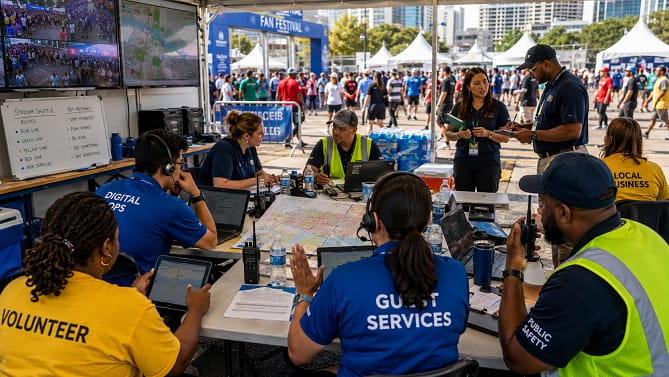
Trust is built through execution. Did stadiums convert properly for soccer? Did fan movement work? Did local organizing committees coordinate with public agencies? Did international teams receive appropriate training and travel support? Did sponsors get the exposure they expected? Did broadcasters receive reliable infrastructure? Did digital systems hold up? Did host cities manage safety without draining the atmosphere from the event?
Those are leadership questions. They are not solved by one executive, one mayor, or one stadium operator. They require layered coordination across local, state, federal, private, and international stakeholders.
If 2026 has strengthened FIFA’s confidence, it is because the U.S. has shown that global soccer can be supported through a national network of venues and host cities rather than one isolated event machine.
How U.S. Host Cities Became The Audition Room
The 2026 World Cup turned American host cities into live demonstrations of future hosting capacity. Houston showed how fan walks could become civic infrastructure. Kansas City showed how federal-local coordination and transportation planning could support the smallest U.S. host market. Miami showed how a host committee could build beyond stadium operations. Seattle showed how walkability, transit and public space could improve the fan experience.
Those examples matter because a Club World Cup does not require only one kind of host city. It needs a network. Some clubs may draw global fan bases. Others may attract more local interest. Some matches may need NFL-scale stadiums. Others may work better in soccer-specific venues. Some cities may be used for group-stage clusters, while others may handle knockout rounds, media operations, or high-demand commercial events.
That is where the U.S. has a structural advantage. It can offer large stadiums, major airports, hotel capacity, college training sites, MLS facilities, NFL operations expertise, and entertainment districts. But those assets only become valuable if local leadership can connect them.
A city with a huge stadium but poor fan movement is not a complete host. A city with a good fan district but weak transportation planning creates pressure elsewhere. A city with excellent facilities but little community engagement risks turning the tournament into a private spectacle.
World Cup 2026 is showing FIFA which cities can handle the whole package.
Why Stadium Infrastructure Alone Is Not Enough
The U.S. is famous for stadium scale. That helps FIFA, but it is not enough.
Soccer infrastructure is different from American football infrastructure. Natural grass quality, field dimensions, sightlines, locker-room needs, warm-up areas, supporter movement, international media operations, team training access, and fan march culture create different requirements. Several World Cup 2026 stories have already shown that converting NFL venues for soccer can be more complicated than simply installing temporary grass.
A 2029 Club World Cup would keep those questions alive. Club teams may arrive with major stars, demanding technical staffs, powerful ownership groups, and strong expectations from European and South American supporter cultures. The tournament would need venues that feel credible not only on television, but also to players and coaches.
That is where leadership becomes technical. Host cities need to understand turf science, field maintenance, heat management, security layouts, supporter sections, media connectivity, ticketing distribution, VIP operations, and public transit. The best cities are not the ones with the biggest buildings. They are the ones that make those buildings work for soccer.
The 2026 audition is therefore practical. FIFA is watching whether American venues can become football venues without losing operational control.
How Commercial Success Changes The Leadership Equation
Commercial success is central to the 2029 conversation. FIFA’s interest in the U.S. is not mysterious. The American market offers premium ticket demand, sponsorship depth, media attention, hospitality revenue, major stadiums, and global brand visibility. The Guardian report’s reference to 6.5 million World Cup tickets sold and projected revenues above $11 billion explains why the U.S. is attractive.
But commercial success also raises expectations. If the U.S. becomes FIFA’s preferred commercial stage, host cities will face more pressure to deliver premium experiences. That means smoother entry, stronger hospitality zones, better digital access, reliable transportation, multilingual services, safer fan districts, and more polished public programming.
The risk is that commercial logic overwhelms civic legacy. A Club World Cup can generate revenue without necessarily improving local sports infrastructure. That is why leadership matters. The best case for another U.S. tournament is not just that FIFA can sell tickets. It is that American host cities can use the event to strengthen public spaces, youth soccer systems, training facilities, transportation plans, digital networks, and small-business participation.
The U.S. should not treat 2029 as a prize for selling 2026 well. It should treat 2029 as a chance to prove that commercial scale can be paired with long-term sports value.
Why Club Football Creates A Different Hosting Challenge
The Club World Cup is not the same as the national-team World Cup. National-team tournaments create patriotic travel, broad casual interest, and country-based fan culture. Club tournaments create different patterns. Some clubs have global followings. Others may depend more heavily on local curiosity, diaspora communities, or neutral fans.
That makes host-city leadership more complex. A match involving Real Madrid, Flamengo, Al Ahly, Chelsea, Manchester City, Boca Juniors, or Inter Miami-style local attraction can produce very different crowd patterns from a match involving two less familiar clubs. Cities have to plan for variable demand.
The FIFA Club World Cup 2025 results page shows the breadth of the tournament: 32 clubs from around the world, group matches, knockout rounds, and a final in New York New Jersey. A 2029 edition could be larger and more commercially ambitious, which would increase the planning burden.
Club football also tests local soccer literacy. Host cities need to understand supporter groups, club histories, ticket demand, training privacy, media interest, and security needs for teams with very different global profiles. The event is not only about filling stadiums. It is about making each market feel prepared for specific clubs and fan bases.
That is another reason 2026 matters. The World Cup has trained U.S. cities to think internationally. The 2029 Club World Cup would test whether they can apply that mindset to club soccer.
What FIFA Will Likely Measure Before 2029
If FIFA seriously evaluates the U.S. for 2029, it will not look at one headline metric. It will study the full operating environment.
The first measure is venue performance. Stadiums must support soccer-specific field quality, player welfare, broadcast needs, premium seating, sponsor zones, and safe crowd movement.
The second measure is market performance. FIFA will look at ticket demand, sponsorship potential, hospitality sales, media value, and the ability of different cities to support less obvious matchups.
The third measure is civic reliability. Host cities must show that local agencies, police, transportation departments, airports, emergency services, health systems, and tourism boards can coordinate under pressure.
The fourth measure is fan infrastructure. That includes public viewing sites, digital connectivity, local mobility, heat planning, multilingual communication, supporter movement, and neighborhood access.
The fifth measure is legacy credibility. FIFA will want commercial success, but local leaders should want more. They should ask whether events create lasting value for youth soccer, public spaces, training facilities, and regional sports systems.
That is the leadership audit behind the audition.
Why The U.S. Case Is Strong But Not Automatic
The U.S. has a strong case for 2029, but it should not be treated as automatic. Brazil, Qatar and other potential hosts have been linked to interest in future Club World Cup editions. FIFA may also consider political relationships, calendar issues, climate conditions, club pressure, broadcasting deals, and strategic regional rotation.
There is also a governance question. If FIFA expands the Club World Cup to 48 teams, the event will become harder to host and more controversial inside the club calendar. European clubs, domestic leagues, player unions, broadcasters, and national federations will all have concerns about workload, travel and scheduling.
The U.S. cannot solve those global politics alone. What it can do is prove that, if FIFA wants scale, America can provide it with fewer infrastructure unknowns than most potential hosts.
That is the audition. The U.S. is not auditioning only against other countries. It is auditioning against doubts about whether global football should keep expanding its calendar and commercial footprint.
A well-run 2026 does not answer every criticism. But it gives FIFA a practical argument: the U.S. can deliver.
How 2026 Could Shape America’s Next Decade Of Soccer Events
The 2029 Club World Cup is only one piece of a larger soccer decade. The U.S. has already hosted the 2025 Club World Cup and is co-hosting the 2026 World Cup. Los Angeles will host the 2028 Olympics. The United States is also tied to future women’s soccer hosting ambitions through a joint 2031 Women’s World Cup bid with regional partners.
That sequence changes the national sports-infrastructure conversation. The United States is no longer merely hosting occasional soccer events. It is building a recurring global soccer platform.
That platform requires leadership continuity. Host cities should not dismantle their knowledge after 2026. They should preserve transportation playbooks, fan-festival designs, volunteer systems, security coordination, digital infrastructure, small-business outreach, training-site partnerships, and grass-conversion knowledge.
If the U.S. wants the 2029 Club World Cup, the best argument is not only that FIFA can make money here. It is that American cities are learning how to host soccer better each time.
That is why 2026 matters. It is the moment when the U.S. can move from event host to global soccer operator.
Why This Leadership Audition Matters Beyond FIFA
The 2029 Club World Cup talks are important even if the U.S. does not ultimately win the event. They show how quickly World Cup performance can influence future sports-infrastructure opportunities.
A successful 2026 can help U.S. cities attract more international friendlies, club tours, continental competitions, women’s tournaments, youth championships, Olympic events, and multi-sport gatherings. A poorly managed 2026 would make those opportunities harder to justify.
That is the broader leadership lesson. Sports infrastructure is not only built in concrete and steel. It is built in confidence. FIFA, clubs, broadcasters, sponsors, fans and local residents all need confidence that a host city can deliver.
The U.S.–FIFA 2029 conversation shows that confidence is being tested now. Every matchday in 2026 is part of the evidence. Every fan zone, shuttle route, stadium field, digital network, and public-safety plan becomes part of the argument for what comes next.
The United States has the venues. It has the market. It has the commercial draw. The question is whether 2026 proves it has the leadership culture to match.
If it does, the 2029 Club World Cup may not simply be another tournament. It could become the next stage in America’s transition from soccer host to soccer infrastructure leader.