San Antonio’s Project Marvel listening tour is not a side note in the Spurs’ downtown arena story. It is the leadership test.
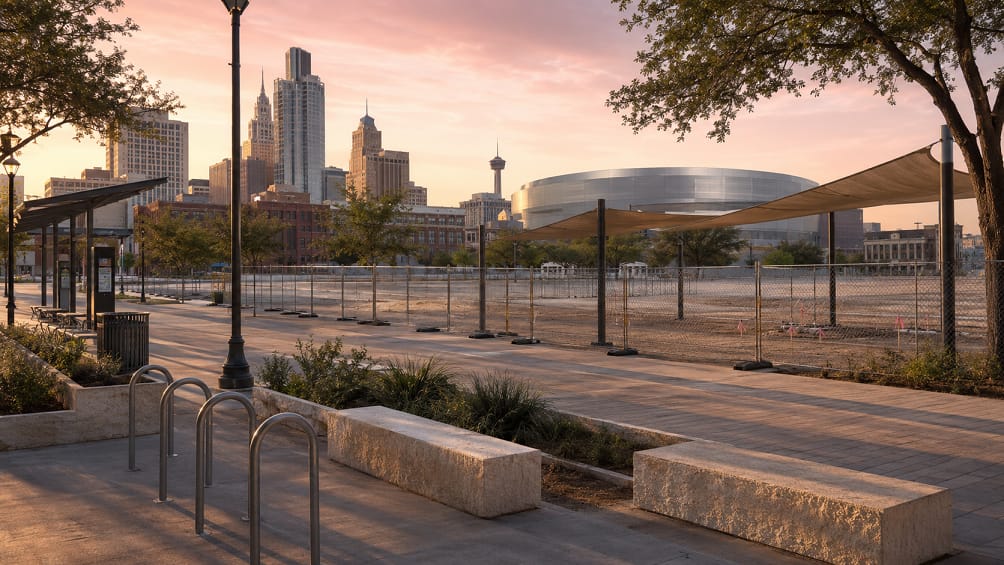
The proposed sports and entertainment district is one of the most consequential sports infrastructure debates in Texas right now. At its center is a planned $1.3 billion downtown arena at Hemisfair that would become the future home of the San Antonio Spurs. Around it sits a broader redevelopment vision involving a renovated Alamodome, an expanded Convention Center, public space, restaurants, apartments, retail, bars, and hotel development.
But the question facing San Antonio is not only whether the Spurs should have a new arena. The sharper question is whether the city, Bexar County, Spurs Sports & Entertainment, artists, residents, labor voices, small businesses, and public officials can shape the project into a civic asset rather than a stadium-first real estate play.
That is why the listening tour matters. Beginning July 13, 2026, Spurs Sports & Entertainment launched 10 community conversations across San Antonio to gather public feedback on the future arena and downtown sports district. For aplevante.org’s Leadership category, this is exactly where modern sports infrastructure leadership is tested: before construction, before ribbon cuttings, before naming rights, and before the first tipoff.
The debate also connects directly to the broader question of community benefits in sports infrastructure. When public money, private capital, downtown land, cultural identity, tourism strategy, and neighborhood equity all meet inside one project, leadership is measured by who gets heard before the deal hardens.
Why The Listening Tour Matters More Than The Renderings
Arena renderings are easy to sell. Listening is harder.
Spurs Sports & Entertainment’s public sessions are scheduled across different parts of San Antonio from July 13 through July 23, including stops at the Pope Francis Center, Alamo Community Colleges, St. Philip’s College, St. Vincent de Paul, the San Antonio Shrine Auditorium, San Antonio Food Bank, St. Paul’s Community Center, Our Lady of the Lake University, and Morgan’s Wonderland. The San Antonio listening tour schedule shows that the organization is not only inviting feedback near the project site, but taking the conversation into different community settings.

That matters because downtown arena districts often begin with a polished promise: jobs, tourism, entertainment, tax growth, civic pride, and year-round activity. But residents usually ask more practical questions. Will the project serve locals or tourists? Will families be able to afford events? Will small businesses be included? Will housing pressure rise? Will public art feel authentic? Will workers benefit? Will traffic worsen? Will downtown become more welcoming or more expensive?
The Spurs’ listening tour is the moment when those questions move from public frustration into the planning process. It gives the organization a chance to prove that community engagement is not only a communication strategy, but a design principle.
That is the leadership test. If the tour is treated as a public-relations checkpoint, it will not build trust. If it shapes public space, affordability, cultural programming, business access, transportation, and community benefits, it could become a model for how NBA arena districts should be planned.
How The Financing Structure Raises The Stakes
The financing structure is why Project Marvel cannot be discussed as a private arena project. San Antonio has committed up to $489 million, Bexar County could contribute up to $311 million, and the Spurs would contribute $500 million toward the planned arena. That mix makes the district a public-private infrastructure project with major civic consequences.
The Express-News report on the public sessions noted that city and Spurs officials are working toward a non-binding term sheet by the end of the year, including financing, construction timelines, and the Spurs’ arena lease. That term sheet is the real policy battleground. Once the financing structure, lease terms, debt repayment model, and development obligations are locked in, community influence becomes harder.
The city’s plan also relies on property tax from surrounding development to repay debt issued for the arena. Spurs Sports & Entertainment has pledged to bring in $1.4 billion in surrounding development projects, including apartments, stores, restaurants, bars, and a hotel for visiting NBA teams. That structure makes the surrounding district more than decoration. It becomes part of the financial logic.
That is why leadership has to connect arena design with district design. A publicly supported arena cannot be evaluated only by the number of luxury suites, premium clubs, or event nights it creates. It must be evaluated by whether the surrounding development produces durable public value.
The financial question is not only “Who pays?” It is also “Who benefits, how soon, and for how long?”
Why Public Support Is Steady But Not Settled
Project Marvel has public support, but it does not have a blank check.
Texas Public Radio reported that a UTSA Center for Public Opinion Research survey conducted June 9–16 found that 47% of San Antonio residents said the city should move forward with Project Marvel, while 35% opposed it. Another 12% were unsure and 8% had no opinion. That means the project has a meaningful support base, but also a large enough opposition and undecided bloc to make leadership essential.
The UTSA poll coverage also noted that the findings were similar to an October 2025 poll of likely Bexar County voters, suggesting that months of debate have not dramatically shifted public opinion. Support has held, but skepticism has not disappeared.
That is a dangerous middle ground for a large sports project. Leaders can misread steady support as permission to move quickly. In reality, steady support may mean residents are waiting to see whether the public process is genuine.
San Antonio’s leadership test is especially sharp because the project has already moved through major political and land-acquisition milestones. Bexar County voters approved Proposition B in November 2025, authorizing an increase in the county hotel occupancy tax to support the county’s share. The city has also been acquiring key properties near Hemisfair.
That progress gives the project momentum. But momentum is not the same as trust. The listening tour is where project leaders must show that the public still has meaningful influence over what gets built.
Why Artists And Culture Became Infrastructure Questions
One of the most important recent developments is that San Antonio artists and cultural leaders are pushing to shape the district before it becomes a generic entertainment zone.
Councilwoman Teri Castillo brought together local artists and arts organizations to discuss how they could influence Project Marvel and preserve San Antonio’s history and character. The artist roundtable discussion included figures such as San Antonio poet laureate Eddie Vega, George and Catherine Cisneros of Urban-15, and Alexandra van de Kamp of Gemini Ink.
That matters because arena districts often risk looking interchangeable. A team store, a sports bar, a hotel, a plaza, and a premium entrance can be built almost anywhere. San Antonio’s challenge is different. The city has a strong cultural identity, a deep arts ecosystem, historic neighborhoods, and a downtown story that cannot be reduced to generic sports entertainment.
Public art, performance space, local food, design language, bilingual programming, festival use, and cultural memory are all infrastructure questions. They shape whether residents see the district as part of San Antonio or as a development imposed on San Antonio.
Castillo’s push also connects culture to equity. Artists are not only decorative contributors. They can help define who the district is for. If local artists and community organizations are included early, the project has a better chance of feeling civic. If they are added late, they risk becoming window dressing.
Why The $75 Million Community Benefits Pledge Needs Structure
The Spurs’ $75 million community benefits pledge is one of the most important pieces of the leadership test. The commitment, described as $2.5 million per year for 30 years, could support programs that make the arena district more valuable to residents. But money alone does not guarantee impact.
Council members Teri Castillo, Marina Alderete Gavito, and Sukh Kaur have called for residents, business owners, artists, and labor union representatives to weigh in on how that money should be allocated. That is the right pressure point. A community benefits pledge is only as strong as its governance.
San Antonio should be asking several practical questions. Who controls the fund? How are priorities selected? Are outcomes measured publicly? Will money support youth sports access, affordable events, workforce development, public art, neighborhood infrastructure, small-business support, transit access, or cultural programming? Will benefits reach communities outside the downtown core? How will residents know whether the commitment is being fulfilled?
This is where the project can move from promise to accountability. A $75 million pledge over 30 years can sound impressive, but the annual impact depends on how funds are distributed and whether they respond to community priorities.
The listening tour should therefore do more than gather general ideas. It should help build a transparent framework for community benefits before the term sheet is finalized.
How The Spurs Are Reframing The Project Beyond “Project Marvel”
Another leadership signal is the branding shift. Spurs Sports & Entertainment CEO R.C. Buford has indicated that the organization is moving away from the “Project Marvel” name and toward language focused on a downtown sports and entertainment district.
That shift is not only cosmetic. Names frame expectations. “Project Marvel” sounds like a code name for a massive development. “Downtown sports and entertainment district” signals a broader civic space. But the language has to be matched by behavior.
If the project is truly a district, it needs to function beyond Spurs games. It needs daytime activity, public spaces, small-business opportunity, pedestrian comfort, cultural programming, safety, shade, transit access, and reasons for residents to visit even when there is no ticketed event.
That is the difference between an arena and infrastructure. An arena hosts games. A district shapes urban life.
San Antonio’s leadership opportunity is to make the arena one component of a larger public system rather than the object around which everything else is forced to orbit. Hemisfair, the Alamodome, the Convention Center, UTSA’s downtown presence, and nearby neighborhoods give the city a chance to plan with more ambition than a standalone venue.
But ambition has to be disciplined. Bigger is not automatically better. The district must be scaled to real demand, real public value, and real community needs.
Why The Alamodome And Convention Center Matter To The Arena Debate
Project Marvel’s broader scope includes a renovated Alamodome and an expanded Convention Center. Those pieces matter because they show the project is not only about NBA basketball. It is about San Antonio’s positioning in sports tourism, conventions, concerts, college events, public gatherings, and downtown development.
That creates both opportunity and risk. A coordinated district could help San Antonio compete for larger events, connect multiple venues, improve visitor movement, and make better use of existing assets. But a poorly coordinated district could spread costs across too many priorities and leave residents unsure which public benefits are actually guaranteed.
The Alamodome is especially important because it is already a civic sports asset. Renovating it as part of a downtown strategy could make sense if the work improves event capacity, visitor experience, and long-term maintenance. But if the arena consumes public attention and dollars while older public facilities remain secondary, the district could become unbalanced.
The Convention Center expansion raises a similar question. Tourism and convention business can support the city economy, but residents want to know whether the investment improves daily life or mainly serves visitors.
That is why the listening tour should not isolate the Spurs arena from the rest of the district. The public deserves to understand how all pieces fit together.
What San Antonio Should Demand From The Listening Tour
The best outcome from the listening tour would be a clearer public accountability map. Residents should be able to see which ideas are heard, which are rejected, which are added to project requirements, and which are still under review.

A strong process would translate public feedback into design and policy categories: affordability, local business participation, public art, mobility, community benefits, housing impact, labor standards, accessibility, public safety, sustainability, event programming, and neighborhood protection.
It would also explain what residents can still influence. Public meetings become frustrating when the most important decisions are already made. If the arena site, funding split, and core district concept are largely set, officials should be honest about that. But they should also be specific about where public input can still shape outcomes.
This is a leadership issue because trust depends on clarity. Vague listening creates cynicism. Specific listening creates accountability.
The Spurs and city leaders should leave the tour with more than quotes and attendance numbers. They should leave with measurable commitments.
Why Project Marvel Is A National Arena Lesson
San Antonio’s debate matters beyond San Antonio because many U.S. cities are wrestling with the same sports infrastructure question. Teams want modern venues. Cities want development. Counties want tourism. Residents want proof that public money will not simply subsidize private value.
Project Marvel sits at the center of that national debate because it combines all the major ingredients: a beloved NBA franchise, a downtown arena proposal, public funding, mixed-use development, community benefits, cultural identity, public art, tourism strategy, land acquisition, and long-term debt repayment.
That makes the listening tour a national leadership test. If San Antonio can use public engagement to shape a more inclusive district, it could provide a model for other cities. If the process feels predetermined, it will reinforce the suspicion that listening sessions are often held after the real decisions have already been made.
The Spurs have an advantage because they are not a transient franchise with shallow roots. They are deeply tied to San Antonio’s identity. That makes the public conversation more emotional, but also more meaningful. Residents are not only debating a building. They are debating what kind of city their team should help build.
Why Leadership Means Slowing Down Before Locking In
The pressure around large arena districts is always to move quickly. Teams want certainty. Developers want timelines. Public officials want momentum. Consultants want plans. Supporters want the project delivered. Opponents want risks addressed before it is too late.
Leadership means resisting the temptation to treat speed as proof of competence. For a project of this scale, the better measure is whether San Antonio can slow down enough to get the public-value framework right before the non-binding term sheet becomes the basis for final agreements.
That does not mean delaying for the sake of delay. It means using the listening tour to sharpen the project. Public engagement should make the arena district better, not merely more defensible.
If San Antonio gets this right, Project Marvel can become more than a new Spurs home. It can become a case study in how a city balances franchise ambition with public accountability. It can show how arts, labor, residents, small businesses, and community benefits can be included before construction begins. It can turn a high-stakes arena debate into a stronger civic plan.
That is why the listening tour matters. The arena will eventually be judged by crowds, revenue, design, and event nights. But the leadership test is happening now, in community rooms across San Antonio, where residents are asking whether this district will belong to them too.