
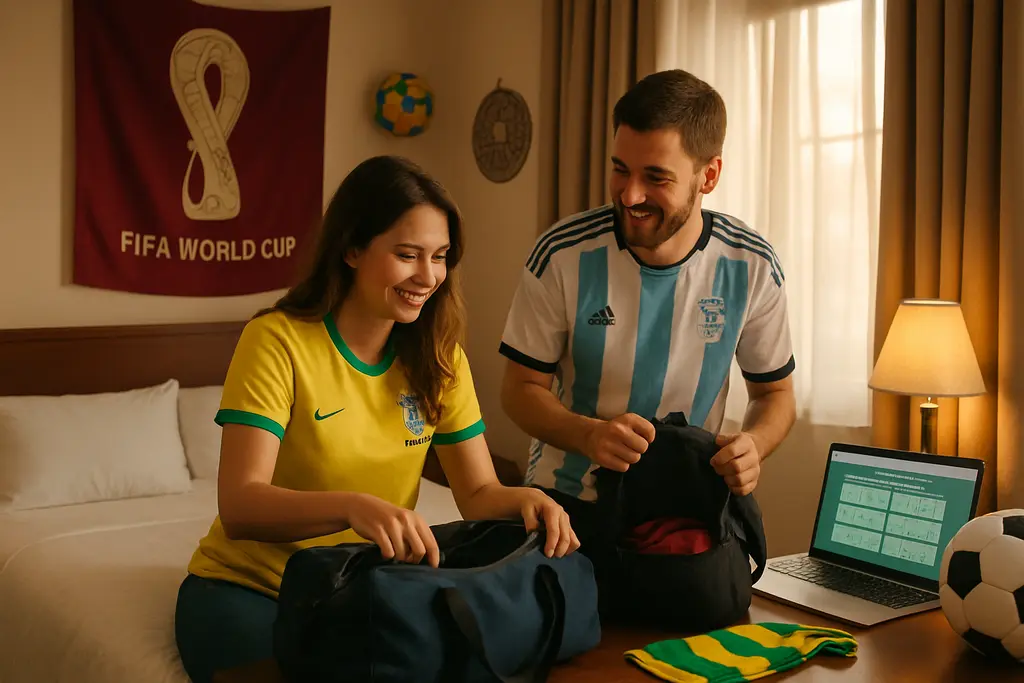
World Cup Hotels became a practical wellness issue during the 2026 FIFA World Cup, not just a travel-market story. By October 22, 2026, the tournament had already concluded, so the useful question is not whether host cities could attract fans. It is whether lodging expectations, price signals, international travel friction, and local planning gave fans a realistic path to sleep, recover, move around safely, and participate in host-city life without avoidable stress.
The strongest evidence provided here came from hotel-industry reporting published before and during the tournament period. That evidence should be read carefully: it was not a full official census of every room night, and it did not measure fan health outcomes directly. Still, it offered clear signals for community sports planners. Expectations of a simple hotel boom did not match the reported booking pace in several U.S. host markets, while rate pressure and uncertainty shaped how fans planned trips.
World Cup Hotels And The Expectation Gap
The Booking Data That Matters
The American Hotel & Lodging Association reported on May 4, 2026, that 80% of hotel operators across the 11 U.S. host cities said bookings were tracking below initial forecasts before the World Cup. The same survey reported that 65% to 70% of respondents cited visa barriers and broader geopolitical concerns as significant factors suppressing international visitor demand. Boston, Philadelphia, San Francisco, and Seattle were identified as markets where nearly 80% of respondents said booking pace was below expectations and even behind what a typical summer would bring, according to the AHLA report.
That matters for wellness because a fan’s match experience starts before kickoff. If hotels, community partners, and local authorities expect a surge that does not arrive evenly, the result can be mixed messaging: some fans delay booking because they expect better availability; others overpay early because they fear scarcity. Both behaviors can raise stress, especially for families, supporters with accessibility needs, and traveling groups that need predictable rest windows.
World Cup Hotels As A Wellness Issue
World Cup Hotels did not operate in one national pattern. Dallas and Houston showed a different reading: roughly 70% of hoteliers in those markets said booking pace was below World Cup-driven expectations, while demand was broadly similar to a typical June or July, based on the U.S. Hotel Outlook Report. Atlanta and Miami, by contrast, showed stronger reported performance in the AHLA material: about 50% of Atlanta hoteliers reported bookings in line with or ahead of expectations, and about 55% of Miami respondents said booking pace was ahead of expectations and typical summer benchmarks.
This unevenness is the planning lesson. A tournament spread across many cities does not create the same lodging pressure everywhere. Community sports groups, supporters’ associations, and municipal partners need city-by-city communication rather than one national message. A fan traveling to Miami may have faced a different planning environment from a fan traveling to Philadelphia or Seattle. Wellness planning should respect those local differences instead of treating “host city” as a single category.
| Market Signal | Reported Pattern | Fan-Wellness Risk |
|---|---|---|
| U.S. host cities as a group | 80% of operators said bookings were below initial forecasts | Confusing expectations around availability and price |
| Boston, Philadelphia, San Francisco, Seattle | Nearly 80% reported booking pace below expectations and behind typical summer levels | Late changes to staffing, transport messaging, and fan services |
| Dallas and Houston | About 70% reported booking pace below tournament expectations, near typical June or July demand | Fans may have received inflated scarcity signals |
| Atlanta and Miami | Reported stronger booking performance than several peer markets | Higher need for early guidance on recovery time, transit, and group lodging |
Why Fan Expectations Missed The Market
International Demand Was Not Automatic
Large football tournaments often create a public assumption that international demand will flood every host city. The AHLA survey data challenged that assumption. Visa barriers and geopolitical concerns were not side issues in the hotel response; they were reported by a majority of respondents as suppressors of international visitor demand. For local wellness teams, this matters because fan services may need to shift from a heavy focus on inbound foreign visitors to a blended model that also supports domestic travelers, regional day-trippers, and local residents.
That shift affects the basics: hydration stations, shaded waiting areas, late-night transport information, family meeting points, and volunteer language coverage. None of those services should be abandoned because bookings lag. Rather, they should be scaled with daily evidence. A hotel desk, a supporters’ hub, and a neighborhood sports club can all report different patterns, and those signals can help city teams adjust staffing without overreacting.
Price Signals Can Harm Planning Behavior
A weak booking pace does not automatically mean an easy trip for fans. Travelers can still face high posted rates, short cancellation windows, or limited rooms near transit corridors. The mismatch between softer-than-expected bookings and fan fears of scarcity can push people into longer commutes, split stays, or shared rooms that reduce sleep quality. Community sports organizations cannot control hotel prices, but they can reduce confusion by publishing plain-language lodging advisories that separate verified availability from rumor.
For community clubs working around World Cup Hotels, the practical task is to set a calm decision calendar. Instead of telling supporters only to “book early,” clubs can name checkpoints: compare refundable rooms, confirm transit from the hotel to the fan zone or stadium area, check the return trip after late matches, and avoid lodging that requires unsafe walking routes after midnight. Readers comparing lodging pressure across other sports can also use the same network’s golf travel coverage as an adjacent reference point for event-trip planning habits.
Practical Tools For Community Sports Planners

A Simple Fan Lodging Risk Score
Sports wellness planning works best when it gives volunteers a shared language. A simple lodging risk score can help. It should not pretend to predict the market perfectly. It should make choices visible before fans are tired, hurried, or priced out.
- Availability risk: Are group rooms still available within a realistic travel time of the match area?
- Cost risk: Are listed rates forcing fans toward longer commutes or split stays?
- Recovery risk: Can supporters get at least one stable sleep location before and after match day?
- Access risk: Does the lodging choice work for fans with mobility, family, or medical needs?
- Communication risk: Are fans receiving verified city-specific updates rather than general tournament claims?
This score can be reviewed weekly before travel and daily during match weeks. The point is not to rank cities for publicity. The point is to decide where to place volunteers, which supporters need direct outreach, and whether a club should organize shared transport from lower-cost lodging areas.
What Host Cities Could Have Shared Earlier
The 2026 hotel-demand gap showed that host-city communication needed more than tourism slogans. Fans needed decision-grade information: what areas had lodging near reliable transit, what neighborhoods were practical for families, where late-night returns were simplest, and how to avoid booking based on fear. A useful public dashboard would have separated hotel availability, average commute time, accessibility notes, and cancellation flexibility. If official lodging figures were not available, cities could still state that clearly and identify the best available verified data.
Community groups also had a role. Local clubs, youth programs, and supporters’ groups could translate market signals into human advice: where to rest, how to plan meals around travel, and when not to add extra activities to an already long match day. For a wider post-tournament planning frame, A Levante’s analysis of sports tourism after 2026 connects these lodging questions to host-city legacy planning.
World Cup Hotels For Healthier Fan Expectations
The main lesson from World Cup Hotels in 2026 is restraint. Host cities should not assume that a global tournament guarantees uniform hotel demand, and fans should not be left to interpret price spikes, booking lags, and travel barriers on their own. The evidence available here points to a split market: many operators reported bookings below early expectations, while some cities performed better and some fans still faced stressful lodging choices.
For the next major event cycle, community sports development should treat accommodation as part of fan wellness infrastructure. That means city-specific lodging briefings, verified updates for supporter groups, realistic transport maps, and volunteer training that treats sleep, cost pressure, and safe returns as part of the match experience. A healthier fan plan does not require perfect forecasts. It requires honest signals, shared local knowledge, and the humility to adjust when demand does not follow the script.