
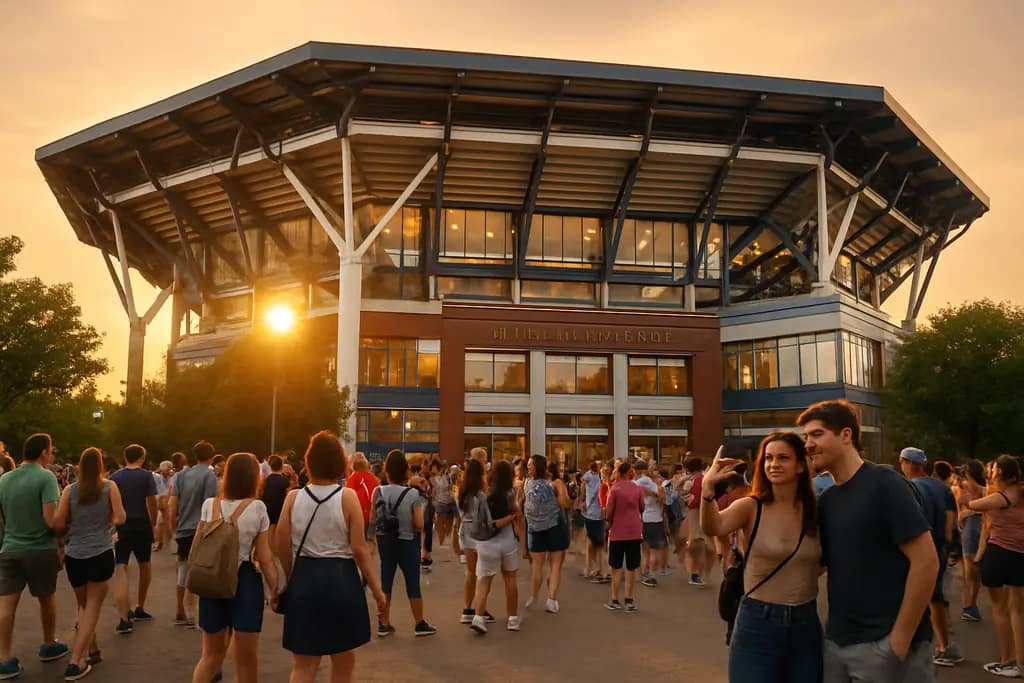
The Arthur Ashe Stadium Transformation is a useful leadership case because it ties a major venue rebuild to crowd management, player services, premium revenue, and New York City sports tourism. The United States Tennis Association announced the $800 million self-funded project on May 19, 2025, with completion scheduled for the 2027 US Open; the plan also includes a new Player Performance Center and a 40% increase in promenade-level concourse space, according to the ATP Tour report.
For community sports leaders, the useful lesson is not that every venue needs a nine-figure budget. It is that facility investment should be tested against clear public-facing outcomes: safer movement, better access to basic amenities, stronger event continuity, and a credible reason for the spending. Large professional projects can still offer planning tools for local parks, school gyms, and municipal fields if leaders separate the principles from the price tag.
Arthur Ashe Stadium Transformation And Civic Value
Arthur Ashe Stadium Transformation Leadership Tests
The Arthur Ashe Stadium Transformation is best read as a governance decision before it is read as an architectural project. A venue that anchors a global tennis event affects more than ticket holders. It shapes transport demand, tourism spending, staffing needs, food service pressure, and the public perception of whether sport infrastructure is being managed for broad value or narrow comfort.
On August 28, 2026, Forbes reported that the 2026 US Open listed full three-week attendance of 1,144,562, up 9% year over year, in its US Open numbers. That figure matters because attendance growth can expose weak points in concourses, restrooms, vertical transport, and arrival patterns. A stadium can have enough seats and still fail the user test if spectators spend too much time stalled in internal circulation.
For local sport agencies, this is a practical warning. Participation growth is positive only if facilities can absorb it. A youth soccer league adding teams may face the same type of pressure at a smaller scale: parking queues, shared restroom stress, tight walkways, overused warm-up areas, and poor separation between participants and spectators. The budget is different, but the leadership question is similar: has growth been matched with operational capacity?
Fan Circulation As A Public-Value Measure
The planned 40% promenade-level concourse expansion is one of the most transferable parts of the project. Fan circulation is often treated as a comfort issue, but it also affects safety, inclusion, and event timing. Wider movement areas can reduce crowd pinch points. More restrooms, elevators, and escalators can help older fans, families with children, and people with mobility needs use the building with fewer barriers.
The removal of food-cart vendors from congested areas, as described in the project details, points to another leadership lesson: revenue activity should not block basic movement. Community venues often face a smaller version of this problem when fundraising tables, food tents, merchandise sales, or equipment storage end up in the only clear pedestrian path. The immediate revenue may look helpful, but the layout can create friction that lowers participation satisfaction.
A related fan-flow analysis of the Arthur Ashe Stadium overhaul breaks this issue into arrival, seating, and concourse trade-offs. For municipal leaders, the same type of mapping can be done with a clipboard, a site plan, and timed observations during peak use.
Leadership Trade-Offs In The Seating Plan
Premium Growth And Access Pressure
The project’s premium-seat emphasis is the area that deserves the most cautious reading. Premium seating and hospitality can fund long-term facility work, improve event revenue, and help an organization stay self-funded. Those are real management benefits. The risk is that leadership attention shifts too far toward the highest-paying users while general-admission experience becomes a secondary concern.
The reported plan keeps total stadium capacity near its established scale while changing the internal mix of seating and hospitality areas. That type of redesign can be rational if the added revenue supports wider building upgrades. It becomes harder to defend if the main gains are private and the shared gains are weak. In this case, the public-facing elements—larger concourses, more vertical transport, better amenities, and continuity of tournament access during construction—are central to the argument.
Community sports leaders can apply a simple test before approving premium add-ons: does the project also improve the experience of the least powerful user? In a public recreation setting, that user may be a volunteer coach, a parent pushing a stroller, a junior athlete carrying gear, or a grandparent trying to reach a seat without stairs. If premium upgrades do not also help general access, the equity case is thin.
Player Services And Event Quality
The new Player Performance Center is scheduled to be fully operational by the 2027 US Open. Research notes describe indoor and outdoor warm-up areas, lounges, upgraded locker-room functions, dining, and a private café across four floors near practice courts. The direct beneficiaries are elite players, but the leadership principle extends beyond elite tennis: participant support spaces affect event quality.
At community level, the equivalent may be shaded bench areas, safe changing space, hydration access, medical response space, storage, and clear separation of players from heavy spectator traffic. These are not luxury items when they reduce stress on volunteers and make participation more reliable. A facility that treats athletes as an afterthought often pays for it through late starts, confusion, complaints, and preventable wear on shared spaces.
There is still uncertainty around how the full project will be judged after the 2027 US Open because completion had not arrived as of September 4, 2026. Attendance, circulation times, restroom wait times, premium revenue, player feedback, and maintenance costs should be assessed after the full build is in use. Leaders should resist declaring success before those measures are visible.
Operational Continuity Through The 2027 Build

Phasing As Risk Management
The renovation plan was organized in three phases: work before the 2025 US Open, work between the 2025 and 2026 Opens, and work between the 2026 and 2027 Opens. That sequencing was designed to avoid interruption to tournament play and fan access during the 2025 and 2026 events. Phasing is less glamorous than new clubs or lounges, but it is one of the clearest leadership signals in the project.
For any sports organization, the cost of construction includes the cost of disruption. A poorly timed field resurfacing can cancel training blocks. A gym floor project can displace school teams. A lighting upgrade can cut into evening access for adult leagues. The Arthur Ashe plan shows why boards and facility managers should treat calendar protection as part of the capital plan, not as a late scheduling detail.
Communication With Users
Phased work also requires user communication. Spectators and participants can tolerate construction better when they know what is changing, what remains open, and when benefits will arrive. This principle fits large venues and local recreation departments alike. A posted timeline, plain-language access map, and direct updates to coaches can prevent confusion and protect trust.
Community-sport publishers in the same network, including Banat Zayed, often emphasize judging sports facility projects by their civic impact. It is crucial to evaluate whether a major stadium overhaul improves accessibility, enhances safety, and offers financial stability while ensuring wide-ranging access remains available.
Arthur Ashe Stadium Transformation Scorecard
Practical Measures For Sports Leaders
For community sports leaders, the Arthur Ashe Stadium Transformation offers a scorecard rather than a script. The exact budget, tennis setting, and global event profile will not transfer to most local facilities. The evaluation habits can transfer. Before endorsing a facility project, leaders should ask for measures that connect spending to participation, operations, and public value.
- Access: Will the project reduce crowding, improve routes, or help users with mobility needs?
- Continuity: Can construction be phased without cutting core participation dates?
- Amenities: Are restrooms, shade, seating, storage, and athlete areas improved in measurable ways?
- Revenue Balance: Do premium or rental gains support shared facility benefits?
- Post-Project Review: Will leaders measure wait times, complaints, attendance, maintenance costs, and user satisfaction after opening?
The long-term benefit case is strongest where the project links revenue growth to better shared operations. If the expanded concourses work as planned, if player facilities improve event delivery, and if the premium program helps fund the building without reducing broader usability, the investment will have a defensible leadership logic. If those outcomes are not measured after the 2027 US Open, the project will be harder to evaluate beyond its headline cost.
The main lesson for smaller systems is disciplined planning. Growth should trigger facility questions before the user experience breaks down. Leaders do not need an $800 million project to act on that idea. They need evidence, phasing, user maps, and the willingness to judge a sports venue by how well it serves people during peak pressure.