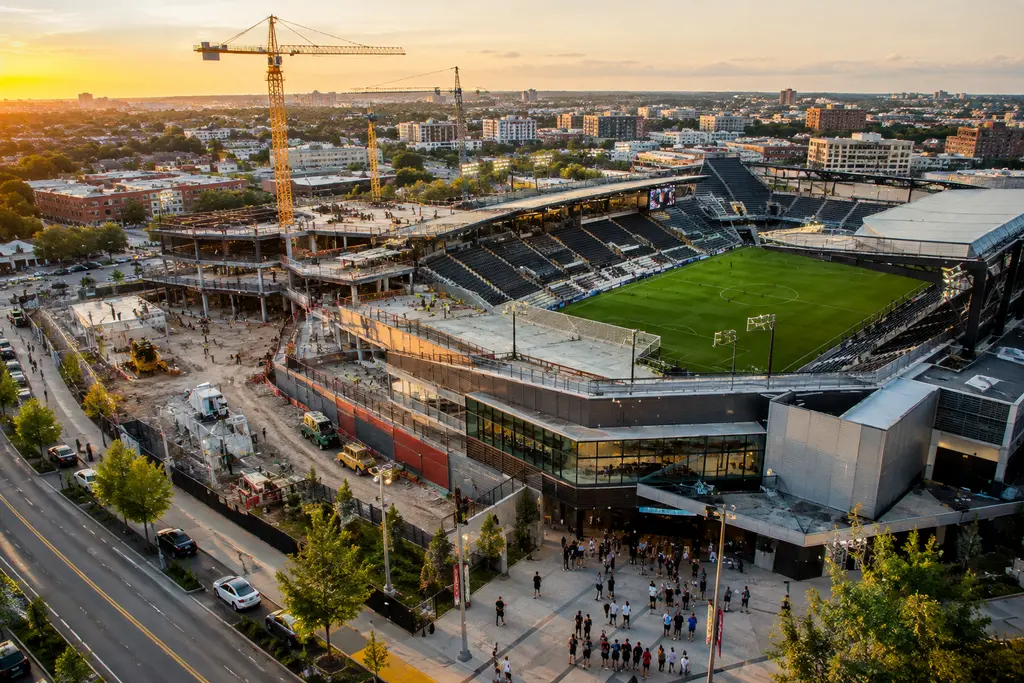
As of November 3, 2026, the Audi Field expansion proposal remained unresolved, with a public record still open and a final D.C. Council vote not expected before the council period that begins in 2027. On July 14, 2026, D.C. Council Chair Phil Mendelson introduced Bill 26-769, a proposal to add a climate-controlled roof and roughly 8,000 seats, taking capacity from about 20,000 to as many as 28,000, as Sports Business Journal reported. The debate is not only about soccer demand. It is about whether public dollars, private capital, event growth, housing commitments, and neighborhood capacity can be tested with enough discipline before the District accepts long-term risk.
The proposal has drawn support because Audi Field is already a proven sports venue, not a theoretical project. D.C. United and the Washington Spirit have given Buzzard Point a regular matchday rhythm, and the club has argued that a roof could help attract winter programming and international tours that do not fit the venue as currently built. Yet the proposal also landed during a period of public concern about large stadium subsidies. That context matters because a venue can be busy and still fail a public-value test if the financing terms are weak.
Audi Field expansion Funding Test
Public Share And Private Exposure
The reported cost structure is straightforward on paper: a $620 million project, with $300 million requested from the District over five years and about $320 million expected from D.C. United and associated private funding, including responsibility for cost overruns. That split is central to the policy question. A public contribution of that size needs more than a promise of more events. It needs enforceable limits, clear repayment or benefit mechanisms, and public access to assumptions behind projected revenue.
A practical test starts with three numbers: the public contribution, the private contribution, and the maximum District exposure if costs rise. Critics have warned that the bill lacks a firm cap on District spending. If that reading holds through amendments, the public risk is larger than the headline $300 million figure. For community sports advocates, the lesson is familiar: capital projects should be judged by downside scenarios, not only by best-case attendance and event projections.
Audi Field expansion Capacity Assumptions
The case for Audi Field expansion depends partly on existing demand. Research on the proposal cited a 2024 average of about 18,137 soccer fans per game, around 90.7% of the venue’s roughly 20,000-seat capacity. That supports the argument that seat demand exists for some events. It does not prove that every added seat will generate new District-wide spending, especially if some attendees shift from other entertainment choices within the city.
The roof argument is broader. D.C. United has said the project could support about 64 additional events per year, lifting annual activity to roughly 114 events. That is a meaningful operational change. A climate-controlled venue can extend use into colder months and reduce weather-related constraints. Still, the public analysis should separate three categories: events that would otherwise skip D.C., events that would move from another District venue, and events that would occur in the region but not necessarily inside city limits.
Economic Claims Behind Audi Field expansion
New Spending Or Shifted Spending
Expansion advocates point to tourism, event staffing, local spending, and a stronger stadium district. Those benefits are plausible only if the new calendar brings people who would not otherwise spend money in D.C. The strongest public case is not “more events” by itself. It is “more net new economic activity after displacement, city costs, and public financing are counted.”
The main concern is cannibalization. If a concert, tournament, or winter event moves from Capital One Arena or another city venue to a covered Audi Field, the District may see a venue shift rather than a citywide gain. That does not mean the project has no value. It means the economic model should identify which events are new to D.C., which are relocations, and which require public services such as transportation management, policing, sanitation, and traffic control.
| Claim To Test | Useful Public Metric | Why It Matters |
|---|---|---|
| 64 added annual events | Share of events new to D.C. | Separates growth from venue switching. |
| Higher attendance capacity | Paid attendance by event type | Shows whether added seats are used outside peak matches. |
| Local spending gains | Net tax revenue after public costs | Prevents gross spending from being treated as public return. |
| Private cost-overrun coverage | Binding contract language | Protects the District if construction costs rise. |
Community Benefit Accounting
A credible benefit model should be public enough for residents to understand and strict enough for lawmakers to amend. It should include sensitivity analysis for lower event counts, delayed construction, higher operating costs, and reduced tax receipts. If the project still delivers public value under moderate downside assumptions, the case becomes stronger. If it only works under optimistic attendance, tourism, and spending multipliers, the city should narrow the subsidy or demand stronger guarantees.
Community Safeguards And Infrastructure Capacity
Traffic, Transit, And Event-Day Load
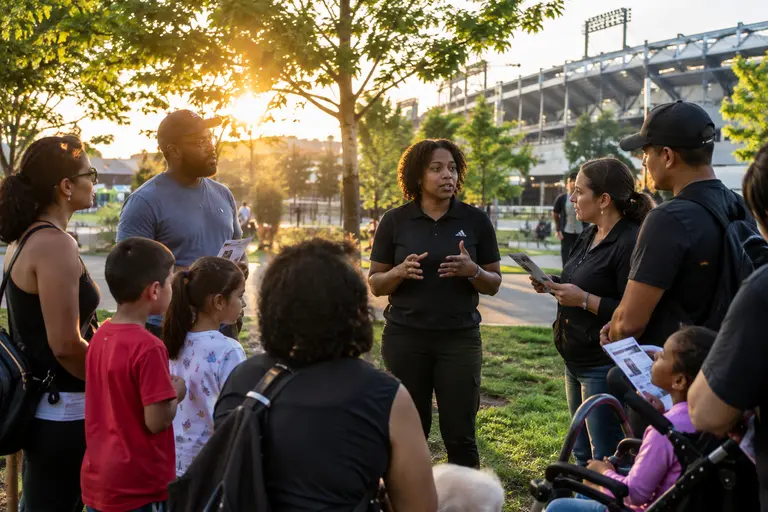
Buzzard Point is not an empty site waiting for activity. More events would mean more arrivals, ride-hailing demand, service vehicles, pedestrian flows, and post-event departures. Council discussion has included constituent concerns about traffic and infrastructure stress, while public testimony on October 23, 2026, reflected both support for possible economic gains and criticism of financial risk. A related local review of the infrastructure impact test frames these issues around capacity, housing, labor, and safeguards.
Venue planning should not stop at matchday operations. Community sports infrastructure works best when residents can see who pays for mitigation and how performance is measured. That means published transportation plans, event caps if service levels fail, and reporting on complaints, curb management, emergency access, and transit coordination. Even smaller facility operators, including Copeland Hills Golf Club, can apply the same principle: a venue’s public value depends on how well it fits the surrounding community, not only on how often it is used.
Housing, Labor, And Tenant Protections
The plan also includes adjacent housing, with more than 400 total units and a portion designated for affordable housing and senior housing. That could make the proposal more than a stadium project, but only if the housing terms are enforceable and not treated as a soft promise. The bill has also been described as including a preservation fund and tax exemptions, both of which should be evaluated alongside the public subsidy rather than apart from it.
The political record shows why stronger terms may be needed. Mayor Muriel Bowser has opposed committing public money to the proposal in its current form and has urged more economic analysis. Councilmembers and stakeholders have raised issues ranging from infrastructure pressure to tenant protections, including concerns tied to women’s sports users of the stadium, according to Washington Post coverage. For a shared venue, the public deal should specify access, scheduling protections, rent terms, and dispute processes for major tenants before approval.
- Set a hard District spending cap before any final vote.
- Publish the economic model and assumptions used to justify public funding.
- Separate net new events from events shifted from other D.C. venues.
- Make affordable and senior housing commitments enforceable by date, unit count, and affordability level.
- Require annual reporting on traffic, public costs, tenant access, and community complaints.
Audi Field expansion Decision Tests
The next near-term date was November 6, 2026, when the formal record for testimony and amendments was set to close. Because a final vote was not expected before the 2027 council period, lawmakers still had time to convert a broad proposal into a measurable public agreement. For the Audi Field expansion debate, that time should be used to answer a narrow set of questions: What is the maximum public cost? Which revenues are truly new? What infrastructure upgrades are required? How will housing promises be enforced? What protections will exist for all stadium tenants?
A cautious approval path would not treat the roof, seats, and housing as separate talking points. It would bind them together in one public-value framework. If the District contributes hundreds of millions of dollars, residents should receive defined returns, not general assurances. If D.C. United and private partners cover overruns, that obligation should survive construction pressure and market changes. If the venue gains more events, the city should track whether those events expand the local sports economy or mainly reshuffle it. That is the standard community sports projects should meet when public funds are on the line.