

The backlash over the 2026 World Cup semifinal kickoff times was not only a complaint about inconvenient soccer scheduling. It exposed a deeper sports infrastructure issue: in the modern World Cup, broadcast windows are fan infrastructure.
The controversy centered on the tournament’s biggest late-stage matches in the United States. France vs. Spain on July 14 kicked off at 3 p.m. ET. England vs. Argentina on July 15 also kicked off at 3 p.m. ET. The July 19 final between Spain and Argentina at New York New Jersey Stadium followed the same 3 p.m. ET window. For Europe, those times created a primetime television product. For many U.S. fans, they created a workday access problem.
That gap matters because World Cup 2026 was not staged in a neutral abstract market. It was staged across North America, with the United States carrying most of the venue load and much of the commercial expectation. If the host country is being asked to provide stadiums, security, fan festivals, airports, transit systems, public services, and local civic energy, then domestic fan access has to be part of the leadership calculation too.
For aplevante.org’s Fan Planning and Leadership categories, the semifinal scheduling backlash shows that fan infrastructure is no longer limited to stadium gates, concourses, water stations, and transit routes. It also includes kickoff windows, broadcast availability, workplace reality, public viewing options, streaming access, and the ability of a host country’s own fans to participate without rearranging normal life. That connects directly to the broader question of World Cup digital fan infrastructure, where connectivity, screens, devices, data, and access shape how fans experience global events beyond the stadium.
Why The 3 P.M. Kickoffs Became A Fan Access Flashpoint
The problem was easy to understand. A 3 p.m. Eastern kickoff is noon on the West Coast, 2 p.m. in the Central time zone, and still inside the standard workday for millions of Americans. That is a difficult window for casual fans, office workers, service employees, parents, students, and anyone without schedule flexibility.
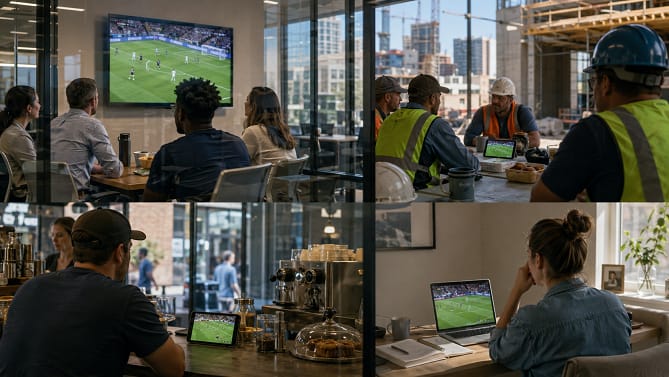
The timing felt especially jarring because the matches were being played in the United States. Fans were not complaining about waking up early for a tournament in Asia or adjusting to late-night kickoffs from Europe. They were watching a U.S.-hosted World Cup with its biggest matches placed in windows that felt built around overseas television.
The FIFA World Cup 2026 match schedule confirms how sharply the late-stage calendar landed. France and Spain played the first semifinal on Tuesday, July 14. England and Argentina played the second semifinal on Wednesday, July 15. Both matches kicked off at 3 p.m. ET. The final at New York New Jersey Stadium followed at 3 p.m. ET on Sunday, July 19.
Sunday afternoon is easier for U.S. fans than a weekday afternoon. But the semifinal issue had already made the point. The biggest matches of a U.S.-hosted World Cup were not necessarily built around U.S. daily life.
That is why the backlash should not be dismissed as online frustration. It identified a real access gap.
How FIFA’s Global Logic Collided With Local Reality
FIFA’s reasoning was not irrational. The World Cup is a global television event. A 3 p.m. ET kickoff places matches in evening windows across much of Europe. That matters when Spain, France, England, and Argentina were all late-tournament draws with massive global audiences.
FIFA also had to consider weather, team travel, stadium operations, recovery windows, security, broadcast crews, and the logistics of a 48-team tournament spread across three countries. Manolo Zubiria, FIFA’s tournament officer, defended the scheduling as part of a broader balancing act involving international audiences and tournament operations.
That defense is understandable. But it does not erase the leadership problem.
The modern host city is asked to do more than stage a match. It has to support public transportation, fan zones, hydration planning, police coordination, digital connectivity, hotel capacity, airport movement, local volunteers, multilingual communication, and community celebration. Those systems are built around people on the ground. When the match window makes it harder for local fans to participate, host-country leadership has to ask whether the broadcast product and the civic product are working against each other.
The issue is not that FIFA should ignore Europe. The issue is that domestic access has to be considered part of the infrastructure plan.
Why Broadcast Scheduling Is Now Infrastructure
Sports infrastructure used to be discussed mostly in physical terms: stadiums, roads, rail lines, parking, airports, hotels, fields, locker rooms, and training sites. That definition is now too narrow.
A global sports event is also carried by broadcast infrastructure. Kickoff times, TV windows, streaming platforms, mobile access, public screens, bandwidth, highlights, replay availability, and watch-party planning all determine whether fans can actually experience the event.
For a U.S.-hosted World Cup, this is especially important because American sports culture is deeply shaped by television windows. The NFL, NBA, college football, March Madness, the World Series, and the Super Bowl all understand that timing is part of the fan product. A game can be technically accessible and still practically inaccessible if it lands at the wrong time for the audience expected to carry the moment.
The World Cup semifinal backlash showed that soccer is now confronting the same issue at global scale. The match was available. But availability is not the same as accessibility.
If a fan has to choose between work and the biggest match of a host-country tournament, the broadcast infrastructure is serving some audiences better than others.
How U.S. Host Cities Became Part Of A Global TV Product
One reason the backlash matters is that U.S. host cities were not only local stages. They became pieces of a global broadcast product.
That means stadium lighting, camera positions, field appearance, crowd atmosphere, skyline shots, public celebrations, fan festivals, and even kickoff times were part of how the world consumed the tournament. The U.S. provided the physical setting. FIFA shaped the global television window.
This creates a leadership tension. Host cities need global exposure, but they also need local participation. A stadium can look spectacular on international television while many local fans are watching from office desks, phones, or delayed highlights. That is not a complete fan experience.
The lesson for future U.S. sports infrastructure planning is that broadcast strategy should be integrated earlier into host-city planning. Cities should understand not only when matches will be played, but how those windows affect transit demand, public viewing needs, employer flexibility, downtown activity, school schedules, heat exposure, and local business patterns.
If a semifinal is scheduled at 3 p.m. on a weekday, a city may need more official lunchtime viewing sites, public-screen partnerships, flexible transit service, after-work replay events, and coordinated communication with local businesses.
In other words, broadcast timing should trigger civic planning.
Why Public Viewing Becomes More Important When Kickoff Is Inconvenient
When kickoff times are inconvenient, public viewing infrastructure becomes even more important.
A weekday afternoon match does not allow every fan to go home, host a watch party, or spend hours at a bar. Public spaces near employment centers, campuses, transit hubs, parks, and civic buildings can make the event easier to experience. Office districts can support outdoor screens. Cities can coordinate with local businesses. Schools and youth programs can host controlled viewing events where appropriate. Downtown plazas can provide short-access fan zones.
This is where the Miami example becomes useful. Miami’s free World Cup watch parties showed how a host region can keep the tournament accessible beyond the stadium schedule. That same thinking applies to difficult kickoff windows. If the broadcast schedule favors global audiences, host cities need local access strategies that soften the burden.
The solution is not simply to complain about FIFA. It is to design around the reality. If global TV windows are going to dominate, U.S. fan leadership has to build local infrastructure that helps residents participate anyway.
That may include free public screens, flexible fan zones, lunch-hour activations, employer partnerships, transit coordination, mobile viewing support, and community watch hubs.
The more global the schedule becomes, the more local the access strategy has to be.
Why Heat And Broadcast Timing Are Connected
The 3 p.m. final at New York New Jersey Stadium also raised another issue: heat.
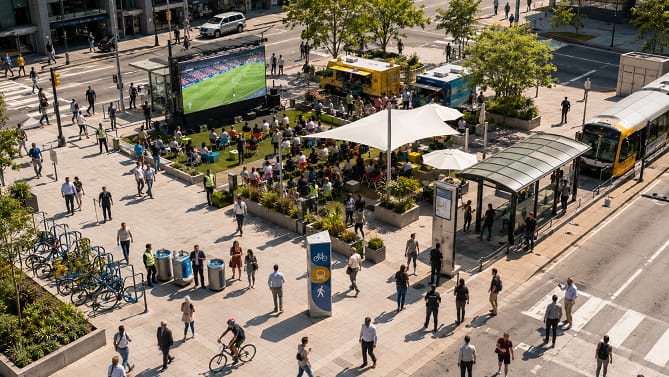
Afternoon kickoffs can create strong global TV windows, but they also intersect with July weather in the United States. In some host cities, mid-afternoon conditions are challenging for players, staff, fans, security workers, volunteers, and broadcasters working in or around open venues.
This does not mean every match should be played at night. Weather, travel, TV windows, venue availability, and security all matter. But the 2026 tournament made clear that heat planning and broadcast scheduling cannot be separated.
A kickoff time changes more than the TV rating potential. It changes hydration needs, shade demand, medical staffing, fan arrival patterns, concession pressure, transit timing, and the amount of time people spend outdoors in the hottest part of the day. That is why scheduling belongs inside the infrastructure conversation.
A city can invest in stadium upgrades and still face fan-experience problems if the kickoff window magnifies heat exposure. A broadcaster can get a strong global audience and still create local operational strain.
The leadership lesson is that player welfare, fan safety, and television value must be balanced together, not treated as separate departments.
Why The Backlash Revealed A Maturing U.S. Soccer Audience
The frustration from U.S. fans also showed something positive: the American soccer audience now cares enough to demand better access.
For years, U.S. soccer fans were expected to adjust to inconvenient global schedules because most major competitions happened elsewhere. Early morning Premier League viewing, weekday Champions League afternoons, late-night international matches, and streaming fragmentation became part of the culture. But a U.S.-hosted World Cup changed expectations.
Fans saw the tournament in their own country and asked why the biggest matches still felt built primarily for someone else’s evening. That reaction is part of soccer’s maturation in the United States. A larger audience brings larger expectations.
That should matter to FIFA, U.S. Soccer, MLS, broadcasters, cities, and sponsors. If the U.S. is being treated as one of global soccer’s most important growth markets, fan convenience cannot be an afterthought. The domestic audience is not just a bonus. It is part of the business case.
A serious soccer market expects serious fan planning.
How Future Host Cities Should Plan Around Broadcast Windows
Future U.S. host cities should treat kickoff windows as early operational data, not late announcements.
If a match is scheduled during a weekday afternoon, the city should model crowd movement differently than it would for a night match. Office districts may become viewing hubs. Transit peaks may overlap with match endings. Restaurants and bars may see unusual demand. Schools, youth programs, and community centers may need guidance. Outdoor fan zones may require more shade and water because of daytime heat.
If a match is scheduled for European primetime but U.S. midday, local leaders should ask specific questions: Where can fans watch near work? How will public agencies communicate road and transit impacts? Are official watch parties timed for realistic attendance? Can local employers support flexible viewing? Are digital networks ready for streaming surges during work hours? Are city-owned public spaces available for free access?
These questions make broadcast scheduling a civic planning issue. They also show why fan leadership has to include public agencies, broadcasters, local businesses, digital providers, employers, parks departments, transit agencies, and event organizers.
A kickoff time is not just a line on a schedule. It is a planning condition.
What FIFA And U.S. Soccer Should Learn From 2026
FIFA should learn that North American hosting does not automatically mean North American access. A match can be played in New Jersey, Dallas, Atlanta, Los Angeles, Seattle, Houston, Kansas City, Miami, or Philadelphia and still feel inconvenient for U.S. fans if the broadcast window ignores domestic daily patterns.

U.S. Soccer and local organizing committees should learn that they need stronger fan-access strategies around global scheduling. They may not control FIFA’s final kickoff decisions, but they can control how the host country supports fans once those decisions are made.
Broadcasters should also learn from the backlash. If a match lands during work hours, coverage strategy should include highlights, replays, mobile-friendly access, second-screen content, public-viewing partnerships, and local-market storytelling. The goal should be to make the match feel present even for fans who cannot sit in front of a television for two hours.
The 2026 backlash should become a planning document for future tournaments. The United States is likely to host more global soccer: club events, women’s tournaments, Olympic matches, international friendlies, and future bids. Each one will face the same tension between global windows and domestic access.
Why U.S. Fan Leadership Is Bigger Than The Stadium
The central lesson is simple: U.S. fan leadership has to move beyond the stadium.
A host country can build world-class venues, sell record ticket numbers, stage spectacular matches, and still frustrate fans if the schedule does not fit the audience being asked to support the event. Stadium infrastructure matters, but broadcast infrastructure decides whether millions of people can participate in real time.
The semifinal backlash exposed that gap. It showed that kickoff times, TV windows, public screens, digital access, workday realities, heat planning, and local viewing infrastructure are all part of the same fan-experience system.
That is why this issue belongs in the sports infrastructure conversation. It is not just a media complaint. It is a leadership test.
If the United States wants to be a long-term home for global soccer events, it needs to prove that it can support both the international broadcast product and the domestic fan experience. That means planning for the fans in the stadium, the fans in public spaces, the fans at work, the fans watching on phones, the fans in schools and youth programs, and the fans who can only participate if access is designed around real life.
World Cup 2026 gave the U.S. the world’s attention. The semifinal scheduling backlash showed what still needs to mature: fan leadership that treats broadcast timing as infrastructure.